**most of my plant culture information comes from Wikipedia entries, opinions are all my own though.
Lactuca sativa, or lettuce, is a member of the Asteraceae family and actually makes a pretty little white or yellow flower similar to a dandelion if you allow it to bolt and go to seed. When cut its stems ooze a milky white substance, hence the reason for the name Lactuca. Some members of the Lepidoptera butterfly family eat lettuce. In Ancient Egypt lettuce was considered an aphrodisiac.
Lettuce grows best in a humus rich, light soil, with constant moisture. Lettuce prefers temperatures between 75 degrees and 45 degrees F. A hot or dry environment may cause it to turn bitter and bolt, though this is less of a problem with certain bolt-resistant or heat-tolerant varieties. Seeds can be direct sown into the garden or transplanted. With a protective cover to keep lettuce from freezing it can be grown in mild climates nearly year round.
The primary types of lettuce are butterhead, romaine, crisphead or iceberg, and loose leaf. Butterhead leaves have a buttery texture, they are similar to romaine, with less crispness and a shorter growth habit. Romaine, or Cos, grows long leaves with a firm central rib, it is more heat tolerant than other varieties. Crisphead, or iceberg, grows in a tight head similar to cabbage. They have a crunchy texture and are generally the mildest flavored lettuces. Loose leaf lettuce has tender, delicate leaves and doesn't grow a "head" but rather as a bunch of loose leaves. Summer crisp or Batavian lettuce has a mix of traits of iceberg and loose leaf, being crunchy in texture and having only a moderately dense head.
The less bitterness a variety of lettuce has, the higher the water content, and consequently the lower the nutritional value. All lettuce varieties will cross-pollinate easily, so be certain to allow only the cultivars you wish to harvest seed from to go to flower.
Lettuce is a fast grower, taking as little as 3 weeks to reach a harvestable size. Remember to keep your lettuce plants moist, and protected from heat. Slugs are the primary pest to watch for on lettuce, though cutworms can also ruin a planting by cutting the stems when seedlings first sprout. Defeat slugs by baiting, hand picking, or laying down a copper barrier. Protect from cutworms with a paper collar, or start lettuce indoors and move outside once they have a few true leaves on and have grown beyond cutworm edibility. Lettuce can be grown indoors over the winter under a grow light or in a windowsill.
Mix varieties of red, green, and mixed color lettuce in a salad for a more interesting presentation. Since lettuce varieties will cross so easily, try leaving two or three favorite varieties to cross-pollinate and see what exciting new crosses you can come up with. For butterhead, romaine, or loose leaf lettuces harvest only the leaves you need and allow the plant to continue growth; crisphead is best harvested as a whole head.
For planting: try planting lettuces under a fruit tree, in early spring they will receive full sun, and once the tree flowers and begins to put on leaves it will shade the lettuces leaves from the heat of the sun. SFG suggests 4 lettuce plants per square, and they can also be interplanted between taller growing brassicas to protect and shade them. If your tomatoes are ripening and you wish to have lettuces to go with them, try planting lettuce under the shade of the tomato plants, or in a shadier corner of the garden. If all else fails, grow them inside during the hottest part of the year, in the cool of the AC.
You are unlikely to be able to preserve lettuce at all; it manages fine in the fridge for a few days though. Be sure to stagger plantings every few weeks to ensure a crop all year and don't plant too many at once or you'll be swimming in fresh lettuce that HAS to be eaten, and can't be saved by preserving.
Happy lettuce growing!
Showing posts with label cross-pollinate. Show all posts
Showing posts with label cross-pollinate. Show all posts
Tuesday, February 28, 2012
Sunday, February 5, 2012
Thinking on Trees
The few days of beautiful February weather got me kicked off to a good start on my yard work, which means I haven't had as much time to sit around the house and blog.
Yesterday I got the pleasure of raking the yard and laying down bark mulch, as it turns out 4 cubic feet of bark doesn't come anywhere near what I will actually need to finish the yard around our patio. I was surprised at just how little it did cover, today I will go back to the store and get another 6 bags (since that's likely all my car can carry at once) and see how much farther it gets me.
In the meantime I am on a mission to discover what would be the best plant to put in the front of my house, where it is bare and gets no shade at all in the summer from about 2 pm to sunset. If I can come up with something attractive with flowers or fruits that will shade the house it could make a big difference in our cooling bill during the summer heat, and provide food or bouquets or at the least a nice centerpiece to the house. I have considered a lilac, but am thinking that it may be too slim to make much difference in shade. I've also considered trellising grapes, wisteria, or clematis, but again I am not sure they would get large enough to provide much shade. An evergreen could make a statement, and won't make a big mess like deciduous or fruit trees, but it also won't make a floral show in spring or fruits later in the year. The other option that came to mind was a cherry tree, or other fruit tree that wouldn't require cross-pollination. I'd have flowers, fruits, a mess to clean up, and a shade tree large and branching enough to make a difference.
The annuals are not nearly so difficult to decide on since they change each year, but a tree is a big deal. It will be there for years, and probably won't produce much for several years after planting, I need to be absolutely certain before selecting a tree to put into the yard.
When you are considering a semi-permanent to permanent change to your landscape here are some things to keep in mind:
-How big will it get?
-How much maintenance will it require?
-Will it drop fruits or leaves that need cleanup each year and do you want to take on the extra work?
-Will the planting location make a difference in other things? Will it shade the house, or garden? Could the roots grow too large and damage sidewalks, driveways, or water pipes?
-What are you trying to gain from the planting? Shade, flowers, food, etc.
-If it is a fruit tree, will you need more than one for pollination?
-Will you move before you can reap the benefits of the plant? If you expect to move in 3-5 years it doesn't make much sense to plant a tree that won't offer much shade for 10 years.
-If you select for appearance, be sure to take the time to find out if your tree or shrub is native, and if it has many known pests or diseases. If you select something for its health to begin with, you will have fewer worries later on.
The Arbor Day Foundation can be a great resource for learning about trees, and even offers 10 free trees selected for your area as a membership incentive (they also offer member discounts for the purchase of trees). This can be a great way to get some trees started in a larger landscape, or you can ask friends or neighbors if they'd be interested in sharing your 10 trees. The small donation/membership cost is worth it if you are planning to add trees to your yard, but aren't necessarily seeking specific types. When I joined a few years ago it was primarily just to make a donation to what I felt was a worthy group, I ended up sending my free trees to my nephew who has several acres and raises fowl as well as a garden, he made good use of the trees which I didn't really have the space for at the time.
I am definitely leaning toward a cherry tree, however there is some debate over what type; my daughter likes sweet cherries, while I prefer to preserve pie cherries. There are combination trees available, but I have never seen one that did as well as separate sweet and sour trees. Next stop, check with the local nursery on good selections for our area, and do a little research on planting a new fruit tree.
Yesterday I got the pleasure of raking the yard and laying down bark mulch, as it turns out 4 cubic feet of bark doesn't come anywhere near what I will actually need to finish the yard around our patio. I was surprised at just how little it did cover, today I will go back to the store and get another 6 bags (since that's likely all my car can carry at once) and see how much farther it gets me.
In the meantime I am on a mission to discover what would be the best plant to put in the front of my house, where it is bare and gets no shade at all in the summer from about 2 pm to sunset. If I can come up with something attractive with flowers or fruits that will shade the house it could make a big difference in our cooling bill during the summer heat, and provide food or bouquets or at the least a nice centerpiece to the house. I have considered a lilac, but am thinking that it may be too slim to make much difference in shade. I've also considered trellising grapes, wisteria, or clematis, but again I am not sure they would get large enough to provide much shade. An evergreen could make a statement, and won't make a big mess like deciduous or fruit trees, but it also won't make a floral show in spring or fruits later in the year. The other option that came to mind was a cherry tree, or other fruit tree that wouldn't require cross-pollination. I'd have flowers, fruits, a mess to clean up, and a shade tree large and branching enough to make a difference.
 |
| This time of year the house is shaded, but by summer there will be nothing to keep it cool. |
The annuals are not nearly so difficult to decide on since they change each year, but a tree is a big deal. It will be there for years, and probably won't produce much for several years after planting, I need to be absolutely certain before selecting a tree to put into the yard.
When you are considering a semi-permanent to permanent change to your landscape here are some things to keep in mind:
-How big will it get?
-How much maintenance will it require?
-Will it drop fruits or leaves that need cleanup each year and do you want to take on the extra work?
-Will the planting location make a difference in other things? Will it shade the house, or garden? Could the roots grow too large and damage sidewalks, driveways, or water pipes?
-What are you trying to gain from the planting? Shade, flowers, food, etc.
-If it is a fruit tree, will you need more than one for pollination?
-Will you move before you can reap the benefits of the plant? If you expect to move in 3-5 years it doesn't make much sense to plant a tree that won't offer much shade for 10 years.
-If you select for appearance, be sure to take the time to find out if your tree or shrub is native, and if it has many known pests or diseases. If you select something for its health to begin with, you will have fewer worries later on.
The Arbor Day Foundation can be a great resource for learning about trees, and even offers 10 free trees selected for your area as a membership incentive (they also offer member discounts for the purchase of trees). This can be a great way to get some trees started in a larger landscape, or you can ask friends or neighbors if they'd be interested in sharing your 10 trees. The small donation/membership cost is worth it if you are planning to add trees to your yard, but aren't necessarily seeking specific types. When I joined a few years ago it was primarily just to make a donation to what I felt was a worthy group, I ended up sending my free trees to my nephew who has several acres and raises fowl as well as a garden, he made good use of the trees which I didn't really have the space for at the time.
I am definitely leaning toward a cherry tree, however there is some debate over what type; my daughter likes sweet cherries, while I prefer to preserve pie cherries. There are combination trees available, but I have never seen one that did as well as separate sweet and sour trees. Next stop, check with the local nursery on good selections for our area, and do a little research on planting a new fruit tree.

 Labels:
apple tree,
arbor day foundation,
cherry tree,
cross-pollinate,
flower,
fruit,
garden,
harvest,
landscape,
pests,
pruning,
shade,
tree
Labels:
apple tree,
arbor day foundation,
cherry tree,
cross-pollinate,
flower,
fruit,
garden,
harvest,
landscape,
pests,
pruning,
shade,
tree
Tuesday, January 24, 2012
Pea Culture
Hopefully I can get a few posts about the culture of different veggies up before spring comes along, to help out gardeners trying new things; on that note, this post is all about peas.
Peas originated in the Mediterranean and Middle East regions, they are eaten fresh or cooked. They can be frozen, canned (pressure can method), or dried. Peas are harvestable between 50 and 75 days depending on variety. There are three primary types of pea; the snow pea, snap pea, and shelling pea. Shelling peas are removed from the pod and only the pea seeds are eaten as the pods are tough and tasteless. Snow peas are the variety most often seen in stir fries, whole pods with smaller undeveloped seeds inside. Snap peas are eaten in the pod as well, but are even sweeter than snow peas and have a crisp, thick pod that is nearly stringless. Depending on which way you prefer to eat your peas you could plant one, two or all three types of pea in your garden.
Peas are one of the first things planted in the spring, they can germinate in soils that are only 40 degrees F. So long as the risk of hard frost has passed they can go directly into the garden. Peas should be sown in the ground, rather than started indoors. They are long and slim vining plants and don't always cope well with transplanting, they are also such fast growers, and have such large seeds that it's just much simpler to put them in the garden. If they fail to germinate in a week or so, plant another round and keep waiting. Pea seeds should be planted fairly deep, about an inch underground. They take up little room and require little nutrition, they can be planted as close as 1-2 inches apart. Or in SFG style, 8 plants to a square. Pea seeds will only be viable for about 2 years, so despite their inexpensive price don't be tempted to stock up too much. Peas are very easy to save seed from, simply leave the end-of-season crop on the vine until they brown and become dry, then harvest, dry further inside, then shell and store seeds in paper bags. (Avoid plastic bags as they can trap any remaining moisture and rot your seeds). Peas also self-pollinate, they don't require pollinators, and generally each flower will pollinate itself. This means that to accidentally cross two pea plants you pretty much have to rub them together. Pea seed will fairly reliably produce seed that grows the same plants as the previous generation.
A cool season crop, peas prefer temperatures below 70 degrees. Peas that mature in temperatures over 85 degrees can develop tough pods. Also, peas stop putting on flowers once temperatures get over about 85 degrees. Harvest continually to ensure continued production of fruits. You can increase your harvest by using a pea innoculant, but innoculant in no way guarantees a great harvest.
The greatest risk to peas is the enation virus, and you should watch for enation resistant varieties when selecting peas for your garden. Peas actually build nitrogen stores in the soil they are planted in, so are a great winter crop or rotation crop to keep in the organic garden. Move them around each year, or start an early spring crop in the space of later heavy feeders. By the time the peas are finishing their growth the heavy feeding summer plants should be ready to put outside.
As vining crops peas will need a trellis of some type, which also helps to keep the fruits up off the ground and in easy picking reach. Peas are an inexpensive, simple to germinate, delicious crop to grow and are perfect for gardens that have small children around. Kids can pick them easily, eat them straight from the vine, watch how they grow and twine around each other and the trellis. In general peas are a great crop for anyone.
I prefer to grow the snow or snap peas, shelling peas are so easy and inexpensive at the store it just doesn't make sense to use up garden space on them, snow and snap peas are expensive though. Plus, I don't look forward to all that shelling. Snow peas are delicious eaten fresh, they can also be blanched and frozen for eating throughout the year. Snap peas are also delicious fresh; sweet, crunchy, and very low in calories; snap peas do not store nearly as well though and can become mushy if frozen or canned. I suggest growing primarily shelling or snow peas, with a small bunch of snap peas just to eat fresh. Last year I planted 6 squares of peas, each square holding 8 plants and I was overwhelmed with the quantity of produce I harvested from them. It may not seem like it at first, but over time, as round after round of peas is ready to pick you will find that each plant is actually very productive. How many peas (in the pod) will you eat each day? However many you think that is, that's probably about how many plants you need. I will happily eat my way through 20-40 pea pods in a day, and my husband and kids rarely eat them. So I need 20-40 plants to produce that amount, if I plan to freeze them I will have to plant more. This year I am putting in more than last year because I only ended up with 2 quarts of frozen peas and would like to have more than that for next winter.

Next time: Pea Recipes, My Own and links to others.
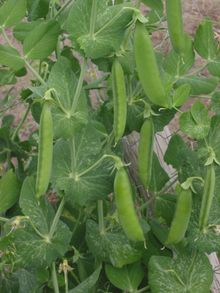 | |
| Pea plant in full fruit. |
Peas originated in the Mediterranean and Middle East regions, they are eaten fresh or cooked. They can be frozen, canned (pressure can method), or dried. Peas are harvestable between 50 and 75 days depending on variety. There are three primary types of pea; the snow pea, snap pea, and shelling pea. Shelling peas are removed from the pod and only the pea seeds are eaten as the pods are tough and tasteless. Snow peas are the variety most often seen in stir fries, whole pods with smaller undeveloped seeds inside. Snap peas are eaten in the pod as well, but are even sweeter than snow peas and have a crisp, thick pod that is nearly stringless. Depending on which way you prefer to eat your peas you could plant one, two or all three types of pea in your garden.
Peas are one of the first things planted in the spring, they can germinate in soils that are only 40 degrees F. So long as the risk of hard frost has passed they can go directly into the garden. Peas should be sown in the ground, rather than started indoors. They are long and slim vining plants and don't always cope well with transplanting, they are also such fast growers, and have such large seeds that it's just much simpler to put them in the garden. If they fail to germinate in a week or so, plant another round and keep waiting. Pea seeds should be planted fairly deep, about an inch underground. They take up little room and require little nutrition, they can be planted as close as 1-2 inches apart. Or in SFG style, 8 plants to a square. Pea seeds will only be viable for about 2 years, so despite their inexpensive price don't be tempted to stock up too much. Peas are very easy to save seed from, simply leave the end-of-season crop on the vine until they brown and become dry, then harvest, dry further inside, then shell and store seeds in paper bags. (Avoid plastic bags as they can trap any remaining moisture and rot your seeds). Peas also self-pollinate, they don't require pollinators, and generally each flower will pollinate itself. This means that to accidentally cross two pea plants you pretty much have to rub them together. Pea seed will fairly reliably produce seed that grows the same plants as the previous generation.
A cool season crop, peas prefer temperatures below 70 degrees. Peas that mature in temperatures over 85 degrees can develop tough pods. Also, peas stop putting on flowers once temperatures get over about 85 degrees. Harvest continually to ensure continued production of fruits. You can increase your harvest by using a pea innoculant, but innoculant in no way guarantees a great harvest.
The greatest risk to peas is the enation virus, and you should watch for enation resistant varieties when selecting peas for your garden. Peas actually build nitrogen stores in the soil they are planted in, so are a great winter crop or rotation crop to keep in the organic garden. Move them around each year, or start an early spring crop in the space of later heavy feeders. By the time the peas are finishing their growth the heavy feeding summer plants should be ready to put outside.
As vining crops peas will need a trellis of some type, which also helps to keep the fruits up off the ground and in easy picking reach. Peas are an inexpensive, simple to germinate, delicious crop to grow and are perfect for gardens that have small children around. Kids can pick them easily, eat them straight from the vine, watch how they grow and twine around each other and the trellis. In general peas are a great crop for anyone.
 |
| Snow peas, purple beans, and zucchini: one day's harvest. |

Next time: Pea Recipes, My Own and links to others.
Labels:
cross-pollinate,
drying,
easy plants,
flower,
freezing,
fruit,
garden,
harvest,
money-saving,
open pollinated,
organic,
peas,
plants,
recipe,
seed,
small space,
trellis,
vegetable
Monday, January 23, 2012
Easy Plants Are a Myth
People often say that a certain plant is easy to grow, or difficult to grow. I say it's BS. Supposedly a great easy to grow plant that even a kid can plant is sunflowers. Well, I have planted mammoth sunflowers many many years and they've always either failed to sprout at all, or grown the saddest spindliest flowers I've ever seen. Last summer however my 3 year old son was helping in the garden and I gave him a couple sunflower seeds to bury just so he could plant some seeds that were large and easy to manage. His two sunflowers topped 12 feet in height, they also put out flower heads that were a good 12 inches in diameter. Maybe it was just better soil? Nope, I put in a few sunflowers too. Planted them at the same time and they only grew to about 6 feet and had 6-8 inch flowers. I have no idea why, but the sunflowers loved being planted by the small boy.
Among the so-called "easy to grow" plants most people list perennial herbs, tomatoes, pumpkins, summer squash, annual flowers, and hardy greens like kale and chard. If you are just starting out with gardening give these plants a shot, but don't give up hope if they don't do well. Sometimes it will just turn out that you have a knack for celery (known to be a very finicky plant), while tomatoes fiercely dislike you.
My brother built a massive greenhouse and garden last summer, on my parents' property. The garden there has been producing piles of tomatoes and summer squash for nearly 20 years. He saved the hot crops for the greenhouse, but continued the tradition of putting summer squash in the garden, he also planted peas, turnips, carrots, kale, broccoli, and chard. While this was the first year he managed such a large garden he is an experienced gardener. Guess what? Everything in the garden did great... except the squash, and the peas. For some crazy reason last year the only things that would grow well in that garden were root veggies and brassicas.
Some crops are considered easy because they have few known diseases or predators, or because they can withstand some drought or flooding. Very few veggies should be considered easy to grow, nearly all of the vegetables people plant are so carefully bred that they are entirely dependent on human kindness for survival. Kale is one of the few that could probably manage on it's own, and in hot climates it is challenging to grow outside of the winter months.
Often when you have difficulty with a certain plant it is not because the plant is difficult but because you don't yet have an understanding of what it takes to make that plant happy. Since a pumpkin makes a very small root compared to the massive amount of aboveground space it takes up, it doesn't generally need a lot of well worked soil. The pumpkins roots won't spread much, they can be put in a 6" pot in a hole full of rocks and be content so long as their 6" of dirt is highly nutritious. Meanwhile, carrots sprout from very tiny seed that then sends down a tap root, while carrots don't actually bulb like an onion (so they can be spaced fairly close) they are rather delicate and need their soil loosened and fluffed to make growth straight down easier. If you've got heavy soil and only loosen the top inch or so, your carrots will never do well. I have never yet been able to grow carrots well. This year I plan to try again in the "Mel's Mix" soil, in hopes that it is light and fluffy enough to keep carrots happy.
Once you get a handle on what the plant needs to be happy you will find it easier to provide those things and have a very "easy" plant to grow. For me, one of the "easy" plants I struggled with was pumpkins. I put them in the ground and they got powdery mildew, or didn't sprout, or didn't grow beyond a sprout, or grew long and happy and healthy but didn't produce any pumpkins. Each year I learned a few things so that I got a little closer to pumpkin perfection. Initially I had it in my head that pumpkins were colder weather plants, it seemed reasonable since they aren't harvested until fall, I planted them in March and my seeds didn't sprout. The variety I was growing needed about 100 days to reach harvest, so I figured out that I needed to start them indoors to keep them warm until the weather improved, this also helped prevent the mildew that sets in during the wet months in spring. Once I had a good start going and the weather improved I moved it into the garden bed, but that year I let them sprawl and only had room for one plant: it grew well but no pumpkins developed. Finally I began trellising, it gave me enough room to grow three pumpkins in my small space and finally had the cross-pollination needed to produce some very healthy fruits.
Gardening is a learning experience, each year you find that you get a little better at managing the plants you grow and get a little better fruit or flower in return. It's a struggle at first for most people, but it does get better. You may never be able to get the hang of sunflowers, but you may grow the best turnips in the county instead. There is no such thing as an "easy" or "difficult" plant, it all depends on the gardener, the garden, the weather, and how many butterflies flap their wings in Taiwan. Gardening is truly an experiment in chaos theory unlike any other.
Among the so-called "easy to grow" plants most people list perennial herbs, tomatoes, pumpkins, summer squash, annual flowers, and hardy greens like kale and chard. If you are just starting out with gardening give these plants a shot, but don't give up hope if they don't do well. Sometimes it will just turn out that you have a knack for celery (known to be a very finicky plant), while tomatoes fiercely dislike you.
My brother built a massive greenhouse and garden last summer, on my parents' property. The garden there has been producing piles of tomatoes and summer squash for nearly 20 years. He saved the hot crops for the greenhouse, but continued the tradition of putting summer squash in the garden, he also planted peas, turnips, carrots, kale, broccoli, and chard. While this was the first year he managed such a large garden he is an experienced gardener. Guess what? Everything in the garden did great... except the squash, and the peas. For some crazy reason last year the only things that would grow well in that garden were root veggies and brassicas.
Some crops are considered easy because they have few known diseases or predators, or because they can withstand some drought or flooding. Very few veggies should be considered easy to grow, nearly all of the vegetables people plant are so carefully bred that they are entirely dependent on human kindness for survival. Kale is one of the few that could probably manage on it's own, and in hot climates it is challenging to grow outside of the winter months.
Often when you have difficulty with a certain plant it is not because the plant is difficult but because you don't yet have an understanding of what it takes to make that plant happy. Since a pumpkin makes a very small root compared to the massive amount of aboveground space it takes up, it doesn't generally need a lot of well worked soil. The pumpkins roots won't spread much, they can be put in a 6" pot in a hole full of rocks and be content so long as their 6" of dirt is highly nutritious. Meanwhile, carrots sprout from very tiny seed that then sends down a tap root, while carrots don't actually bulb like an onion (so they can be spaced fairly close) they are rather delicate and need their soil loosened and fluffed to make growth straight down easier. If you've got heavy soil and only loosen the top inch or so, your carrots will never do well. I have never yet been able to grow carrots well. This year I plan to try again in the "Mel's Mix" soil, in hopes that it is light and fluffy enough to keep carrots happy.
Once you get a handle on what the plant needs to be happy you will find it easier to provide those things and have a very "easy" plant to grow. For me, one of the "easy" plants I struggled with was pumpkins. I put them in the ground and they got powdery mildew, or didn't sprout, or didn't grow beyond a sprout, or grew long and happy and healthy but didn't produce any pumpkins. Each year I learned a few things so that I got a little closer to pumpkin perfection. Initially I had it in my head that pumpkins were colder weather plants, it seemed reasonable since they aren't harvested until fall, I planted them in March and my seeds didn't sprout. The variety I was growing needed about 100 days to reach harvest, so I figured out that I needed to start them indoors to keep them warm until the weather improved, this also helped prevent the mildew that sets in during the wet months in spring. Once I had a good start going and the weather improved I moved it into the garden bed, but that year I let them sprawl and only had room for one plant: it grew well but no pumpkins developed. Finally I began trellising, it gave me enough room to grow three pumpkins in my small space and finally had the cross-pollination needed to produce some very healthy fruits.
Gardening is a learning experience, each year you find that you get a little better at managing the plants you grow and get a little better fruit or flower in return. It's a struggle at first for most people, but it does get better. You may never be able to get the hang of sunflowers, but you may grow the best turnips in the county instead. There is no such thing as an "easy" or "difficult" plant, it all depends on the gardener, the garden, the weather, and how many butterflies flap their wings in Taiwan. Gardening is truly an experiment in chaos theory unlike any other.
Labels:
cross-pollinate,
easy plants,
flower,
fruit,
garden,
harvest,
organic,
plants,
pumpkin,
seed,
small space,
starts,
vegetable
Friday, January 20, 2012
Plant Genetics and Hybrids
 |
| Punnett square showing pea cross |
in the Punnett square above you can see two pea parent plants. One is yellow and has a dominant Y (yellow) gene and a recessive y (green) gene, the other is green and has 2 recessive y (green) genes. When these two plants cross-pollinate the seed they produce will grow into 50% yellow peas and 50% green peas. But what if you only like yellow peas? Well then, you'd better not grow any green ones nearby or cross-pollination could happen and you'd end up with some green in the mix.
So why talk about genetics on a garden blog? Because of hybrids (and I don't mean cars). Hybrid seed is often listed as F1 or F1 hybrid. Basically this is a first generation cross of two plants that show good qualities. While hybrid seed has it's advantages; being consistent in phenotype, having the best qualities of both parents, and being widely available. It also has disadvantages for the home gardener. Primarily, the seed from two hybrid parents will likely produce a large amount of recessive seeds. This means that two parents with great qualities will likely produce 75% recessive gene (bad quality) seeds. Those seeds will then grow into plants that don't have the same color, flavor, heat tolerance, or disease resistance that the original hybrids did. Or they will simply be sterile and not produce usable seed at all.
The alternative to hybrid seed is open pollinated seed. This means that the plants that will grow are from a stable genetic background that has been bred over many generations to eliminate most recessive throwbacks. Open pollinated plants will also cross together to create new strains with very similar qualities of the original plants. The major advantages to OP seed is being able to save your own seed (saving you money), creating new strains, and each successive generation grown in the same area will show improved adaptation to that area. If your garden seems to suffer from something unknown fairly regularly, after several generations an open pollinated plant will begin to build a resistance and you will see each new generation producing healthier and better producing plants.
There are some exceptions when buying OP seeds that need to be understood. OP plants will cross-pollinate with ANY nearby plants that are genetically close enough to them. For example, carrots are only sold as F1 hybrids in my area because a common weed here is too close a relative to them to make the resulting OP seed safe for eating. Queen Anne's Lace is everywhere in this area, and is a close cousin to the carrot, but not edible. If I were to collect any seed from carrots I grew, it would most likely produce Queen Anne's Lace, and some half-QAL half-carrot hybrids. So in this instance I am forced to buy hybrid seed.
Seed catalogs often list plants as hybrid or OP and a little research can help you to decide which is best for you. There are many books on plant biology and genetics as well to help gardener's learn how best to breed plants. One thing to be careful of when collecting seed from plants is the crossing of different species within the garden. Pumpkins, butternut squashes, acorn squash... all of these are from the same plant family and it is possible to have them cross pollinate unintentionally. If you are serious about your seed production you can limit this by either only planting one type of each family in your garden, planting the different species far from each other, or by selecting a newly opened flower, hand pollinating it with the correct pollen and then gently bagging it to keep other pollens out until it begins to fruit.
Labels:
cross-pollinate,
flower,
fruit,
garden,
harvest,
hybrid,
lettuce,
money-saving,
open pollinated,
organic,
plants,
seed,
vegetable
Subscribe to:
Posts (Atom)