Sorry to be a slacker about blogging, but this week has been full of recovery from the kitchen remodel and catching up on all the things I didn't do because I was remodeling. Like laundry and dishes and cleaning house.
The garden has been rather unproductive too. The peas are done, but the eggplants and peppers and winter squashes have nothing to harvest yet. Right now the only things coming out of the garden are a few beans (the Royal Burgundy are still producing like crazy, Fortex is a smaller harvest but still going), cucumbers that have slowed down since their initial burst of fruits, a zucchini here and there, and a handful of tomatoes each week. I am so sad that after all of the work I put into the garden this year the weather has nearly shut down tomato, eggplant, squash and pepper production completely.
Surprisingly the jalapenos have quite a few fruits ready... but with no tomatoes for salsa making I'm just not sure what to do with them. My family just isn't into spicy stuff.
I did can some pickle relish earlier this week, and one quart of dill pickles. It's my first attempt at pickles, so I'm letting them rest before trying them and hoping that the recipe worked out well. If anyone has an awesome dill pickle recipe for whole pickles I'd love it if you'd share, I'm always on the hunt for great, tested, and approved recipes.
That's about all I have to report today, hope everyone has a lovely day.
Showing posts with label eggplant. Show all posts
Showing posts with label eggplant. Show all posts
Thursday, August 23, 2012
Tuesday, July 3, 2012
Slacker Blogger = Harvest Tuesday
This post was meant to be for Harvest Monday... but I got distracted by Legos and never wrote it.
I started out my week's harvest by heading back to the farm to pick raspberries. Then I made up 14 jars of raspberry jam and 2 jars of raspberry sauce (for mixing into yogurt and stuff). I'm hoping that the raspberry and strawberry jams together will keep us in jam until next year; I am really tired of picking berries now.
The sugar snap peas are finally piled with fat pods, and the snow peas are just starting to have harvestable pods ready too. Yesterday I picked 1 1/2 quarts of them for my mom. Friday I picked another quart of sugar snaps for my trip south to visit friends, and Wednesday I picked half a quart. Peas are one of my favorite things to grow in the garden, especially since the snow and sugar snaps are so expensive to buy at the store. Shelling peas just don't seem worth it though, they are cheap and it would take up a lot of space to grow enough of them. Somehow I ended up with one shelling pea plant in my sugar snaps though, so now amid my 63 sugar snap plants there is one shelling pea plant hiding. I'd just pull it out but they are a tangled mass now, so instead I have to watch out for the pods and separate them from the others. It's no fun eating sugar snaps and then accidentally biting into the tough, tasteless pod of a shelling pea.
The strawberries above are from the yard, picked yesterday. They went into a gallon bag and into the freezer, I'll continue to add to this bag until it's full then start a new one if they are still producing. Not sure I'll get two bags though, the strawberries are definitely starting to wind down.
The Parel cabbages are just finishing up, I've picked 3 already. They are about a pound each and very space-saving. I find them to be excellent since we rarely manage to use up a whole large cabbage before it goes bad. These are a one dish cabbage. The combination of slugs, earwigs, and cabbage loopers meant i lost more than a few leaves to insect damage, but the centers of the heads were untouched and perfectly lovely. I'm not sure how much longer the Derby Day cabbages will go, the heads are about the size of baseballs and very firm but they are supposed to get much larger than the Parel.
The bonus to Oregon being among the three states in the Union that are not swelteringly hot right now, is that I still have lettuce! In fact, I haven't lost a single lettuce plant to bolting this year. The only thing that has bolted in my garden is the cilantro, but that's to be expected. Of course, the downside to that is that the eggplants and peppers (my biggest heat-loving plants) are incredibly sad, and I'm beginning to lose hope that they will recover from this. If I had known what the weather was going to be like this summer I would've grown spinach, and much more leaf and stem crops and less heading and fruiting crops. Oh well, you know what they say about hindsight.
 |
| Raspberry Jam! |
 |
| Peas and strawberries. |
The strawberries above are from the yard, picked yesterday. They went into a gallon bag and into the freezer, I'll continue to add to this bag until it's full then start a new one if they are still producing. Not sure I'll get two bags though, the strawberries are definitely starting to wind down.
 |
| More peas, and a cabbage |
 |
| Pearl onions, Alex's carrots, cabbage, and lettuces. |
Tuesday, June 19, 2012
Garden Update: June 19th
Let's take a walk around the garden.
Coming in through the front gate we pass the strawberries, currently they are cranking out about a pound of berries daily.
As we enter the gate to the left we see the remaining un-planted starts in their pots. A scoop of compost in each pot, followed by a dose of fish fertilizer, and a dose of compost tea the next day has really improved the health of the tomatoes. They have perked up, greened up, and kicked out a few healthy new leaves. There is still some purpling but they are definitely improving, and hopefully with another boost of tea in a few days that too will fade. I'm really surprised they are recovering so well, I was afraid I would lose them all within a week or two.
Turning to the left we see the first raised bed. With the removal of the celery, broccoli, garlic, and remaining lettuce the bed is looking pretty thin. Several tomatoes have been planted to replace the harvested plants, and all of the cucumbers as well. The sugar snap peas in back are cranking out pea pods like crazy, though none have yet begun to bulge with seed development. The first of these peas should be ready in a day, possibly two.
I finally have my first tomato beginning! It's a bit late to be at this stage, but the Spring has been rather cool and wet, and I am happy to have anything right now. Oregon Spring has proven itself to be a great producer in the past (for such a small plant), and judging by the 18 flowers on it right now I'm guessing it will be again. IF the weather ever warms up. The other tomatoes that have gone in the ground are green and healthy and obviously recovering well from their bout with malnutrition.
Further along the first bed we see a burst of color as the first nasturtium blooms pop out amid the blue-green leaves of the cabbages. The Parel cabbages have firm but small heads and are nearly ready for harvest, Derby Day however still has a long way to go.
Surprise, surprise! Deep within the recesses of the cauliflower leaves are tiny but beautiful little heads of cauliflower. Graffiti is ahead of Amazing by a few days, and the color is just incredible. The one good thing about the cooler weather is that I may actually get summer cauliflower undamaged by heat.
Moving past the first bed we see the bench area, the herbs here have exploded. The lavender and sage doubled in size, the spearmint is spreading (and recovered well from whatever was eating it). The catnip looks very sad, but that's to be expected since the cats flop down and roll on it, and then chomp the leaves off like it's an all-you-can-eat salad bar. I'm surprised it's survived at all.
Just past the bench is the second raised bed. The peas are not as tall here, but everything else has grown above and beyond. In fact, I was forced to break off several of the largest broccoli leaves because they were shading out so many other plants. A few little lettuces are tucked away here for later eating, and some beautiful dill is hiding in amid the brassicas. Otherwise it is very similar to the first bed. On the far end are the few peppers I planted after pulling the chard and kale. I transplanted one chard plant and one kale plant into the pumpkin bed in hopes of a few more harvests.
To our left, at the end of the patio, sits the first whiskey barrel. The barrel currently contains Alex's carrots, most of which are just sizing up before being harvested. The eggplant, slicing cucumbers, and jalapenos were planted a few days ago. There are also a couple bolted cilantro tucked into the barrel, and I plan to let them go to flower to help attract beneficials. Behind the barrel are three large pots containing artichokes and my rhubarb. They are all growing well, but there will be no harvests off of them this year.
Further to the left is the second whiskey barrel. This barrel holds a few little lettuce plants that will be harvested soon, and the same eggplants, jalapenos and lemon cucumber combination as the first barrel. The three large pots hold my potato plants. Feeling down into the dirt beneath the potatoes you will find several long thin rootlets that will hopefully plump up into potatoes soon. The small pot contains a spare kale that had nowhere else to go, it's struggling and I probably will never see a harvest from it.
Stepping into the yard between the barrels we face the shed and the rosemary and thyme planted in front of it. Both are growing incredibly well and the tiny thyme flowers are always buzzing with insect life. I didn't picture the third barrel here, but it sits along the fenceline billowing with flowers. The delphinium has faded and gone to seed, so things look a bit shabby, but the bee balm is just about ready to bloom and the glads and lillies are popping up between the other flowers.
At the very back of the garden sits the pumpkin bed. Beans fill most of this bed, both pole beans along the back, and bush beans throughout. A massive zucchini has filled the corner near the fountain and will take over most of that side of the bed by summer's end. To the left side of the bed, planted along the shed trellis are the pumpkin plants. They are healthy and growing but haven't yet had enough heat to begin their stretch up the trellis onto the shed roof. There are a few tiny basil planted at the front edge of the bed, but the slugs have happily nibbled them down to almost nothing and I will be surprised if they survive to provide me fresh basil this year.
Turning left and walking through the back gate we come into the previous blackberry patch. It still looks pretty shabby back here. Annual and perennial weeds are popping up throughout the yard, the lava rock path only extends a few feet before giving up, and the blackberries are popping out new leaves all over. I go back there and trim them down to stubs every week or two, but haven't gotten up the time and energy to finish all the cleanup yet. There is a small strip of cleared ground though that contains four small plots of winter squashes. I have given up any thoughts of growing corn back there though, it is too late and the area still isn't ready for it. The squashes are doing well for the most part, a few died (likely eaten by slugs) but the rest are starting to stretch their leaves out and expand into the area. I can't wait to see them take over that space and make it a flowing carpet of squash leaves and flowers. And eventually, fruit!
And that concludes our tour. Please stop by the concession stand on your way out.
Coming in through the front gate we pass the strawberries, currently they are cranking out about a pound of berries daily.
 | |
| Tomatoes starting to perk up. |
 |
| The remaining starts; tomatoes and a few peppers. |
 |
| First tomato to develop. Oregon Spring. |
 |
| First nasturtium blossoms. |
 |
| Graffiti cauliflower |
 |
| Herb and bench area |
 |
| Bed #2 |
 |
| Whiskey barrel and pots |
 |
| Whiskey barrel 2 and pots |
Stepping into the yard between the barrels we face the shed and the rosemary and thyme planted in front of it. Both are growing incredibly well and the tiny thyme flowers are always buzzing with insect life. I didn't picture the third barrel here, but it sits along the fenceline billowing with flowers. The delphinium has faded and gone to seed, so things look a bit shabby, but the bee balm is just about ready to bloom and the glads and lillies are popping up between the other flowers.
 |
| Pumpkin bed. |
Turning left and walking through the back gate we come into the previous blackberry patch. It still looks pretty shabby back here. Annual and perennial weeds are popping up throughout the yard, the lava rock path only extends a few feet before giving up, and the blackberries are popping out new leaves all over. I go back there and trim them down to stubs every week or two, but haven't gotten up the time and energy to finish all the cleanup yet. There is a small strip of cleared ground though that contains four small plots of winter squashes. I have given up any thoughts of growing corn back there though, it is too late and the area still isn't ready for it. The squashes are doing well for the most part, a few died (likely eaten by slugs) but the rest are starting to stretch their leaves out and expand into the area. I can't wait to see them take over that space and make it a flowing carpet of squash leaves and flowers. And eventually, fruit!
And that concludes our tour. Please stop by the concession stand on your way out.
Tuesday, June 12, 2012
Garden Update
This week I pulled a lot of kale and a few broccoli and celery and finally got a chance to plant some more tomatoes. I also put in a couple cucumbers, peppers, and eggplants.
All of this transplanting gave me a chance to see how the starts were doing in their pots. Quite a few that were planted 2 to a pot were rootbound, so I divided them into the newly empty pots.
Not long after posting about the health of my little plants, the tomatoes started having their leaves blacken and crisp up and then fall off. I'm guessing it's some type of fungus; the grow room maintains a temperature between 68 and 82 degrees, but when it's hot and humid outside it becomes very humid in there. So all of the plants got moved outside, for sunshine and cool nighttime temperatures. I'm brewing some compost tea to spritz them with as well, and if that fails to improve things I'll try garlic water spritz too. I'm hoping one thing or the other will help them to survive this.
Strangely, all of my pickling cucumbers are still in good health but the Lemon and Marketmore 97 are having yellowing leaves and gray spots. This always seems to happen to my cucumbers. All the cucumber disease pictures online look pretty much the same though, so it's hard to tell what might be causing it. I may take one of the plants to the Farmer's Market next weekend and ask the Extension Agents there if they can identify it.
The Sweet Million was the hardest hit by the fungus, it has been transplanted into the garden now and I'm hoping it will perk up nicely. At this rate I am beginning to doubt I'll even have tomatoes this year.
Meanwhile, in the garden proper, the cabbages are growing strong and have small but firm heads coming in. The cauliflower are absolutely huge, but still show no signs of heading.
While the pearl onions are growing well and beginning to show their glossy white bulbs, the spanish white onions are not bulbing at all.
Finally the peas are flowering, they seem late to me, though it's probably just my imagination.
My one and only zucchini is ridiculously healthy and putting out it's first male flower. There are several female flowers on it as well but they are not quite ready to bloom.
All in all everything is doing well. I'm concerned about the tomatoes, but I have faith that once they are planted they will recover well. I am anxious to get them into the ground and be done with all this waiting.
 |
| Back to front: peppers, cukes, eggplants. |
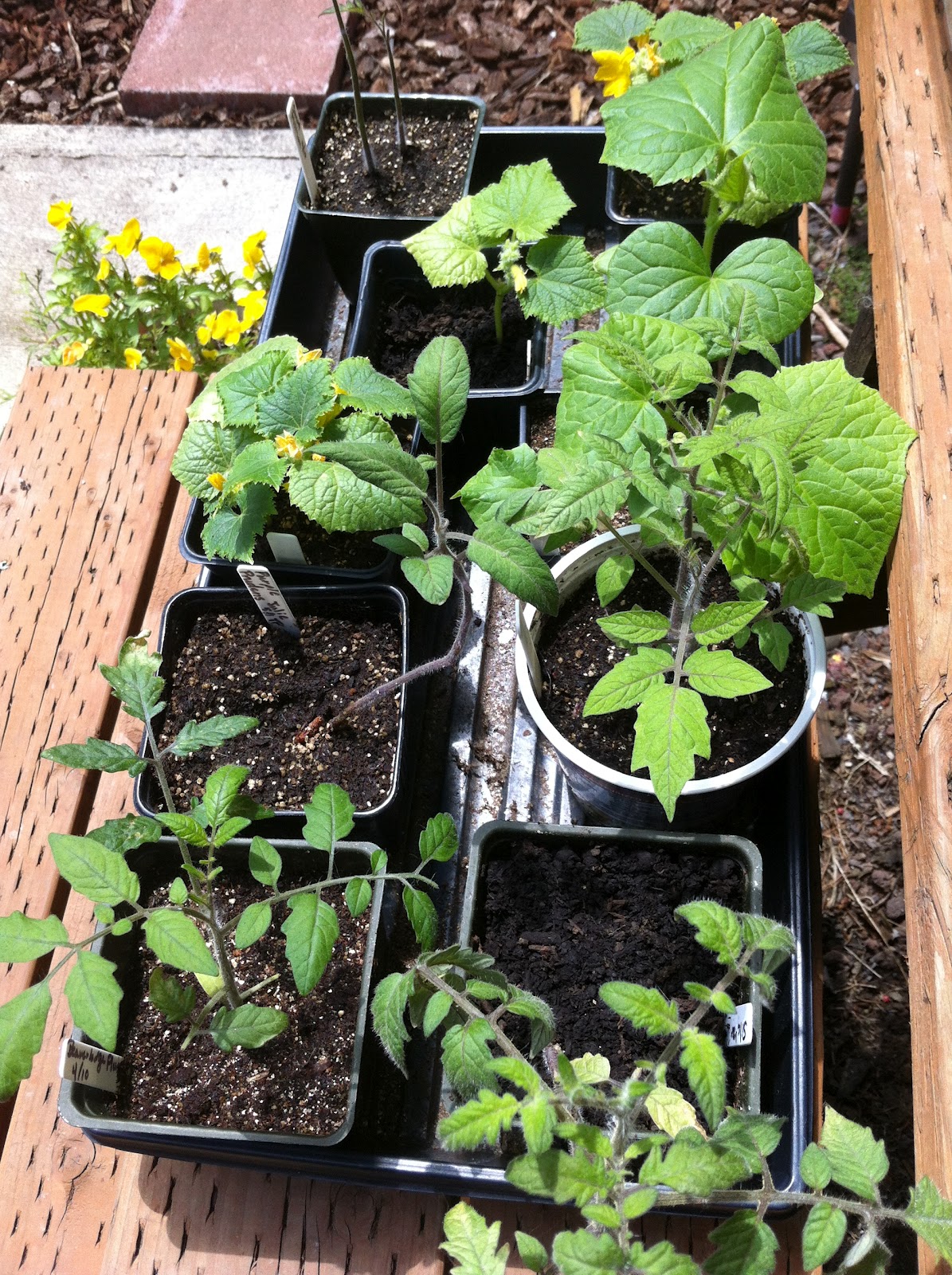 |
| Cucumbers and the largest tomato plants. |
 |
| Yellowing cucumber leaves. |
 |
| Sweet Million afflicted by fungal disease. |
 |
| Cabbage head developing |
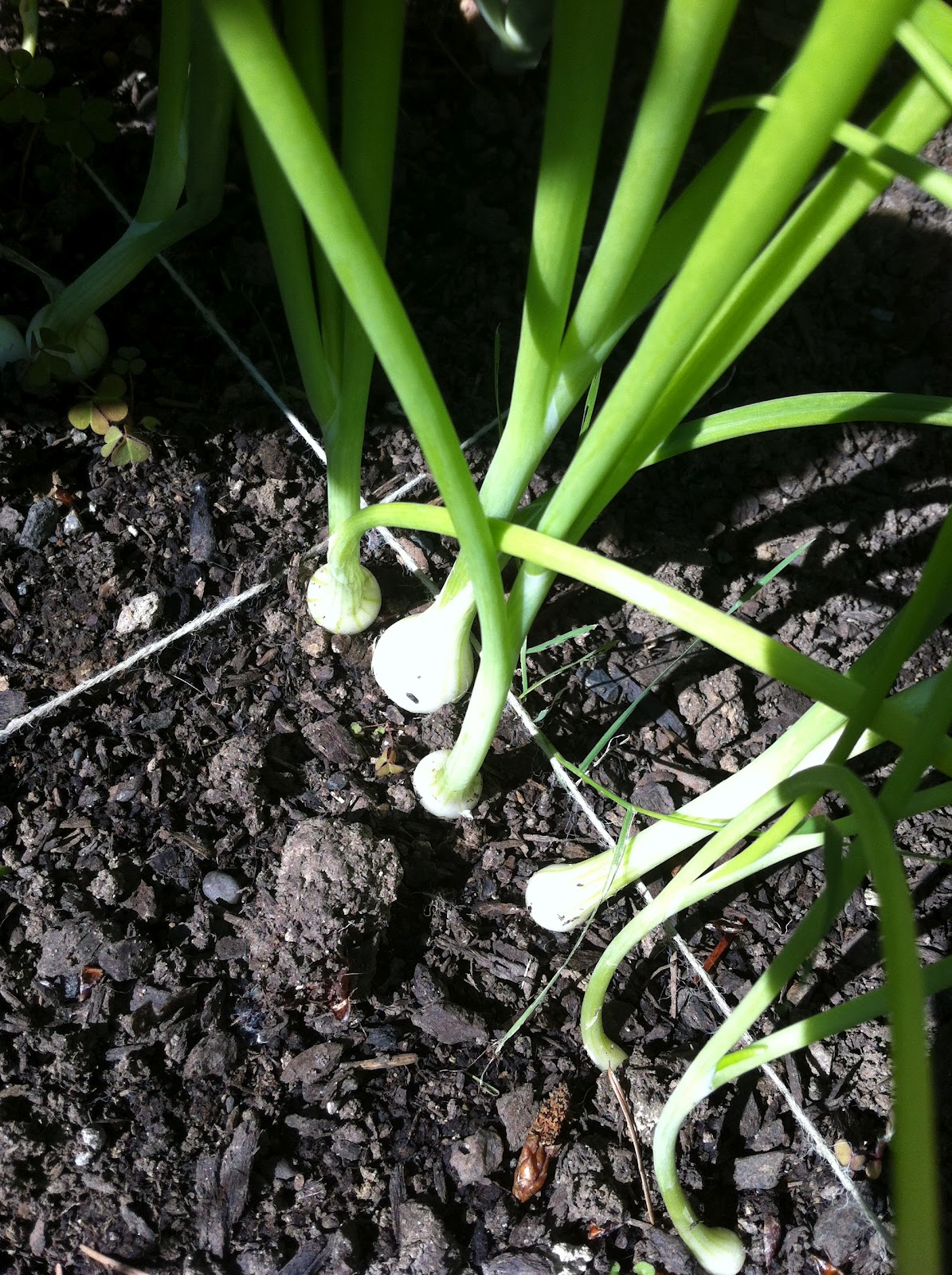 |
| Pearl onions |
 |
| Pea flowers! |
 |
| Zucchini |
 |
| Garden from the East side. The thing above the fence is the butterfly bush. |
Wednesday, June 6, 2012
Seedling Review
Since nothing much is happening this week in the garden, other than the few strawberries I pick each morning, I thought I would give a quick breakdown of how my hot weather seedlings are doing.
Eggplants:
Fairy Tale and Prosperosa are both doing incredibly well. They are large and healthy and looking great.
Peppers:
Cute Stuff - very healthy plants, growing better than any of the others, 100% germination.
Red Ruffled - lost a couple leaves but otherwise in great health, 5 of 6 germinated perfectly.
Rainbow Bell Pepper - these were seeds from Julie so not sure if they are a mix of varieties or if "Rainbow Bell" is the variety, also very healthy, no lost leaves, 5 of 6 germinated.
Jalapeno (Julie's) - not sure of the variety, but they have recovered nicely and appear to be in excellent health.
Cucumbers:
Bush Pickle - 100% germination, already flowering, no disease problems. Very healthy. Transplanted a few of these into an open square today.
National Pickling - 2 of 3 germinated perfectly, the third one sprouted late and is stunted. All three appear to be very healthy, no flowers yet.
Marketmore 97 - 2 out of 3 germinated perfectly, third was late and is smaller. Beginning to see spots on lower leaves. Think it's alternaria leaf blight, but no leaves lost yet. Lowering humidity may help control it.
Lemon - These were saved seed from my plants last year and may not even be Lemon, may be a Lemon/Marketmore, or Lemon/Wautoma, or even Lemon/Tigger melon cross. Won't know until they fruit. One grew well, another is stunted, and the third did not sprout at all. They started out in good health, but are now showing signs of alternaria and lost leaves.
Tomatoes: (H=heirloom, OP=open pollinated, F1=hybrid)
(From Julie)
Siletz (OP) - Health has improved greatly, but root system is small. Transplanted to better container today to encourage healthier root development.
Roma (?) - very healthy after receiving adequate light, thick stalk, no disease.
Purple Prudens (?) - this plant was in the worst shape when I got it, it now has a very healthy few sets of leaves after being transplanted into a better container and receiving adequate light. No disease.
(My seed)
Oregon Spring (OP) - these are out in the garden now, 100% germination, very healthy plants, grew quickly, producing flowers already. No disease.
Beaverlodge Plum (OP) - Transplanted to garden today, 100% germ., v. healthy, fast grower, flowering now. No disease.
Chadwick Cherry (H) - Transplanted today. 100% germ., v. healthy, fast grower. No disease. This was the healthiest of the cherries I grew.
Indigo Rose (OP)- first planting failed to germinate, second planting had 50% germination. Still very small, growing very slowly, but healthy. No disease.
Zebra Cherry (F1) - first planting failed to germinate, 2nd planting had 50% germination. Tiny, slow growing, healthy. No disease.
Sweet Million (F1) - 100% germination. Slow growing, started out in good health. Currently has disease, removed diseased leaves, waiting for recovery.
Beefsteak (OP) - 0% germ. These were a free packet from a company I don't know well, planted 4 seeds, nothing even sprouted. Not sure if it's because of the company, or the variety.
Black Plum (OP) - 100% germ. Healthy, slower growing, strong stems. No disease.
Pineapple (H) - 100% germ. V. healthy, growing quickly, strong stems. No disease. These are the healthiest of the seedlings still inside. Deep, strong roots too.
Cuore di Bue (OP) - 100% germ. 1 of the 4 is stunted, all 4 are in great health and growing quickly. No disease.
Brandywine (H) - 100% germ. 1 of the 4 is stunted, all 4 are in great health and growing quickly. No disease.
San Marzano Gigante 3 (OP) - 100% germ. Planted 8 and all are in great health, tall, leafy, and growing fast. No disease. Among the healthiest, along with Pineapple.
Everything is in pretty good shape, I'm not sure what is wrong with the Sweet Million. It looks like it may be some type of fungus so the damaged leaves have been removed and the plant has been set out with the larger tomatoes to enjoy some sunshine. I'm hoping the sunlight will dry it out some and I'll see some new healthy growth in the next week or so. Whatever it is it doesn't seem to have affected the other plants.
So, of 15 varieties, only 4 have had issues. Two of those four were hybrids; one was from a seed company I've never ordered from before, and probably won't in the future; the last was a very unusual blue variety, if it's germination is any indicator it certainly explains why this variety is so unusual.
I was very pleased by the germination and health of the San Marzanos, since they are meant to be my primary canning tomatoes. Hopefully I'll be able to make a report of the overall health of these varieties in the garden later in the summer, and a final report of their production and health at the end of summer as well.
Eggplants:
Fairy Tale and Prosperosa are both doing incredibly well. They are large and healthy and looking great.
Peppers:
Cute Stuff - very healthy plants, growing better than any of the others, 100% germination.
Red Ruffled - lost a couple leaves but otherwise in great health, 5 of 6 germinated perfectly.
Rainbow Bell Pepper - these were seeds from Julie so not sure if they are a mix of varieties or if "Rainbow Bell" is the variety, also very healthy, no lost leaves, 5 of 6 germinated.
Jalapeno (Julie's) - not sure of the variety, but they have recovered nicely and appear to be in excellent health.
Cucumbers:
Bush Pickle - 100% germination, already flowering, no disease problems. Very healthy. Transplanted a few of these into an open square today.
National Pickling - 2 of 3 germinated perfectly, the third one sprouted late and is stunted. All three appear to be very healthy, no flowers yet.
Marketmore 97 - 2 out of 3 germinated perfectly, third was late and is smaller. Beginning to see spots on lower leaves. Think it's alternaria leaf blight, but no leaves lost yet. Lowering humidity may help control it.
Lemon - These were saved seed from my plants last year and may not even be Lemon, may be a Lemon/Marketmore, or Lemon/Wautoma, or even Lemon/Tigger melon cross. Won't know until they fruit. One grew well, another is stunted, and the third did not sprout at all. They started out in good health, but are now showing signs of alternaria and lost leaves.
Tomatoes: (H=heirloom, OP=open pollinated, F1=hybrid)
(From Julie)
Siletz (OP) - Health has improved greatly, but root system is small. Transplanted to better container today to encourage healthier root development.
Roma (?) - very healthy after receiving adequate light, thick stalk, no disease.
Purple Prudens (?) - this plant was in the worst shape when I got it, it now has a very healthy few sets of leaves after being transplanted into a better container and receiving adequate light. No disease.
(My seed)
Oregon Spring (OP) - these are out in the garden now, 100% germination, very healthy plants, grew quickly, producing flowers already. No disease.
Beaverlodge Plum (OP) - Transplanted to garden today, 100% germ., v. healthy, fast grower, flowering now. No disease.
Chadwick Cherry (H) - Transplanted today. 100% germ., v. healthy, fast grower. No disease. This was the healthiest of the cherries I grew.
Indigo Rose (OP)- first planting failed to germinate, second planting had 50% germination. Still very small, growing very slowly, but healthy. No disease.
Zebra Cherry (F1) - first planting failed to germinate, 2nd planting had 50% germination. Tiny, slow growing, healthy. No disease.
Sweet Million (F1) - 100% germination. Slow growing, started out in good health. Currently has disease, removed diseased leaves, waiting for recovery.
Beefsteak (OP) - 0% germ. These were a free packet from a company I don't know well, planted 4 seeds, nothing even sprouted. Not sure if it's because of the company, or the variety.
Black Plum (OP) - 100% germ. Healthy, slower growing, strong stems. No disease.
Pineapple (H) - 100% germ. V. healthy, growing quickly, strong stems. No disease. These are the healthiest of the seedlings still inside. Deep, strong roots too.
Cuore di Bue (OP) - 100% germ. 1 of the 4 is stunted, all 4 are in great health and growing quickly. No disease.
Brandywine (H) - 100% germ. 1 of the 4 is stunted, all 4 are in great health and growing quickly. No disease.
San Marzano Gigante 3 (OP) - 100% germ. Planted 8 and all are in great health, tall, leafy, and growing fast. No disease. Among the healthiest, along with Pineapple.
Everything is in pretty good shape, I'm not sure what is wrong with the Sweet Million. It looks like it may be some type of fungus so the damaged leaves have been removed and the plant has been set out with the larger tomatoes to enjoy some sunshine. I'm hoping the sunlight will dry it out some and I'll see some new healthy growth in the next week or so. Whatever it is it doesn't seem to have affected the other plants.
So, of 15 varieties, only 4 have had issues. Two of those four were hybrids; one was from a seed company I've never ordered from before, and probably won't in the future; the last was a very unusual blue variety, if it's germination is any indicator it certainly explains why this variety is so unusual.
I was very pleased by the germination and health of the San Marzanos, since they are meant to be my primary canning tomatoes. Hopefully I'll be able to make a report of the overall health of these varieties in the garden later in the summer, and a final report of their production and health at the end of summer as well.

 Labels:
Brandywine,
Cuore di Bue,
eggplant,
garden,
grow room,
organic,
pepper,
seedling,
tomato,
tomato selection,
tomato varieties
Labels:
Brandywine,
Cuore di Bue,
eggplant,
garden,
grow room,
organic,
pepper,
seedling,
tomato,
tomato selection,
tomato varieties
Wednesday, May 2, 2012
A Little Light Goes a Long Way
I stopped by my neighbor, Julie's, house the other day to exchange a few seeds with her and she gave me a couple tomato and jalapeno starts as well.
Seeing Julie's grow room system and the condition of her starts made me decide to put up a post regarding legginess and lighting.
In the photos above you can easily see that Julie's plants are much older than mine, but you can also see that they have a paler green color to their leaves, much longer stems between each set of leaves, and I'm actually holding the tomato up because its stem isn't strong enough. So why the difference? Light.
I wish I had taken a picture of Julie's grow room, but sadly I'll just have to describe it. She has one large set of fluorescents in a 4 bulb fixture above a wood shelf in a west facing window. There is a second shelf below that one with no lighting. The light fixture is suspended about 6-8 inches above the pots.
All in all it isn't a bad system, but it's not adequate; the easiest way to tell that it's not adequate is the pale leggy look of the starts. The light fixture she has would be perfect for the one shelf if it were positioned lower, but it does nothing for the lower shelf, especially since the wood shelves let no light from above down onto the plants below.
So if you are having trouble with leggy, sickly pale green starts try adding more lights, bringing the lights closer to the plants (fluorescents are very cool and will not burn your plants even if the leaves touch them) or if possible the very best way to improve the health of your starts is to set them out in the sunshine a few hours a day. Only do this when it's comfortably warm out though and slowly progress them from an hour or so to a full day in the sunlight.
Just to add a quick update to things: the past few days have been cold, rainy, and depressing. The plants in the garden are growing very well and I'm waiting for my first harvest with bated breath. I haven't been able to get the rest of my tomatoes started yet because there is no room under the grow lights, but the weekend is expected to be beautiful and I will try to get the pumpkin bed cleaned up and planted with pumpkins, beans, zucchini and basil. Hopefully that will give me enough space to start the rest of the tomatoes.
Keep your lights close to your plants, give them more light than you think they can bear, and good luck!
Seeing Julie's grow room system and the condition of her starts made me decide to put up a post regarding legginess and lighting.
 |
| Left, my pepper starts, planted about 2-3 weeks ago. Right Julie's jalapenos, planted 2 months ago. |
 |
| Left: my tomatoes, Right: Julie's tomatoes (the little ones in front are mine too. |
I wish I had taken a picture of Julie's grow room, but sadly I'll just have to describe it. She has one large set of fluorescents in a 4 bulb fixture above a wood shelf in a west facing window. There is a second shelf below that one with no lighting. The light fixture is suspended about 6-8 inches above the pots.
All in all it isn't a bad system, but it's not adequate; the easiest way to tell that it's not adequate is the pale leggy look of the starts. The light fixture she has would be perfect for the one shelf if it were positioned lower, but it does nothing for the lower shelf, especially since the wood shelves let no light from above down onto the plants below.
So if you are having trouble with leggy, sickly pale green starts try adding more lights, bringing the lights closer to the plants (fluorescents are very cool and will not burn your plants even if the leaves touch them) or if possible the very best way to improve the health of your starts is to set them out in the sunshine a few hours a day. Only do this when it's comfortably warm out though and slowly progress them from an hour or so to a full day in the sunlight.
 |
| Eggplants finally sprouted! (Only planted two though, WTF? Why are there three?) |
 |
| More starts under the lights, I bought one Oregon Spring tomato in hopes of a very early harvest from it. |
Labels:
eggplant,
garden,
garden notes,
grow room,
leggy,
light,
pepper,
planting time,
plants,
pumpkin,
seed starting,
seedling,
small space,
starts,
tomato,
vegetable
Thursday, April 26, 2012
The Need For Speed
One of the conundrums new gardeners face each year is when to plant each type of seed. The seed packs always say 4-6 weeks before/after last frost date or something similar, but that's not all that helpful most of the time. They also sometimes say what temperature the soil should be for germination, which is nice for outdoor planting, but doesn't really matter for things you start inside. More important is the question of how fast the seeds will sprout and grow before you run out of room for them and are forced to put them outside? And how slow will they grow? Will you run out of summer before they are big enough to go outside?
So here's a quick list of the crops I've grown and their growing speed to give you an idea what should be planted super early, what can wait a bit and what will outgrow your indoor space before the weather warms.
Fastest to slowest:
-lettuce
-spinach
-squashes (summer and winter)
-radish
-brassicas
-melons
-peas
-beans
-tomatoes
-Swiss chard
-peppers
-carrots
-basil
-onion family (from seed, not set)
-herbs
-eggplant
-celery
I haven't grown corn yet, so have no idea how quickly it grows, but this should give an idea that you would not want to start celery and lettuce together in early Spring for a harvest at the same time. In fact, celery is the slowest growing vegetable I've planted, which is why I usually buy it as a start. I could plant celery in January and it still might be too small to go outside in April. At the same time it would be pointless to plant zucchini seeds (summer squash) inside in February when it will outgrow your space by April and (here, in Oregon) can't be planted outside until the rains slow down in May. I've lost many cucurbits to powdery mildew and no longer take any chances, plus since they grow so quickly I have plenty of time for a good harvest even after waiting out the rains.
Tomatoes are much faster growers than peppers or eggplants, if you plan to transplant all three together once the weather is warm enough you'll have to plant your eggplants, wait a week, plant the peppers, wait two more weeks and then start the tomatoes. Otherwise your tomatoes will be far too large to keep under grow lights before the rest have a chance to catch up, especially if you have failed germination and have to replant something.
Point in case: One row of my garden bed right now has lettuces and swiss chard that were planted inside the same day, cared for the same, and transplanted the same day as well; it also has peas that were planted outside the day the others were transplanted. Today this row has lettuce that's nearly ready to harvest, peas that are about 6" tall, and Swiss chard that is still little more than a sprout with it's first true leaves. I transplanted all of this on March 26th, then started some tomatoes on April 10th. The tomatoes are already putting on their second set of true leaves, and are far ahead of the chard despite being planted 2 weeks after the chard went outside.
I hope this post is helpful in determining planting dates, and good luck with the gardens everyone!
So here's a quick list of the crops I've grown and their growing speed to give you an idea what should be planted super early, what can wait a bit and what will outgrow your indoor space before the weather warms.
Fastest to slowest:
-lettuce
-spinach
-squashes (summer and winter)
-radish
-brassicas
-melons
-peas
-beans
-tomatoes
-Swiss chard
-peppers
-carrots
-basil
-onion family (from seed, not set)
-herbs
-eggplant
-celery
I haven't grown corn yet, so have no idea how quickly it grows, but this should give an idea that you would not want to start celery and lettuce together in early Spring for a harvest at the same time. In fact, celery is the slowest growing vegetable I've planted, which is why I usually buy it as a start. I could plant celery in January and it still might be too small to go outside in April. At the same time it would be pointless to plant zucchini seeds (summer squash) inside in February when it will outgrow your space by April and (here, in Oregon) can't be planted outside until the rains slow down in May. I've lost many cucurbits to powdery mildew and no longer take any chances, plus since they grow so quickly I have plenty of time for a good harvest even after waiting out the rains.
Tomatoes are much faster growers than peppers or eggplants, if you plan to transplant all three together once the weather is warm enough you'll have to plant your eggplants, wait a week, plant the peppers, wait two more weeks and then start the tomatoes. Otherwise your tomatoes will be far too large to keep under grow lights before the rest have a chance to catch up, especially if you have failed germination and have to replant something.
Point in case: One row of my garden bed right now has lettuces and swiss chard that were planted inside the same day, cared for the same, and transplanted the same day as well; it also has peas that were planted outside the day the others were transplanted. Today this row has lettuce that's nearly ready to harvest, peas that are about 6" tall, and Swiss chard that is still little more than a sprout with it's first true leaves. I transplanted all of this on March 26th, then started some tomatoes on April 10th. The tomatoes are already putting on their second set of true leaves, and are far ahead of the chard despite being planted 2 weeks after the chard went outside.
I hope this post is helpful in determining planting dates, and good luck with the gardens everyone!
Monday, April 23, 2012
Quick Pics and an Update
Just to keep things updated: I cleaned out the back shed yesterday, forcing my poor mistreated husband to do the dirty work of smashing all the wasp nests in it. Everything in there is now neat and tidy, we have tons of free space there now and as a bonus there is no longer a giant plastic Frankenstein staring at me every time I look for a shovel. Frankie is going to Goodwill to grace the porch of some other kindly soul on Halloween night.
The trailer is filled with things to go to the dump, and we didn't even get the other shed done! I still have work to do in the back yard to prep it for all of my overflow plants and the squashes, but it's in much better shape now and won't be too much work.
The seedlings are all out enjoying a lovely sunny day. Everything is in great shape; but I am desperately awaiting the sprouting of the eggplants and peppers which seem to be taking forever. Until i know if they will sprout I don't want to plant more. The eggplant seed pack says it'll take 16 days for germination! In gardening, that's like saying an eternity.
Peaceful Valley Farm and Garden supply sent me a catalog the other day with an enclosed free pack of Beefsteak Tomato seeds, so I suppose I will add them to my list of varieties to plant, and a friend gave me a few seeds of Chadwick (?) Cherry tomatoes as well. I think that brings my tomato variety list up to around 12. Hopefully I can find room for all of them, I generally only plant one of each variety but the Brandywine and Cuore di Bue which I plant two of. This year both beds will be planted in hot season crops though so i might be able to fit extras of each, as well as the peppers and cucumbers.
I can't wait to have a larger garden, the lack of space is really beginning to get to me.
For posterity's sake here are a few quick pictures of how the garden is coming along:
And that about wraps it up for today! It's supposed to be hot, hot, hot today reaching a near record high of 81 degrees so I think I'll kick back and relax and just do the dump trip to conserve energy. Have a lovely day all! :)
The trailer is filled with things to go to the dump, and we didn't even get the other shed done! I still have work to do in the back yard to prep it for all of my overflow plants and the squashes, but it's in much better shape now and won't be too much work.
The seedlings are all out enjoying a lovely sunny day. Everything is in great shape; but I am desperately awaiting the sprouting of the eggplants and peppers which seem to be taking forever. Until i know if they will sprout I don't want to plant more. The eggplant seed pack says it'll take 16 days for germination! In gardening, that's like saying an eternity.
Peaceful Valley Farm and Garden supply sent me a catalog the other day with an enclosed free pack of Beefsteak Tomato seeds, so I suppose I will add them to my list of varieties to plant, and a friend gave me a few seeds of Chadwick (?) Cherry tomatoes as well. I think that brings my tomato variety list up to around 12. Hopefully I can find room for all of them, I generally only plant one of each variety but the Brandywine and Cuore di Bue which I plant two of. This year both beds will be planted in hot season crops though so i might be able to fit extras of each, as well as the peppers and cucumbers.
I can't wait to have a larger garden, the lack of space is really beginning to get to me.
For posterity's sake here are a few quick pictures of how the garden is coming along:
 |
| Sasha enjoying the garden. |
 | ||
| Sasha is a firm believer that the garden is a tiny jungle grown just for her. |
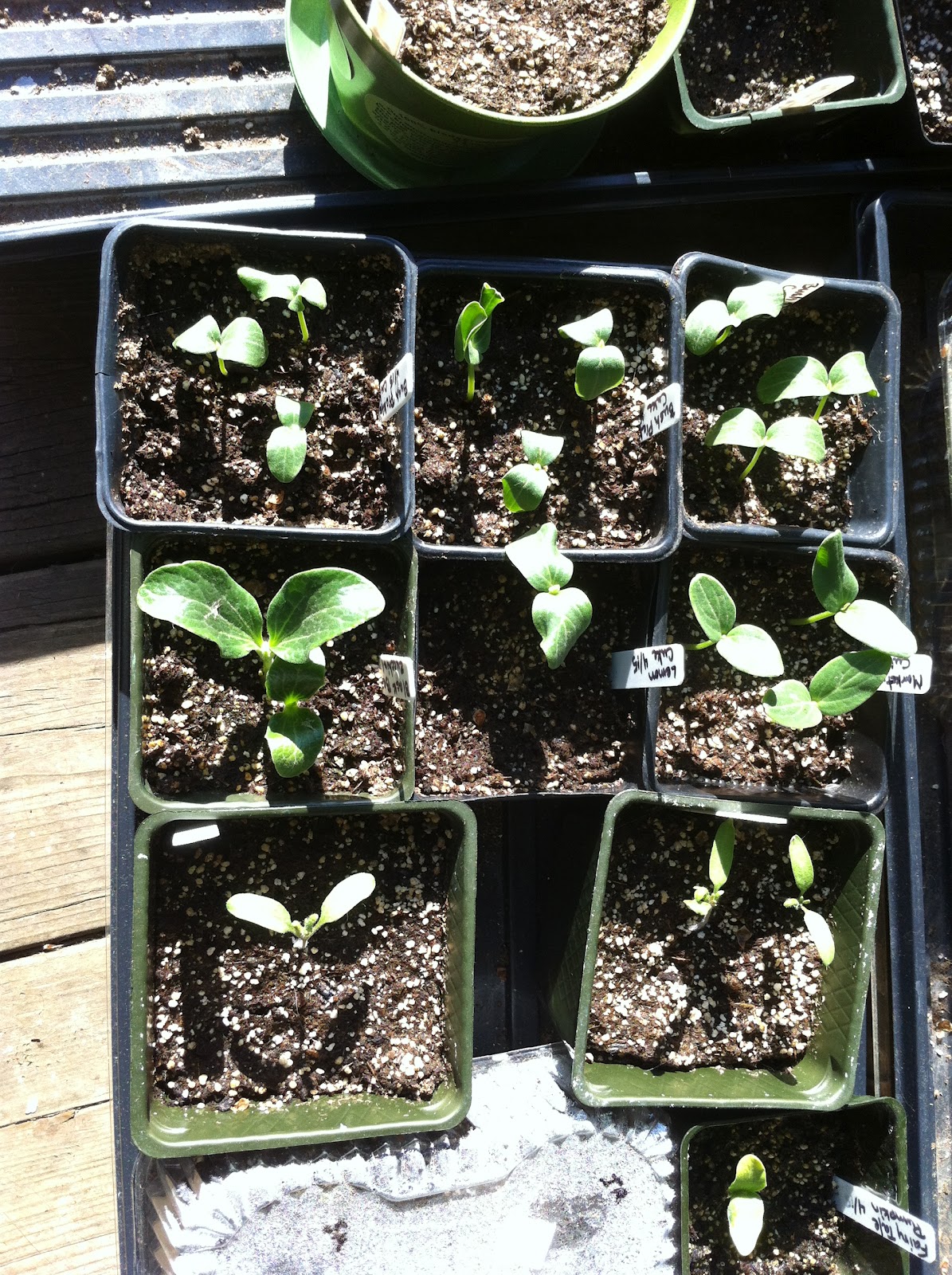 |
| Pumpkin, zucchini, cucumber, and tomato seedlings in the sunshine. |
 |
| more tomato seedlings, the ones in the clamshell haven't sprouted yet. |
 |
| Winter squash seedlings are getting big... may be time to repot. |
 |
| Bed #2 all planted and covered |
 |
| Whiskey barrel #2 bizarre scattering of volunteer sunflowers, carrots my son threw in, cilantro in need of planting and two old onions I had no room for. |
 |
| Whiskey barrel #1: kale and a few spare lettuces (they are sad because they went through the snow) |
 |
| Backyard full of Goodwill holiday decor. Wanna play Where's Frankie? |
 |
| The lovely, (almost) blackberry-free soil behind all the Goodwill boxes. |
And that about wraps it up for today! It's supposed to be hot, hot, hot today reaching a near record high of 81 degrees so I think I'll kick back and relax and just do the dump trip to conserve energy. Have a lovely day all! :)
Labels:
blackberry,
eggplant,
garden,
kale,
lettuce,
onion,
peas,
plants,
pots,
raised bed,
seed starting,
seedling,
small space,
update
Wednesday, April 18, 2012
Garden Update: Pictures!


Hopefully my weekend will be busy and sunny and lots of work!
Labels:
eggplant,
garden,
garden plan,
grow room,
lettuce,
peas,
planting time,
seed starting,
seedling,
square foot garden,
tomato,
vegetable
Tuesday, January 17, 2012
How Much Harvest?
If you are new to gardening and want to grow some food this is the post for you.
Planting a tomato plant or two is nice and you get a few tomatoes, if you don't kill them somehow, but how do you know how much is right for you and your family? When space is at a premium this can be an important decision, it can determine whether you will have room for tomatoes, carrots, zucchini, bell peppers and cucumbers... or just enough room for tomatoes. Having too few tomatoes may mean you have enough for hamburgers one night, but not for salads the next day. Or that you harvest more than your family can eat fresh, but not enough to make it worth the effort to can salsa. Having too much of one harvest can mean an overstock of salsa, spaghetti, canned tomatoes, sun-dried tomatoes, tomato soup, fresh eating tomatoes... you get the idea. You don't want to waste garden space growing more than you could possibly eat in a year. Most home canned goods and frozens are only good for a year, and by the next summer you'll have a whole new crop to process.
Tomatoes are a good example for this. I have a family of four that is not big on vegetable eating, my son is a huge cherry tomato eater, my husband and daughter prefer their tomatoes fresh in their meals, while I like to have salsas, sauces, canned tomatoes, soups, etc. for after the harvest. My 2011 garden worked out just about perfect giving me a mix of cherry, saucing and slicing tomatoes at a rate of about 4lbs every 4 or 5 days. When we had an overabundance of slicers I simply seeded them and added them to sauces, when saucers were more productive I would chop them into meals. The cherry tomatoes were eaten fresh or added to salads. In total we planted 12 tomato plants with a mix of extra-early to late season, in differing sizes shapes and colors. We actually ended up short on spaghetti sauce but I gave a lot of tomatoes to my mom because I was sick of processing them.
The tomatoes worked out to 3 plants per person, which seems to be just right for my family, though not necessarily for yours. If you are big vegetable eaters, or plan to share a lot of your harvest aim for closer to 5 per person. If you are overwhelmed with that number you can always post on craigslist that you have too many tomatoes and would love to make a trade with someone who grew too many bell peppers, or share your extras with friends and family. Around here, summer squash are the most overgrown vegetable (people just don't realize how productive they are) and are nearly impossible to get rid of, but tomatoes, carrots, peppers, corn, and peas are an easy thing to trade with friends and neighbors.
Generally when I'm selecting a new food to grow I put in one or two (if needed for pollination) plants and wait to see what comes of it. This served me well when my brother insisted I should grow five or six eggplants last year and I decided to leave more cucumber space instead and only plant 2 eggplants. Those 2 eggplants produced more eggplant than I could have ever managed to eat, luckily my mom took a lot of it off my hands, and meanwhile the extra cucumber space was needed since my pickling cucumbers ended up being completely shaded out by the nearby tomatoes. For new gardeners this is a great way to practice trial and error too, and may keep you from giving up in disgust when your favorite veggie does poorly the first year you plant it. When planning your garden, plan many different types of vegetables, in several varieties if possible, plan for them to ripen at different times if you plan to eat them fresh, or all at once for processing big batches. As exciting as a lush patch of hot chilis may sound, if you won't eat them or don't know someone who will, it's probably not worthwhile to grow them. And obviously, if you are a massive watermelon eater who simply can't get enough it may be worthwhile to plant several just for yourself. Keep in mind that perennial fruits and vegetables tend to get bigger or spread over the years too, don't keep investing in blueberry bushes or strawberry plants to fill your garden bed if a few will spread in a year or two and fill it nicely. Instead use that money to purchase some u-pick berries the first year or two until your patch can keep up with your demands.
As an example of what can be done in a small garden this is a list of what I planted last year in my 102 square feet.
-one Thai chili plant
-two jalapenos
-two lemon cucumbers
-four slicing cucumbers
-two eggplants
-one small melon
-one luffa
-three pumpkins
-one zucchini
-six marigolds
-four calendula
-about 30 runner beans
-12 tomatoes
-eight pickling cucumbers
-three bell peppers
-eight basil
-six garlic
-24 bush beans
-six mammoth sunflowers
-six celery
-three cabbage
-four broccoli
-24 lettuce
-27 spinach
-12 nasturtiums
-42 peas
-and a handful of carrots
That's over 200 individual plants, of 27 different types of vegetable/flower. Admittedly there were only a few of each type but they were more than enough to keep my family stocked for the year, with a few exceptions.
Planting a tomato plant or two is nice and you get a few tomatoes, if you don't kill them somehow, but how do you know how much is right for you and your family? When space is at a premium this can be an important decision, it can determine whether you will have room for tomatoes, carrots, zucchini, bell peppers and cucumbers... or just enough room for tomatoes. Having too few tomatoes may mean you have enough for hamburgers one night, but not for salads the next day. Or that you harvest more than your family can eat fresh, but not enough to make it worth the effort to can salsa. Having too much of one harvest can mean an overstock of salsa, spaghetti, canned tomatoes, sun-dried tomatoes, tomato soup, fresh eating tomatoes... you get the idea. You don't want to waste garden space growing more than you could possibly eat in a year. Most home canned goods and frozens are only good for a year, and by the next summer you'll have a whole new crop to process.
Tomatoes are a good example for this. I have a family of four that is not big on vegetable eating, my son is a huge cherry tomato eater, my husband and daughter prefer their tomatoes fresh in their meals, while I like to have salsas, sauces, canned tomatoes, soups, etc. for after the harvest. My 2011 garden worked out just about perfect giving me a mix of cherry, saucing and slicing tomatoes at a rate of about 4lbs every 4 or 5 days. When we had an overabundance of slicers I simply seeded them and added them to sauces, when saucers were more productive I would chop them into meals. The cherry tomatoes were eaten fresh or added to salads. In total we planted 12 tomato plants with a mix of extra-early to late season, in differing sizes shapes and colors. We actually ended up short on spaghetti sauce but I gave a lot of tomatoes to my mom because I was sick of processing them.
The tomatoes worked out to 3 plants per person, which seems to be just right for my family, though not necessarily for yours. If you are big vegetable eaters, or plan to share a lot of your harvest aim for closer to 5 per person. If you are overwhelmed with that number you can always post on craigslist that you have too many tomatoes and would love to make a trade with someone who grew too many bell peppers, or share your extras with friends and family. Around here, summer squash are the most overgrown vegetable (people just don't realize how productive they are) and are nearly impossible to get rid of, but tomatoes, carrots, peppers, corn, and peas are an easy thing to trade with friends and neighbors.
Generally when I'm selecting a new food to grow I put in one or two (if needed for pollination) plants and wait to see what comes of it. This served me well when my brother insisted I should grow five or six eggplants last year and I decided to leave more cucumber space instead and only plant 2 eggplants. Those 2 eggplants produced more eggplant than I could have ever managed to eat, luckily my mom took a lot of it off my hands, and meanwhile the extra cucumber space was needed since my pickling cucumbers ended up being completely shaded out by the nearby tomatoes. For new gardeners this is a great way to practice trial and error too, and may keep you from giving up in disgust when your favorite veggie does poorly the first year you plant it. When planning your garden, plan many different types of vegetables, in several varieties if possible, plan for them to ripen at different times if you plan to eat them fresh, or all at once for processing big batches. As exciting as a lush patch of hot chilis may sound, if you won't eat them or don't know someone who will, it's probably not worthwhile to grow them. And obviously, if you are a massive watermelon eater who simply can't get enough it may be worthwhile to plant several just for yourself. Keep in mind that perennial fruits and vegetables tend to get bigger or spread over the years too, don't keep investing in blueberry bushes or strawberry plants to fill your garden bed if a few will spread in a year or two and fill it nicely. Instead use that money to purchase some u-pick berries the first year or two until your patch can keep up with your demands.
As an example of what can be done in a small garden this is a list of what I planted last year in my 102 square feet.
-one Thai chili plant
-two jalapenos
-two lemon cucumbers
-four slicing cucumbers
-two eggplants
-one small melon
-one luffa
-three pumpkins
-one zucchini
-six marigolds
-four calendula
-about 30 runner beans
-12 tomatoes
-eight pickling cucumbers
-three bell peppers
-eight basil
-six garlic
-24 bush beans
-six mammoth sunflowers
-six celery
-three cabbage
-four broccoli
-24 lettuce
-27 spinach
-12 nasturtiums
-42 peas
-and a handful of carrots
That's over 200 individual plants, of 27 different types of vegetable/flower. Admittedly there were only a few of each type but they were more than enough to keep my family stocked for the year, with a few exceptions.
Subscribe to:
Posts (Atom)