Showing posts with label plants. Show all posts

Thursday, September 20, 2012

Still Harvesting

cucumbers, beans, tomatoes
 I discovered a pile of harvest photos that I haven't yet shown off this morning.  Most of the tomatoes are nearly green in the pics because I have been picking them at first blush.  Now that it's mid-September I've actually managed to harvest quite a few of them, and even my first couple of Fairy Tale eggplants, which are small but still tasty.
cucumbers, tomatoes, jalapenos.


After mowing the lawn a few days ago i discovered the blackberry vines growing over the fence from the neighbor's yard had a conciliatory harvest for me... probably in hopes that the bribe would keep me from cutting them.  It wasn't much of a harvest but I also didn't put much effort into clinbing around in the busshes looking for more.  Mina had them on her ice cream and said they were delicious.

Blackberries!
 Not sure if I already mentioned the results of my potato growing or not.  The 3 potatoes I planted never bloomed, but I was sick of waiting on them so I turned over the 3 gal. pots they were in and low and behold I had potatoes!  There was a total of about a dozen baby potatoes, and some tiny ones that were just developing.  I ate them!  The tiny ones are being saved for spring planting though, maybe I won't have to purchase seed potatoes again.

Beans, tomatoes, potatoes, cucumbers.
 Eventually all those blushing tomatoes end up looking like the ones below and I use them fresh or cook them up for salsa or spaghetti sauce.
Tomatoes, green peppers, jalapeno, onions, garlic, and lime.  Ready for salsa!

Cooking the salsa.
Cherry tomato bowl.  Plus a couple eggplants.
 So despite the slow end of August and beginning of September harvests, things have kind of picked up as the days are growing shorter and the garden is getting more shade.  We've been seeing temperatures in the upper 80s and occasional 90s the past couple weeks, but that ends this week and temps will continue to get cooler.  So far the tomatoes have managed to prove their worth, even though I haven't yet seen enough at any time to preserve.  The huge fat San Marzanos are driving me crazy though, they are so thick with tomatoes the branches are breaking through the string holding them to their stakes, but not a single one has ripened yet.  Maybe the change in weather will give them a nudge to finish up before they die?

Custom cabinetry.
 The last item to share is that we finished up the final touch on the kitchen before we put in the new floors... the custom cookbook shelf on the end of the island.  I need to pick up a few more little shelf brackets for the tiny shelves, but otherwise it is done.  I think it looks great!  And it's much handier than digging around in the dining room cabinets to find a recipe.  Also, the shelves are designed to contain and hide the electrical outlets for the island, which aren't visible in this picture because they face in toward the oven. 

I have been house hunting this week and found a great place with a lot of potential, including garden potential, just waiting on a response from the bank and needing to finish up the work at this house and we'll be ready to dive into buying a house!


Wednesday, August 29, 2012

76 Lbs. What a Shame

Painted lady on butterfly bush
Today my vegetable tally is at a whopping 77 lbs.  Not too bad considering that my two large beds are full of tomato plants that have given me a whole 12 tomatoes, and about 2 dozen cherry tomatoes.  Last year my 4 pumpkins alone weighed in at 75 lbs. 

The majority of the weight for August has been cucumbers, most of which came off the Marketmore 97s.  The Lemon cukes are just starting to roll in now, two harvested and several still growing.  I have one small green pumpkin on my shed this year, I can only hope it will ripen before the vine starts dying off.  It doesn't look like it will weigh in at more than about 10 lbs. though.
Pumpkin on shed today.


It has been a very sad year for my garden.  Apparently I'm not the only one either.  My neighbor Julie told me her tomatoes started coming in about 3 weeks later than normal, and her pumpkins are also still green and small.  In a normal year her pumpkin vines sprawl across most of her back yard and she harvests enough for cooking and carving for the whole family. 
Pumpkin vines on shed.

My garden is producing, all of the plants are in good health, but there is such a short window of growing season here that a week or two of cool weather throughout the season can be enough to completely destroy any chance of main season tomato production.

Chocolate Cherry tomatoes.
So far the tomatoes that have ripened have all been the extra early varieties.  Oregon Spring and Beaverlodge Plum and a few varieties of cherries.  I thought that my double planting rotation could be a factor in their lateness, and I'm sure it is somewhat, but it is most definitely not the primary problem.  The volunteer Chocolate Cherries have been in the ground since the first planting went in, and while they have outproduced the other cherry varieties that were planted later, they haven't outproduced them by much.  Like the other plants they are weighed down with green fruit that simply won't ripen.

Indigo Rose tomato
I considered covering them with plastic to extend the growing season.  The late season plants haven't even gotten fruits yet though, and nighttime temps are getting down into the low 50s already.  I just don't know if the plastic will make any difference.  It doesn't look like we'll be having an Indian summer this year, we may not even have much of an autumn. 

Winter is coming.
(snicker)

All in all this year's garden has been a major disappointment.  While the rest of the country has been hit by a heat wave, our tiny corner of the world has been much cooler than normal.  I did have a few standouts in the garden this year though despite the weird weather and will have a post soon to acknowledge those plants that really outdid expectations.

For now, I should probably get back to my housework and prepping for the new school year to begin.

Wednesday, June 13, 2012

Strawberry Shortcake!

This morning, after ignoring them for 3 days, I went out and picked strawberries.  Despite all of the slug nibbling, I managed to harvest 2 lbs. 4.5 oz. today.

Strawberries!! (and a scale, for scale)
Of course, the very best thing to do with my first decent strawberry harvest of the year... is to make Strawberry Shortcake!  My absolute favorite dessert.

There are three categories of strawberry shortcakes: Lazy, Simple, and Old Fashioned.

The Lazy shortcake maker mashes berries, buys a pack of little spongecake cups, or an angel food cake, or something similar, and tops it with spray whipped cream or CoolWhip.  This is tasty enough, super easy to make even if you live in a teepee, and you could do it while completely drunk.  It's more expensive though and is the least tasty option.

The Simple shortcake maker mashes berries with a tablespoon or two of sugar; takes out a box of Bisquik and makes up the biscuit recipe with a few tablespoons of sugar added; then tops it off with spray whipped cream or homemade whipped cream if they have none in a spray can.  This is the way I generally make mine, because I'm lazy and it's Simple.  It tastes better, is much cheaper if you keep biscuit mix around the house normally, and while you need an oven for it (can't make it in a teepee) it is still pretty foolproof.

The Old Fashioned shortcake maker mashes berries with a bit of sugar; gets out a proper shortcake recipe and bakes it up; then tops it with fluffy delicious homemade whipped cream that they've whipped with the sweat of their brow.  This is the BEST way to have shortcake.  I don't generally feel like putting this kind of effort into it... but when someone else does, I will eat it with much praise and delight.

I can't even truly explain the difference, but you know it when you try it.  I also can really appreciate knowing exactly what went into a treat like this.  Yes, buttery shortcake and heavy cream aren't exactly "healthy" foods; but it's nice to know there's no carageenan, guar gum, hydrogenated vegetable oil, or Red #5 in it.  Just organic strawberries, heavy cream, sugar, flour, eggs, salt, milk, butter, and baking powder.

So for those who want to give the experience of real shortcake (rather than little spongecake cups) a try at home here is my Old Fashioned Shortcake recipe:

2 1/4 cups flour
4 tsp. baking powder
2 tbsp. sugar
1/2 tsp salt
1/3 cup butter (softened) or shortening (butter will give a crunchier crust, shortening a softer crust)

Mix together all of the dry ingredients.  Cut the butter/shortening in with forks or pastry cutter until it gets a crumbly texture.  Set aside.

1 egg
2/3 cup milk

Mix together the wet ingredients.  Pour into the crumbly mixture, and combine together carefully (it is a quick bread, similar to muffins and over-mixing will make it tough!) until ingredients are well-incorporated.  Press dough evenly into a well greased 8x11 or 9x9 baking dish.  Bake for 15 minutes at 425 degrees, a toothpick inserted should come out clean.  Cut into pieces and serve with sweetened mashed strawberries (or other fruits or berries!) and whipped cream. 

Tip #1: don't accidentally read the recipe next to it in your cookbook and add way too much sugar. Like I just did. /facepalm

Tip #2: don't use a whisk to cut in the butter, like I just did, it will just get all of the butter stuck in the whisk and be a pain to get out.

Tip #3: don't forget to grease your pan, like I just did.

Wow, I'm just on a roll today.  If this shortcake comes out decent it will be through sheer luck!

...15 minutes later...


Amazingly, it turned out beautiful!
And that is how you make an old fashioned traditional shortcake.  Enjoy!

Tuesday, June 12, 2012

Garden Update

 This week I pulled a lot of kale and a few broccoli and celery and finally got a chance to plant some more tomatoes.  I also put in a couple cucumbers, peppers, and eggplants.

Back to front: peppers, cukes, eggplants.
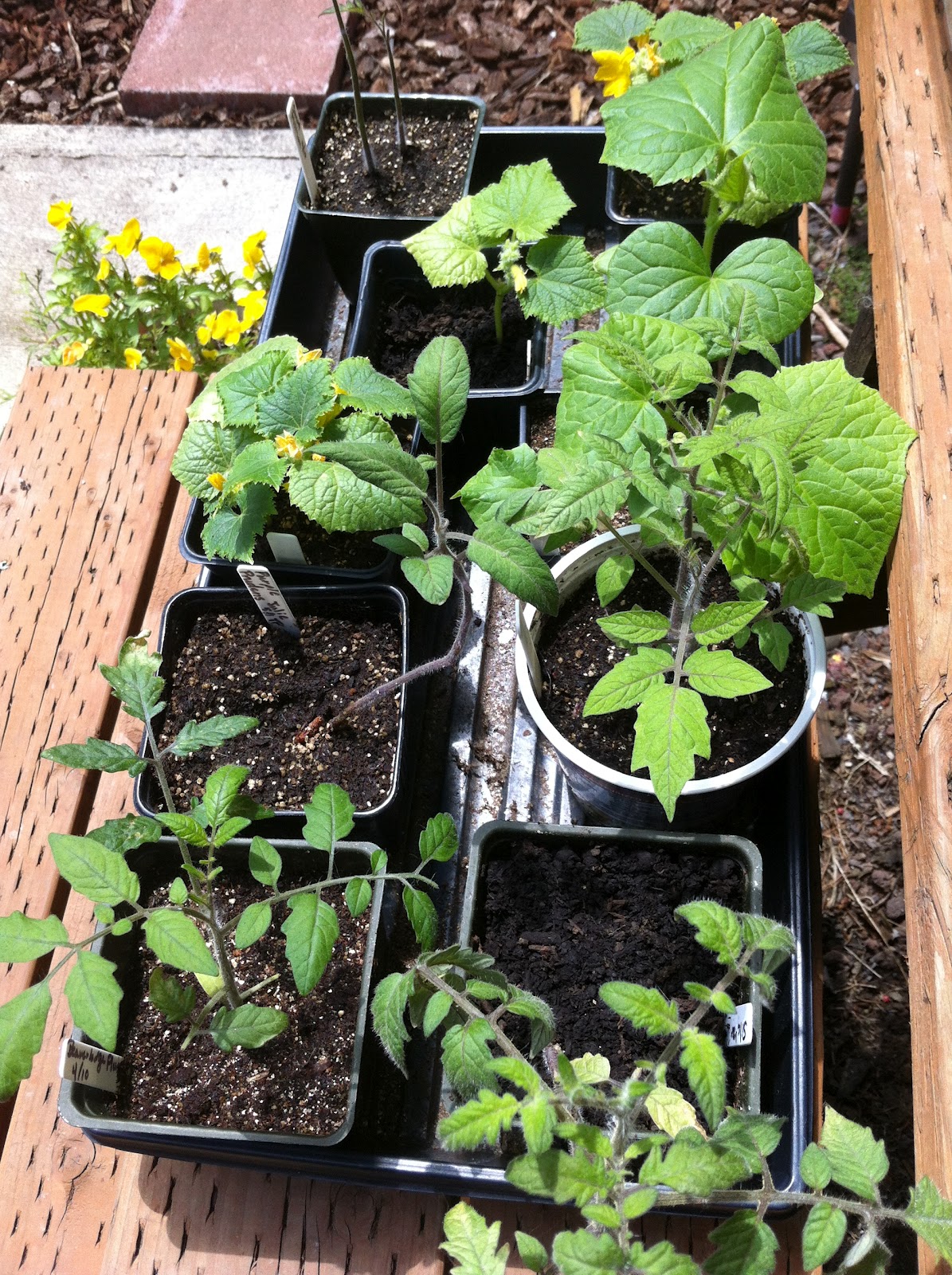
 All of this transplanting gave me a chance to see how the starts were doing in their pots.  Quite a few that were planted 2 to a pot were rootbound, so I divided them into the newly empty pots. 


Cucumbers and the largest tomato plants.
 Not long after posting about the health of my little plants, the tomatoes started having their leaves blacken and crisp up and then fall off.  I'm guessing it's some type of fungus; the grow room maintains a temperature between 68 and 82 degrees, but when it's hot and humid outside it becomes very humid in there.  So all of the plants got moved outside, for sunshine and cool nighttime temperatures.  I'm brewing some compost tea to spritz them with as well, and if that fails to improve things I'll try garlic water spritz too.  I'm hoping one thing or the other will help them to survive this.

Yellowing cucumber leaves.
 Strangely, all of my pickling cucumbers are still in good health but the Lemon and Marketmore 97 are having yellowing leaves and gray spots.  This always seems to happen to my cucumbers.  All the cucumber disease pictures online look pretty much the same though, so it's hard to tell what might be causing it.  I may take one of the plants to the Farmer's Market next weekend and ask the Extension Agents there if they can identify it.
Sweet Million afflicted by fungal disease.
 The Sweet Million was the hardest hit by the fungus, it has been transplanted into the garden now and I'm hoping it will perk up nicely.  At this rate I am beginning to doubt I'll even have tomatoes this year.

Cabbage head developing
 Meanwhile, in the garden proper, the cabbages are growing strong and have small but firm heads coming in.  The cauliflower are absolutely huge, but still show no signs of heading.

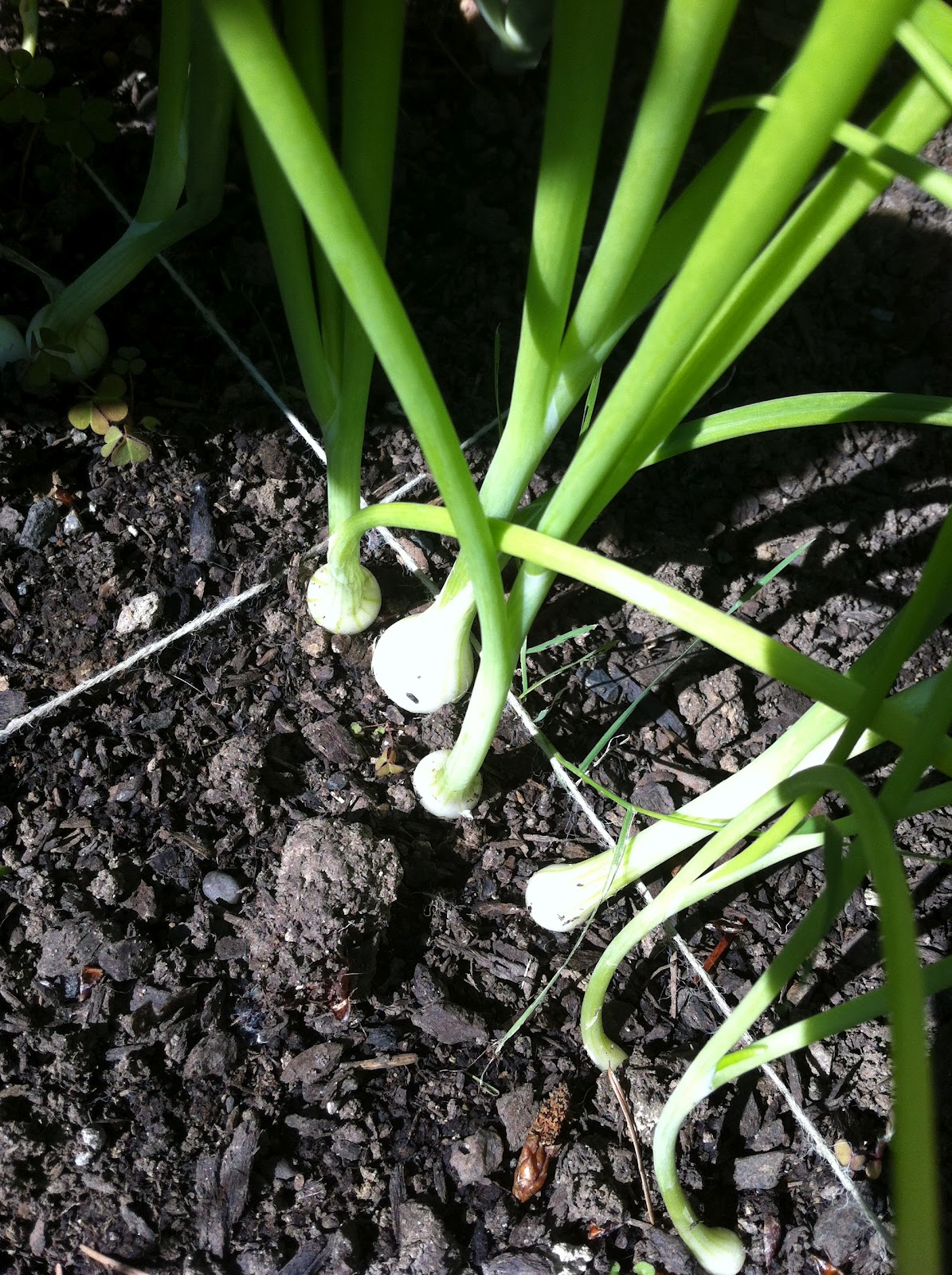
Pearl onions
 While the pearl onions are growing well and beginning to show their glossy white bulbs, the spanish white onions are not bulbing at all. 

Pea flowers!
 Finally the peas are flowering, they seem late to me, though it's probably just my imagination.

Zucchini
 My one and only zucchini is ridiculously healthy and putting out it's first male flower.  There are several female flowers on it as well but they are not quite ready to bloom.

Garden from the East side.  The thing above the fence is the butterfly bush.
All in all everything is doing well.  I'm concerned about the tomatoes, but I have faith that once they are planted they will recover well.  I am anxious to get them into the ground and be done with all this waiting.

Thursday, May 31, 2012

Flower Companions: The 411

There are so many elements to gardening that many of them get overlooked in the details of climate and pests and nutrition and plant selection.  One of the oft overlooked elements to gardening is the use of flowers in the food garden.  Whether your food garden consists solely of a rhubarb plant, or two blueberry bushes, or is an entire backyard teeming with vegetables and fruits from Artichoke to Zucchini; adding flowers to it will be worth your while.

Cosmos in bloom
The benefits of flowers in the garden:

-As food! 
-They are pretty
-Attract and provide food/homes for beneficials
-Repel pests, or trap crops
-Reduce weeding
-Reduce erosion
-Cut flowers
-Smell wonderful
-They are pretty!

The only reasons not to plant flowers are the costs; space constraints; or that you hate pretty things. ;)

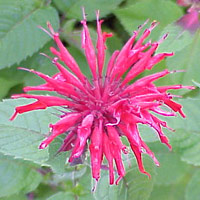
Bee balm or Monarda Didyma or wild bergamot attracts pollinators and makes a tasty tea as well.

So what are some good flower options for your garden?  Nearly any flower will do the job of attracting bees, but if you are looking for flowers that really pack a punch as far as benefiting the garden goes, I have listed a few common flowers below.

Marigold

Marigold:  Marigolds are one of the most commonly thought-of companion flowers.  They are said to deter some common insect pests, including nematodes; marigolds are often companion planted with nightshade plants (i.e. tomato, potato, pepper, and eggplant).  Some species are deer-, rabbit-, and rodent-resistant.  The flower petals African marigold (Tagetes erecta) can be used as a yellow food coloring.  Marigolds are a food plant for butterflies and certain Lepidoptera caterpillars. 
On the down side, marigolds do NOT smell particularly pleasant, and their roots emit antibacterial thiophenes so should never be planted near legume crops.

Potted nasturtium (center)

Nasturtium:  Nasturtiums are my favorite garden flower.  They grow as beautiful flowing carpets of green with bright yellow, orange, and red flowers.  They actually prefer to grow in poor soil; rich soil will give them abundant foliage but reduce flower production.  Nasturtiums make a great ground cover to keep down weeds in areas you are not ready to plant, or around bulbs that won't come up for a while.  They don't require much nutrition, have small root systems, self-sow year after year, and are very inexpensive seeds.  Most importantly, the leaves and flowers are edible (they have a mild peppery taste); and they repel a great many cucurbit pests, like squash bugs, cucumber beetles, and several caterpillars. They have similar benefits for brassica plants, especially broccoli and cauliflower. They serve as a trap crop against black fly aphids. They also attract beneficial predatory insects. 

Red Yarrow

Yarrow:  Yarrow flowers in a flat cluster of tiny white, yellow, or pink blossoms.  Yarrow has been used as a vegetable in the past, the younger leaves can be cooked similar to spinach or added to soups.  It has a sweet, slightly bitter flavor.  It has also been used medicinally as a tonic, and to treat wounds.  Pasture grasses traditionally contained a small proportion of yarrow, because it's leaves were particularly high in certain minerals, thus preventing certain mineral deficiencies in cattle.  It repels bad insects and attracts predatory wasps, ladybugs, and hoverflies.  It improves soil quality and its leaves are considered to be good fertilizer and a beneficial additive to compost.  It is said to improve the health of plants nearby, and starlings use it to line their nests (inhibiting the growth of parasites).  Common Yarrow can be invasive.  Wikipedia has some great information on the extensive history and uses for yarrow.


Sunflower:  Both a beautiful annual flower, and an edible; the sunflower's seeds and oil are eaten, while the leaves can be fed to livestock, and the stems can be used in papermaking.  The seed is often used in bird seed blends.  Sunflower is also used in phytoremediation to extract toxic ingredients from soil, such as lead, arsenic and uranium.  Sunflowers are allelopathic, meaning they inhibit other plant growth.  This can be a good thing!  Plant sunflowers in a sunny area that has major weed problems, or around the outskirts of your garden beds to protect from encroaching weeds.  Don't plant them inside the beds though, the roots exude a substance that will inhibit your plants' growth.  I am seriously considering growing them in my blackberry zone in hopes that they will kill off the remaining blackberries.


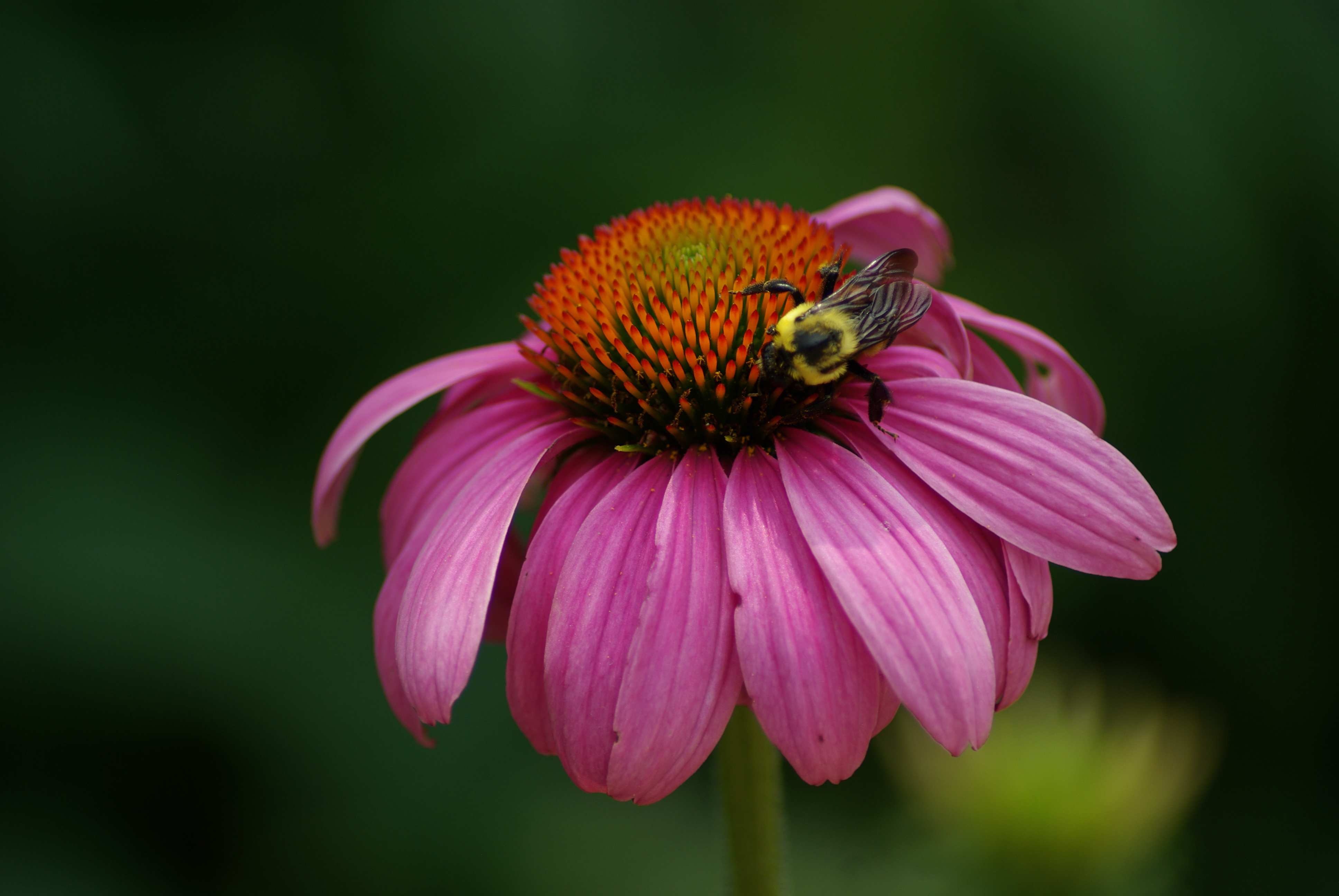
Coneflower (Echinacea):  Echinacea produces large, often purple, daisy-like flowers.  Medicinally it is used primarily as an immune booster, but also for several other purposes.  It also attracts beneficial insects to the garden.


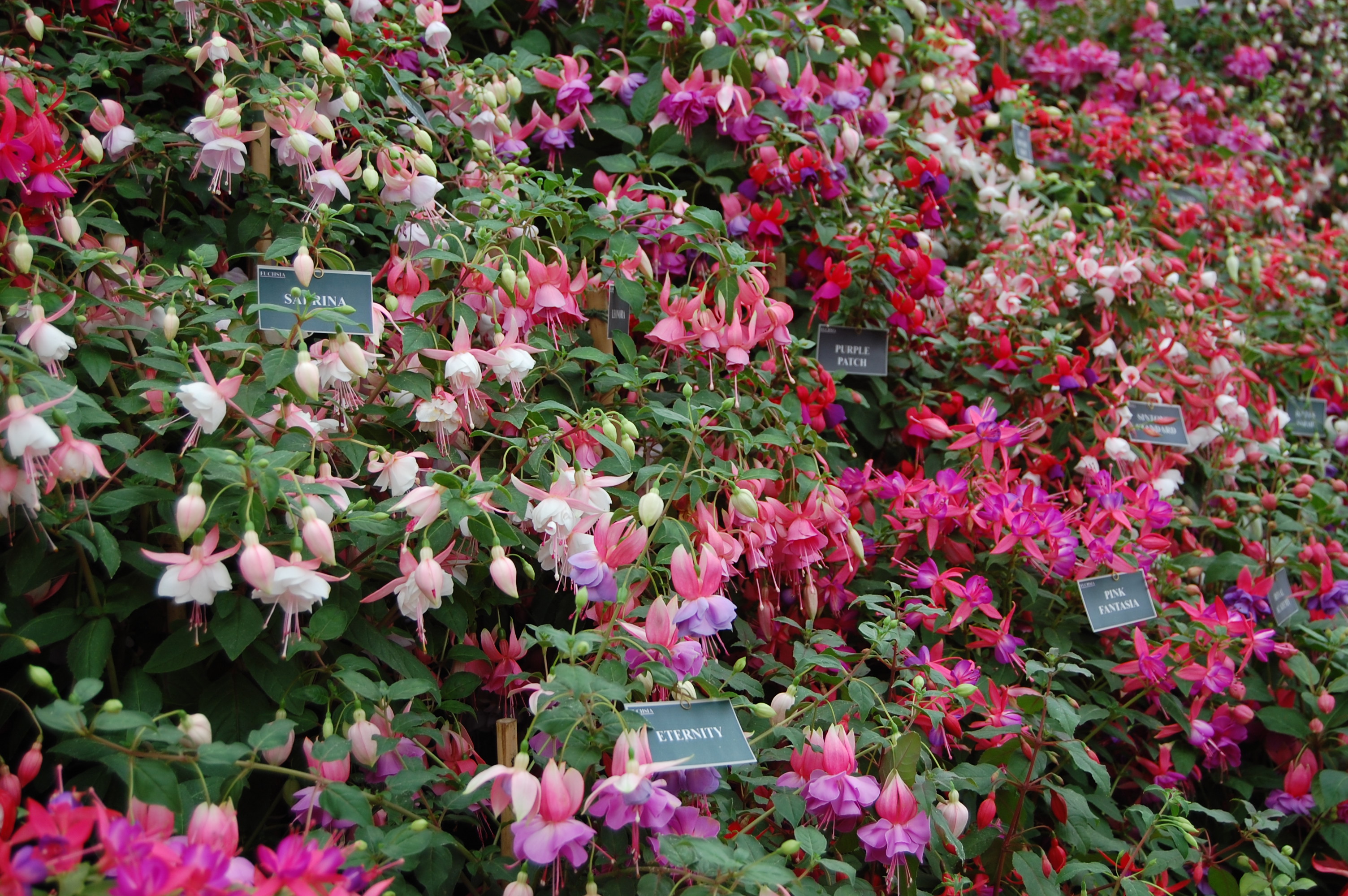
Fuchsia:  In my area fuchsia are commonly grown as trailing container plants, and annuals.  Fuchsia are actually perennial plants, though not especially hardy.  Besides being absolutely gorgeous, fuchsia are major attractors of butterflies, bees, and hummingbirds; they smell great, look better, and if you are going to plant them anyway you may as well do it near your vegetables.

Catmint:  Nepeta sp. include common catnip as well as several other catmints.  I'm sure most people know the purpose of planting catnip as far as cats go.  Catmints also produce very pretty flowers, and are used medicinally for humans.  It contains a chemical that is a strong repellant to mosquitoes, cockroaches, termites, and flies.  Planting it away from your vegetables can keep your cats out of the area, while planting it within the garden can repel certain insects.  While it is a perennial, if your cats are like mine you may need to buy multiple plants each season because they roll on it so often the whole plant dies.


Hollyhock (Alcea sp.)/Mallow (Althaea sp.):  Tall or short, gorgeous, biennial or short-lived perennials.  A beautiful cut flower and attractor of many beneficial species.  Hollyhocks will often self-sow and are very drought-resistant, they are a great way to brighten up a hot, dry corner of your garden.  Ancient peoples used the Althaea species in both medicines and cooking.  They are also considered one of the mainstays of a traditional cottage garden.


Morning Glory:  Not to be confused with Field Bindweed, a perennial species of Morning Glory that is a nasty weed!  Delicate flowers open in the morning and close in the evening, giving the morning glory its name.  It is a slender vining annual, that will quickly spiral its way up a trellis to offer shade to plants, animals or people below.  Morning Glory will happily cover up a chain link fence with a view of your neighbor's backyard and replace it with a view of green leaves and blue, pink, or white flowers.  The trumpet-like cones of the flowers are particularly attractive to hummingbirds and butterflies.


Rose:  Wondrously scented, beautifully flowered.  The hips and petals are edible; they have been used in cooking, perfumery, winemaking, as floral arrangements, and are a symbol of love and beauty.  A rose by any other name would smell as sweet... and would, obviously, attract plenty of pollinators.  But roses have so many pests and diseases, right?  Yes, and no.  Hybrid tea roses are very needy little things that do require much care (and are very commonly found), they have been developed over many years for the showiest blossoms, leaving the plants themselves weak and of poor quality.  The old garden roses, or heritage or historic roses, are far more independent.  They tend to have highly disease-resistant foliage.  Albas, Gallicas, Damasks, Centifolia, Moss, Portland, and China roses are all fairly safe older varieties of rose.  Also the Tea, Bourbon, Hybrid Rugosa, Noisette, Hybrid Musk, and Hybrid Perpetual.  Modern roses are more demanding and include the Hybrid Tea, Pernetianas or Hybrid Foetidas, Polyantha, Floribunda, etc.  Before purchasing a rose to include in your garden take time to do your homework, they are well worth the effort to plant, but if you buy based solely on the picture you may find they are too much work and too sickly to work for you.  (I did this once and was sorely disappointed by the sad sticks with even sadder single blossoms on top, I have since learned my lesson.)


Violet/Pansy/Johnny-Jump-Up/Heartsease:  Viola tricolor actually has over 200 colloquial names.  The wild variety has been cultivated into the many different sizes and colors of pansy we see in nurseries today.  The pansy in its wild form has been used for centuries as medicine, as a plant dye, and the flowers are edible.  They are hardy plants and will survive a short freeze even while blooming.  Pansies are actually biennials, but are often sold the second year and treated as annuals.  They may reseed themselves, but are susceptible to several diseases and a few pests.  They certainly do bring a bright spark of color to the garden early on though, and I can't imagine a Spring without them popping up all over.  The bonus is that pansies are not only pretty, but incredibly cheap!  They do suffer from aphids, but in my mind that makes them a great trap crop. ;)


So, I know I didn't cover all of the great flowers available and all of the great advantages they offer in the veggie garden, but I did cover most of my favorites!  If you have a favorite garden flower that you just couldn't live without, leave me a comment and tell me why it's so great.  (I probably should have included something about Cosmos and Bee Balm, ... but I'm tired!)


Wednesday, May 30, 2012

End Of May: Garden Update

I haven't posted in over a week, partly because I've had visitors coming and going, and partly because the garden hasn't done much in that week.  I harvested several more heads of lettuce, and some kale and chard that I sauteed up and threw in the freezer for another time.  There are still no ripe strawberries or peas and the anticipation of them is killing me.  I did pull enough lettuce to get my two earliest tomato plants into the garden finally, both are Oregon Spring and one is already flowering.  Sadly it also suffered a bit of sunburn during the hot days a few weeks ago.

Flowers on Oregon Spring tomato.
The garden as a whole is getting rather crowded.  Not so crowded that the plants are suffering, so I think my spacing is okay, but the carrots and onions are starting to get shoved aside by the cabbage leaves.  The good thing about spacing things so closely is that there's very little bare dirt, which reduces weeds, and the shade of the plants helps keep moisture in without needing mulch.  The bad thing is that sometimes your cabbage gets a little overzealous and completely smothers your carrots.

The garden is getting crowded.
 The broccoli are finally getting some heads on, I wish I had enough room to let them keep growing after the main heads are harvested, but I will likely get one large head each and then rip them out to make room for the tomatoes and peppers and cucumbers.

Broccoli head.  It had better get bigger than this!
 Despite the damage done by slugs, we are still swimming in lettuce.  Sadly, because there are no tomatoes and carrots and other such things, and I refuse to go buy them when we'll have some of our own soon... I have been struggling with making salads.  Plus, the lettuce are so pretty!  Especially the ruffly Red Sails next to Salad Bowl and the tall straight green of Valmaine.  All of these varieties ended up being delicious too.  I was very happy with my mixed lettuce seed, except that it was mixed so I couldn't control the proportion of each variety to each other.  I ended up with 2 Red Sails, 4 Salad Bowl/Slo-Bolt (I can't tell the difference!), 6 Valmaine, and like 20 Buttercrunch! 

Lettuces are too pretty to pull... just can't bring myself to do it yet.
 My little boy, Alex, has an amazing green thumb.  He was the one who planted the sunflowers last year that grew over 14 feet tall.  This year he planted some carrots in one of the whiskey barrels.  They are doing much better than mine, though I did have to thin them a bit.  Every day he goes out to check on his carrots and says "They are doin' good!"  He's so excited for them to get big enough to eat after all this waiting.

Alex's carrots.
 My brother informed me that it was way beyond time for me to fill up my potato buckets, so I scooped in more soil to a few inches below the tops of the plants.  I'm still kind of winging it on the potatoes, I just plan to keep them alive this year... I'll work on improving my harvest next time. 

Potato pots, potted kale and more lettuces in the whiskey barrel.
 The pumpkin bed is uncovered, and the beans are putting on their second set of leaves.  Soon enough the entire corner where the pumpkin bed is will be a wall of green, with piles of fresh green and purple beans coming in.
The pumpkin bed; pumpkins, zucchini, pole beans in back, and bush beans.
Finally, my stockpile of canned goods from last year has been reduced to 2 jars of applesauce, 1 bread and butter pickles, 1 pickle relish, 5 jars of strawberry jam, and 1 freezer jam.  Time for the last minute push to get things finished off before the restocking begins.  Guess we'll be eating a lot of PB&J in the next few weeks.  I made a total of 41 jars and frozen 1/2 pints of strawberry jam last year; I'm thinking that worked out to just about right.  Though this year I'll be doing more freezer jams and less canned, they are so much easier.

Soon enough the sun will be back full force and plant growth will take off again!  Can barely contain my excitement!

Friday, May 18, 2012

Cole-Ture

Brassicas, sometimes called cole crops or cruciferous vegetables, are a genus of plants in the Mustard family.  It is remarkable for containing more important agricultural and horticultural crops than any other genus.  Most Brassica species are annual or biennial.  The genus is native to Western Europe, the Mediterranean, and temperate Asia.

Some of the agricultural species of brassica today include: rutabaga, turnip, kohlrabi, cabbage, kale, broccoli, cauliflower, Brussels sprouts, mustard, cress, bok choy, and rapeseed (or, in the U.S., canola).

The brassicas provide high levels of nutrients, including Vitamin C, soluble fiber, and several anticancer agents.  To maximize the nutritional value of these plants avoid boiling them, and instead steam them for 3-4 minutes.

The ten most commonly eaten cruciferous vegetables are in a single species B. Oleracea, and only differ by cultivar.  Check out the Taxonomy Chart at Wikipedia to see just how closely related these plants are.

What follows is a brief description of the culture of the cole crops I am most familiar with:
Bolting broccoli

Broccoli was first introduced to the United States by Italian immigrants but did not become widely known until the 1920s.

Broccoli: broccoli is an annual, it will sprout from seed, grow, flower, and seed all within one year.  Like most of the popular cole crops, broccoli can be over-wintered in a sunny spot with a mild climate.  Light frost will not harm it, and in fact, too warm temperatures in Spring and Summer may cause it to bolt, going from dense green (or purple) heads to yellow flowers nearly overnight.  Once broccoli heads begin to flower they become very bitter.  Plants grow in an upright manner, unlike their cousins the cabbages.  Seeds can be started as early as December indoors, then planted outside once soil temperatures reach 50 degrees.  The earlier broccoli is transplanted, the better, as it will be more likely to produce large heads before the weather warms too much.  Broccoli can be planted as a Spring crop or direct seeded in summer for a Fall crop.  It prefers cool, moist soil; it is not susceptible to molds for the most part.  The primary scourges of broccoli, and most other cole crops  are slugs and cabbage moth caterpillars.  Removing plants after harvest can reduce the damage of caterpillars, as can row covers early in the season (preventing moths from laying eggs), and keeping plants indoors until they have at least two sets of true leaves will help with slugs.  Slugs
will eat holes in the leaves but if plants are large enough this is only cosmetic and won't affect the harvest.
Imported Cabbageworm, A.K.A. Cabbage moth larva.
 The best thing about broccoli is that it takes very little care, it is not disease prone, not particular about its soil (though it does best in Nitrogen high soil) and can be grown nearly all year in many climates.  The downside is that it tends to be hit or miss at harvest time, if you wait too long for the head to reach it's full size you may end up harvesting some very bitter broccoli that is ready to flower.  Also, once the main head is harvested many broccolis will put out side shoots; I have found though that unless I have an entire bed of broccoli these side shoots do not make a large enough harvest to be worth the wait and all the space they take up in the garden.

Cauliflower head.
The first reliable reference to cauliflower is found in the writings of Arab Muslim scientists between the 12th and 13th centuries.


Cauliflower:  cauliflower is similar to broccoli in many ways, it is annual, prefers cool weather, is mostly disease-free, and shares the same pests.  Cauliflower is usually planted early in Spring, or in the late summer for Fall harvest, along with its cousins broccoli and cabbage.  Cauliflower tends to be more picky about heat and drying out though, I have heard many a gardener bemoan the cracking and loss of their cauliflower heads after dry spells.  Planting early, even watering, or planting as a Fall crop are some ways to prevent this.  To keep your cauliflower pearly white, you should blanch it by wrapping the leaves over the head as it begins to develop.  Cauliflower most often is found as a tight packed white ball, but is also found in green, orange, and even purple.  Check out the different tastes of these variations at a local farmer's market and ask what the varieties are called so you can plan to plant your favorite in Fall, or next Spring.


Cato the Elder praised the cabbage for its medicinal properties, declaring that "It is the cabbage that surpasses all other vegetables."

Cabbage:  much like the previous two plants cabbage is grown in early Spring or late Summer.  It prefers cool weather, has no real disease problems, and few pests.  Cabbage however, is much less finicky when it comes time to harvest.  Primarily this is because cabbage is a biennial, it won't flower or go to seed until its second year of growth.  Because of this a head of cabbage can often be left for several weeks before it has to be harvested; it also means it is far less likely to split, and only extreme temperature or moisture changes will cause the head to split.  Cabbage requires no blanching either.  It is most commonly found as a solid green ball, but is also available in red or purple varieties, Chinese cabbage which is much looser leaved, and in all different sizes as well, from fist-sized to pumpkin-sized.  Cabbage heads are ready to be harvested when they are solid and hard to the touch.

In addition to this, cabbages are one of the prettiest plants to grow in my opinion.  I love the way their flat leaves open up into a massive rosette around the globe-like head.  The blue-tinged leaves sometimes take on a purple tinge as well, all in all they are very pretty.

In square foot gardening, broccoli, cauliflower, and cabbage each take one square foot to grow.  If you are selecting large varieties though it doesn't hurt to have nearby squares only half filled with smaller plants, such as 2 lettuce, or 4 peas.  Cabbage leaves especially are very wide and can cover up other plants next to them if they are too close.  One way to manage this is to grow cabbages in between slightly taller growing plants, the cabbage leaves can shade the roots of the taller varieties and in return they shade the cabbage a bit.

Saving seed from these crops can be a bit tricky, since the cultivated brassicas are so closely related they can easily cross-pollinate.  A 3-4 year rotation of seed saving can help with this: Year 1, save broccoli seed, not allowing other annual brassicas to flower; Year 2, save cabbage seed from biennial cabbage planted the previous year, not allowing other brassicas to flower; Year 3, save seed from cauliflower, don't allow others to flower; Year 4, repeat with another biennial, or annual brassica.  Since brassica seeds stay viable for 3 years this is a good rotation to follow, any more years would leave you with very old seed that may not germinate from your first year.  If you have more than four brassica cultivars you will either have to resort to trading for or buying seed, or put plenty of space between your cultivars.  There are other ways to manage this, including bagging, spacing farther apart, etc. but this is probably the simplest.  No extra steps but harvesting everything you don't want seed from before it blooms.

A final note on these crops: although we normally eat only the heads of these three plants, the outer leaves and stems are edible as well.  If you find yourself a bit short on cabbage for a recipe you can add cauliflower leaves, outer cabbage leaves, and broccoli leaves and stems (so long as they haven't become woody and tough) to fill in.

I think that's all I have for these crops, I will post some of my favorite recipes for them soon as well.  If you have any other tips or tricks about cole culture to share please leave a comment!


The Lettuce is Out Of Control

Just a quick update, the lettuce has grown so much, so fast, that I fear we will be eating so much salad in the next few weeks that it will start coming out of our ears.  Since my mom is in California visiting friends I can't even give some to her to stifle the avalanche.  We are expecting some last minute cool weather next week, so I am hoping it will give me time to use that lettuce before it starts to bolt.  I'm planning to leave at least one plant in for seed, but haven't yet decided if it will be the Valmaine, Red Sails, or SloBolt.  Those three have been my favorites of the mix I planted.  Valmaine did the best and I have the most of it, so I am thinking that since Red Sails seemed to be in the smallest proportion it is likely the best to save seed from. 

Note to Self: just spring for the individual packs of seed next year, seed mixes are kind of a pain.  As in, more than half the seeds ended up being Buttercrunch, and I can't specifically plant more of a different type because I can't tell from the seed what it will come up as.  And I still don't know if the green leaf is Salad Bowl or SloBolt because they are identical plants!

I'm still waiting on the strawberries, and the peas are getting tall, but haven't flowered yet.  Harvest total is at 1 lb. 10 ozs. today, after picking more lettuce and thinning the celery down (the tiny celery thinnings went into the stock bag).

I think it's about time for another informational post as well.  Maybe a culture post, or a recipe post... Not sure what I feel like doing yet.

Tuesday, May 15, 2012

Always Late to the Party

Many other garden bloggers take part in Harvest Monday, hosted by Daphne's Dandelions, but I tend to forget to post that sort of thing.  So since I am posting about my harvests I thought I'd give Daphne a nod, even though it's actually Tuesday.

Kale, chard, and onions


Ta-Dah!  Ok, so it's not much... the onions needed thinned so I pulled the small ones and those that were a bit too close, then snipped off the largest of the kale and chard leaves.  They were fabulous in quiche last night.  Total weight for this harvest was 1.5 ozs.  Total weight harvested for 2012: 15 ozs.

Not to worry though, most of that was lettuce, which may as well be weightless.  Once the peas and strawberries start coming in the pounds will start adding up!

Wednesday, May 9, 2012

Finally, It Looks Like a Garden!

 Can definitely tell the difference between the phone camera and the good camera.  Bunch of shots of the garden after nearly a week of gorgeous weather, the sun really helped get things moving along.

Kale


Artichokes and cilantro

Alex's carrots.  He checks on them regularly to see if they're ready yet. :)

Broccoli.

Leaf lettuce

Romaine lettuce

The tulips are done, but the pansies are taking over.

Oregon Spring tomato just waiting for an opening in the garden beds.

Swiss chard is finally starting to grow at a decent pace.

Potato plant, 3 of the 5 I planted are growing well.  The other two never did anything.
The first bed is really starting to look like a garden now, but the second one has some catching up to do still.


Raised bed 1.
Raised bed 2.

Hot weather starts enjoying some sunshine.

New whiskey barrel (#3) with perennials and bulbs planted.

Strawberry bed, flowering and doing great, but I really need to weed the path next to it.
That's how my garden's growing today, not long now till there will be peas, lettuce, kale, and strawberries coming in on a daily basis.  Over the next few days I plan to make some adjustments to my watering system, and have my brother help me with some work in the front and back yards.