Showing posts with label cilantro. Show all posts

Friday, August 3, 2012

Woohoo! First Tomato of the Year

In all its glory...
 Picked my first ripe tomato today, it's the Oregon Spring one that's been hanging around for over a month.  In a normal year the first tomato would be picked in mid- to late June.  This has not been a normal year.  On the plus side it weighed in at 7.5 ounces.  Also the two volunteer cherry tomatoes I left in the ground still haven't ripened anything, so I don't think my late planting really affected the other tomatoes; they are right on par with their volunteer cousins.  It would seem that the weather alone has been responsible for the tomato tardiness. 

Tomato and the first two pickling cucumbers.
 The pickling cucumbers are finally beginning to produce, not a lot so far.  I have a dozen plants, but if they don't start doing better i will never have enough cukes at once to pickle.  The slicing cucumber is cranking out fruit faster than they can ripen, I'm guessing I'll have about 3 cukes ready to pick tomorrow and more a few days after that.

I didn't take a photo of the onions i pulled earlier this week, nor did I weigh them, they are curing in the laundry room/grow room/pantry and once cured they will be weighed in and photographed.  I only pulled the ones with good sized bulbs and developed skins, which accounted for about a quarter of what was planted.

Herbs (this basket holds about 2 gallons)
Also, above is the photo of the herbs I trimmed the other day.  Most of this is rosemary, which is buried under the thyme, sage, spearmint, and lavender.  The oregano wasn't big enough for trimming yet, and the cats have mauled the catnip too much to harvest.  All of these herbs were lightly rinsed (to remove spiders and dust), blotted dry, bundled, tied up, and hung to dry.  Once they are crispy i will strip them from their stems, crumble them a bit, then mix up seasonings or bag and freeze them, or fill my nearly empty spice jars with them.  I am a bit disappointed the oregano didn't grow more, I was hoping not to have to buy it for making Italian Seasoning Mix.  The mint and lavender will likely be saved for potpourri or teas, since I don't do much cooking with them.

The one other major thing I did was pull a few problem plants: the last celery that I left to flower for the beneficial bugs, the cilantro (it had long ago gone to flower and was seriously shading out the rhubarb and some peppers) and the dill that was completely infested with aphids and ladybugs.  I let the dill stay in the garden long enough for the ladybug eggs to hatch, and the nymphs to grow into adults, but they were failing at eating enough aphids fast enough so I moved them onto other plants and tossed the buggy dill.  I'm disappointed that I lost the dill before the cucumbers were ready for harvest though, i had hoped to use my own dill for pickling.  The nasturtiums have done their job of black-fly-aphid-traps so well that the aphids are killing them and moving onto other plants nearby, so I pulled a few of the most infested nasturtiums and left the others to continue their work.  Hopefully the aphids will stay out of the other plants again and move into the healthy nasturtiums.


Thursday, April 26, 2012

The Need For Speed

One of the conundrums new gardeners face each year is when to plant each type of seed.  The seed packs always say 4-6 weeks before/after last frost date or something similar, but that's not all that helpful most of the time.  They also sometimes say what temperature the soil should be for germination, which is nice for outdoor planting, but doesn't really matter for things you start inside.  More important is the question of how fast the seeds will sprout and grow before you run out of room for them and are forced to put them outside?  And how slow will they grow?  Will you run out of summer before they are big enough to go outside?

So here's a quick list of the crops I've grown and their growing speed to give you an idea what should be planted super early, what can wait a bit and what will outgrow your indoor space before the weather warms.

Fastest to slowest:
-lettuce
-spinach
-squashes (summer and winter)
-radish
-brassicas
-melons
-peas
-beans
-tomatoes
-Swiss chard
-peppers
-carrots
-basil
-onion family (from seed, not set)
-herbs
-eggplant
-celery

I haven't grown corn yet, so have no idea how quickly it grows, but this should give an idea that you would not want to start celery and lettuce together in early Spring for a harvest at the same time.  In fact, celery is the slowest growing vegetable I've planted, which is why I usually buy it as a start.  I could plant celery in January and it still might be too small to go outside in April.  At the same time it would be pointless to plant zucchini seeds (summer squash) inside in February when it will outgrow your space by April and (here, in Oregon) can't be planted outside until the rains slow down in May.  I've lost many cucurbits to powdery mildew and no longer take any chances, plus since they grow so quickly I have plenty of time for a good harvest even after waiting out the rains.

Tomatoes are much faster growers than peppers or eggplants, if you plan to transplant all three together once the weather is warm enough you'll have to plant your eggplants, wait a week, plant the peppers, wait two more weeks and then start the tomatoes.  Otherwise your tomatoes will be far too large to keep under grow lights before the rest have a chance to catch up, especially if you have failed germination and have to replant something.

Point in case:  One row of my garden bed right now has lettuces and swiss chard that were planted inside the same day, cared for the same, and transplanted the same day as well; it also has peas that were planted outside the day the others were transplanted.  Today this row has lettuce that's nearly ready to harvest, peas that are about 6" tall, and Swiss chard that is still little more than a sprout with it's first true leaves.  I transplanted all of this on March 26th, then started some tomatoes on April 10th.  The tomatoes are already putting on their second set of true leaves, and are far ahead of the chard despite being planted 2 weeks after the chard went outside.

I hope this post is helpful in determining planting dates, and good luck with the gardens everyone!


Friday, February 24, 2012

The Costs of an Early Start

Growing seasons differ across the country.  A lucky friend of mine just sent me a picture of the lemon and orange trees in her yard that are in full fruit right now, living in southern California makes a big difference I suppose.  The weather here is still touching on freezing overnight and with as mild as the winter was it would not be remiss to expect it to keep going this way for another month or even two.

I recently picked up an indoor/outdoor thermometer with min/max capabilities to keep an eye on how much the temperature in my tiny greenhouse is changing.  In the past week the minimum temperature inside the greenhouse was 33 degrees, and the maximum was 96.  Unless one of the kids slapped the thermometer with a hot potato when I wasn't looking, that means there was a more than 60 degree change in temperature just within the week.  Too cold for winter veggies and too hot for them too.  I definitely need a better greenhouse system, but I'm unwilling to invest in one since I have such limited space.  Instead the greenhouse will be used solely for hardening off, opening it up during the day and closing it on cooler nights to keep the temps from going out of control.

This has left me in need of a space to get my winter veggies started.  My brother, may his awesomeness reign forever, has agreed to start my hot weather plants for me again this year.  I plan to attempt starting the cold weather plants myself though.  With that in mind I decided to build a "grow room"... er, shelf inside.

People give you a lot of strange looks when you mention that you are building a grow room, it seems the phrasing just makes them think of growing marijuana, but in actuality it makes good sense (cents?).  Starts from a nursery are often limited to the most common varieties, and by what is in stock.  Each start you buy ranges in price from .99 to $5.00 (for gallons).  But if you have a grow room and some seeds you can effectively pay far less in the long run and have better quality plants of more varieties.  If you save your own seed it cuts the cost even further.

So let's talk about the costs of a grow room.  For cool weather plants the costs are lower than for hot weather plants, primarily because you don't have to heat them as much.  Start with a shelf, or shelves, or a tabletop, or a windowsill, anywhere you can find room to set one or more trays of pots, hang a light over it, and keep it away from things or people that could cause trouble.  You will need lighting, if it's a completely enclosed space you'll need ventilation, if it's outside of the house or you will grow hot weather plants longer than a few weeks you'll need a heat source you can monitor and adjust.  You also need trays, pots, potting soil, seeds, water, and a power source for the heat/lights/ventilation.

For example, my "grow room" will actually be a few shelves in my laundry room.  The furnace and back door are in there, and it is generally left open to the rest of the house so ventilation and heat should not be an issue.  There is a power source (the outlet the washer is plugged into) to run the lights, though I will need a power strip to use more than one light at a time.  Currently I have a small metal shelving unit in there which holds the overflow of my Costco shopping trips that won't fit in the kitchen.  My plan is to replace this with a 4 tier shelf that is wider and taller.  It will still hold my overstock goods in the bottom two shelves, but the upper two will be outfitted with lights and house my starts.

Costs:
36" wide 4 tier shelves:  $60
Power strip:  $20
2' wide single bulb flourescent light fixtures:  $10 each
2' long flourescent light bulbs (daylight or plant and aquarium):  $8 each
Plastic seedling trays:  $2 each
Organic seedling potting mix (small bag): $5 each
Aluminum foil: $5
Newspaper/reusable old pots/phone book:  $0
Cardboard:  $0

Depending on how many plants you plan to start it should have an initial cost of about $150 or more.  Nearly half the cost is just the shelving unit, which is totally reusable year after year and can be used for storage between growing seasons.  The other big cost is the power strip and it can also be used year after year, or used for other things when it's not needed for the plants.  The light fixtures and plastic trays should last you a few years too.

The things that need replacing each year are the potting mix, aluminum foil, cardboard and pots.  But cardboard is free from any recycling bin, aluminum foil is inexpensive, potting mix can be made in bulk, and pots can be made of free recycling items too.

So, to make the cost comparison, let's say you are planning to grow cabbage, broccoli, kale, onions, and carrots.  About 70 plants total.  To buy these plants already started you'd pay about $2 each for four packs of the larger veggies or 6 packs of the smaller ones.  For this price you get the smallest starts, basically a stem with its first set of true leaves.  If you want 40 of the large veggies it will cost $20 and let's say about another $10 for 30 of the smaller ones.  So you spent $30 on starts.  Not so bad really, in fact, I know I usually spend more than this... maybe I underestimated the cost.  But no matter.  4" potted starts will cost you up to twice as much for one plant.

The first year of building a grow room you will have spent $150 on the setup alone, and about $7.00 for the same five types of plants.  The difference is that a packet of kale seeds contains around 50 seeds, carrot packets contain closer to 100 or more.  So instead of 70 plants you have the ability to grow 250 plants.  You can grow spares and sell them, or trade them to other gardeners, or share with friends or family.  Or you can save all that extra seed for the next year and save yourself the seed costs.  Obviously there is no savings the first year, but the second year you only have to pay... well, nothing if you make your own potting soil from your own compost, about $5-$15 if you buy it, depending on how much you need.  And so on, for many years.  Light bulbs will need to be replaced every few years, and undoubtedly your plastic trays will eventually need replacing, but for the most part the grow room will be low maintenance and save you money in the end.

Considering I spend $150 on seeds alone, of nearly 40 different plants, if the grow room will allow me to improve their survival rate and possibly even turn a few starts into cash by selling them to neighbors or my mom at a discount I will be happy with the investment.  Two shelves of grow space alone should provide all of my cool season crops adequate room, and it could also be enough space for the hot season plants if needed (after the cool plants were moved outside).  Imagine how much you could grow in a whole room!

The other big bonus to creating your own grow room is getting ahead of the game on planting times.  In the Willamette Valley a gardener has between April 15th and October 1st to do all of their growing.  Just over 5 months.  If it takes a cabbage 60 days to reach maturity and a tomato 80 days... there just isn't enough time to plant one from seed and then follow it with the other from seed.  Working in a small space you can really increase your returns by planting the same area twice, or even three times, in one season.  With a grow room I can start my cabbages inside a month earlier than I could outside, while the soil is still too cold for germination.  They can grow larger under optimum conditions before being put outside, then finish their growth in the garden where they will have plenty of room.  This means that I should be able to have the cool weather crops (or at least most of them) harvested and pulled out in time for the hot weather plantings to go in at the beginning of June.  Then I can even start a fall crop in August when the determinate tomatoes have finished producing and the basil is harvested, leaving the longer season tomatoes to finish off before it gets cold again.

Lastly, I can use my grow space over the winter to grow entire plants for fresh eating indoors.  Spinach, lettuce, green onion, annual herbs like cilantro and basil, all of these can grow indoors over the winter.  They won't outgrow their space and can easily be harvested as needed without sacrificing the entire plant.  Inside a house they shouldn't even need extra heat to stay healthy.

P.S. I almost forgot to explain the purpose of the foil, cardboard and newspaper etc.  Backing and/or siding your shelves with a reflective surface (i.e. aluminum foil wrapped over cardboard for stability) will help keep the light and heat focused inward toward the plants and can make a big difference in plant health.  Newspaper or phone book pages make excellent paper pots, or you can reuse any old start containers from previous years, just be sure to wash them well with soapy water.  I've found that newspaper origami pots are about a 4" pot, while phone book pages make a pot closer to the size of a 2" peat pot.  Yellowbook phone books are totally recyclable and have soy based inks that won't contaminate your soil, check online to see if your phone book is made with soy based inks.  If not, stick to newspaper, which is always made with non-toxic inks.

Next time... When the Men Are Away, the Women Will... Build a Grow Room?
In which my daughter and I put together our grow room, start seeds, and then wait for my husband to notice it when he gets home.


Monday, February 20, 2012

A Bit About Bugs

While doing some weeding of the garden beds in preparation for my first spring plantings I came across some bugs (well grubs) of an unknown type.  By the way, this is a great time to pull up any dandelions, dock and other taproot weeds since the soil is still very soft and moist; it's more likely you will get the entire root out rather than have it break off and re-sprout.  The grubs I found were gray or dirty white with dark heads, I also found a green grub or caterpillar that was hanging around in the weeds.  I have no idea what they are, after some internet investigations the best answer I could find was cutworms.  Since I'm not certain of this I tossed them over the fence into the empty lot.  If they are harmful at least they are out of the garden, if not, I wish them the best in their new home.
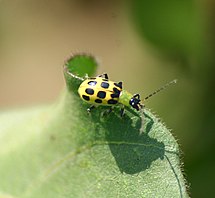
I am considering picking up some beneficial nematodes to help manage soil dwelling pests.  One reason for this is that I spotted two cucumber beetles at the end of last summer, bright beautiful little green ladybug-like beetles with 12 black spots.  While they are very pretty, these beetles are a real problem in the garden.  They eat just about any vegetable they can get to, then lay eggs in the soil, when larva hatch they too will feast on vegetables and they spread bacterial wilt and squash mosaic virus.

Spotted cucumber beetle


Cucumber beetles also have a striped species that looks similar but the spots are instead stripes that run from the head to the rear.  These guys are a real danger to a garden.  Unfortunately they are also a challenge to be rid of.  Parasitic wasps can be helpful, if you don't know how to get these, try planting flowers that will attract them to the garden.  Tiny nectar-filled flowers such as thyme, savory, dill, cilantro, parsley, yarrow, candytuft, verbena, sweet allysum and goldenrod.  If you spot caterpillars or other pest bugs with tiny white sacs attached to them leave them alone!  The sacs are the cocoons of parasitic wasps and the pests will die when they emerge, spawning a new generation of pest killers.  Another cucumber beetle predator is the soldier bug, "leather"-backed firefly-like bugs that can eat up to 100 bugs a day.  Soldier beetles are attracted to pollen and nectar filled flowers and particularly like hydrangea, goldenrod and milkweed.  Tachinid flies are also effective at managing beetle populations, and are another type of parasitoid.  Tachinids are not as preferential as other biological controls and will just as likely parasitize butterfly caterpillars.  Having a large garden variety will help to attract these pest managers.

Beneficial nematodes are microscopic roundworms that live in soil and prey on soil dwelling insects.  They are effective controls of fleas, ants, termites, roaches, flies, grubs; yet they are harmless to humans, pets, and our soil-dwelling friends the earthworms.  You can try to attract nematodes to the garden by adding plenty of compost and having rich organic soil, but this is a grab bag; you could just as easily attract pest nematodes.  It may be wiser to purchase a small package of beneficial nematodes to spread through your garden instead.

Since I live in a mobile home park that was built over an orchard in the 60s, I suspect this area was heavily treated with pesticides in the past and the likelihood of it supporting its own nematode population is fairly slim.  So I will most likely purchase them from a supplier and sow them in and around my garden and yard.  Ants are a major issue in our area, and I imagine if we had a natural nematode population that would not be the case. 

I also plan to sow a package of "Beneficial Bug Mix" flowers in the empty lot next door.  My garden lacks space to add a lot of these plants but I can at least use them to attract beneficials to the vicinity of the garden itself. 
If you plan to attract beneficials to your garden to help with pest management, you should keep a few things in mind:

-Don't spray! Insecticides will kill your beneficials, birds that eat pests, and the pests.  Let the birds and bugs do their jobs and handle the pests for you.

-Identify before you destroy.  It does you no good to attract ladybugs to your garden and then kill their nymphs because you thought they were pests.  Take time to identify bugs, if you can't then move them out of the garden and hope for the best.

-Provide what they need.  Food and shelter in the form of flowering plants, and water.  Your bugs need to drink too.

-Putting out a suet block or feeder of quality untreated bird seed will attract a variety of birds to your garden, many of which also eat pests.  You may find you have a lot of millet to pull up later in the year though.  You can also grow sunflowers and save the seed each year to offer the birds.

The garden is an environment all its own, keeping a balance between flowers and food, pests and beneficials will allow it to transform into its own natural environment that maintains its own balance rather than needing constant interventions. 


Friday, January 20, 2012

Bolting is Bogus

Have you ever planted lettuce, or spinach, or cilantro alongside tomatoes in excitement over the lovely salads and tasty Mexican dishes you plan to make when they are ready only to find the lettuce/spinach/cilantro bolts and begins setting seed in early June? While your lovely tomatoes are nothing more than tiny green marbles?

Bolting is what happens when a leafy plant shoots up a center stalk and blossoms in order to make seed.  If this is a common occurrence in your garden you can try a few things to prevent it. 
First, look for slow bolt or heat tolerant/heat resistant varieties of these plants. These varieties are less likely to begin bolting when temperatures jump up for a short time.  Second, try planting these crops in a partially shaded corner of your garden, or even fully shaded.  Diffuse light is enough for these plants and they can manage just fine getting the second hand light reflecting off neighboring sunny areas or through a cloud cover while being protected during the hottest part of the day.  Another option is to plant them to the East of a shrub, tall plant, or tree, they will have full sun early in the day, but be shaded after noon to keep them cooler.  Lastly, you can try covering them with a shade cloth during the hottest days; this is an option many garden books suggest, but I find it the least practical option since it requires much more attention on the gardener's part. 
In the event your leafy plants do bolt, don't panic too much.  Plant a few more, or grow some lettuce and cilantro on a window sill inside the air conditioned house.  Or just make the most of what you've got and harvest the dry seed for next year.  Cilantro seed is called coriander and is an excellent spice in it's own right, so you can plant it or add it to your spice rack.
Lettuces will cross-pollinate with impunity, as will spinach.  This means that if you plant several different types of these plants and they flower at the same time you will likely get seed that is the offspring of the two parents rather than a clone of the original plant.  You may end up with a fabulous new variety of lettuce or spinach all your own; of course the flip side of that is that you may end up with seed that grows less tasty plants that are not worth growing.  It's a gamble, but these plants grow quickly and it's worth it to try planting your own seeds and see what you get.  If you find a favorite new cross you can remove the others before they flower and just let that variety flower to make more seed of that type.