Showing posts with label mint. Show all posts

Friday, August 3, 2012

Woohoo! First Tomato of the Year

In all its glory...
 Picked my first ripe tomato today, it's the Oregon Spring one that's been hanging around for over a month.  In a normal year the first tomato would be picked in mid- to late June.  This has not been a normal year.  On the plus side it weighed in at 7.5 ounces.  Also the two volunteer cherry tomatoes I left in the ground still haven't ripened anything, so I don't think my late planting really affected the other tomatoes; they are right on par with their volunteer cousins.  It would seem that the weather alone has been responsible for the tomato tardiness. 

Tomato and the first two pickling cucumbers.
 The pickling cucumbers are finally beginning to produce, not a lot so far.  I have a dozen plants, but if they don't start doing better i will never have enough cukes at once to pickle.  The slicing cucumber is cranking out fruit faster than they can ripen, I'm guessing I'll have about 3 cukes ready to pick tomorrow and more a few days after that.

I didn't take a photo of the onions i pulled earlier this week, nor did I weigh them, they are curing in the laundry room/grow room/pantry and once cured they will be weighed in and photographed.  I only pulled the ones with good sized bulbs and developed skins, which accounted for about a quarter of what was planted.

Herbs (this basket holds about 2 gallons)
Also, above is the photo of the herbs I trimmed the other day.  Most of this is rosemary, which is buried under the thyme, sage, spearmint, and lavender.  The oregano wasn't big enough for trimming yet, and the cats have mauled the catnip too much to harvest.  All of these herbs were lightly rinsed (to remove spiders and dust), blotted dry, bundled, tied up, and hung to dry.  Once they are crispy i will strip them from their stems, crumble them a bit, then mix up seasonings or bag and freeze them, or fill my nearly empty spice jars with them.  I am a bit disappointed the oregano didn't grow more, I was hoping not to have to buy it for making Italian Seasoning Mix.  The mint and lavender will likely be saved for potpourri or teas, since I don't do much cooking with them.

The one other major thing I did was pull a few problem plants: the last celery that I left to flower for the beneficial bugs, the cilantro (it had long ago gone to flower and was seriously shading out the rhubarb and some peppers) and the dill that was completely infested with aphids and ladybugs.  I let the dill stay in the garden long enough for the ladybug eggs to hatch, and the nymphs to grow into adults, but they were failing at eating enough aphids fast enough so I moved them onto other plants and tossed the buggy dill.  I'm disappointed that I lost the dill before the cucumbers were ready for harvest though, i had hoped to use my own dill for pickling.  The nasturtiums have done their job of black-fly-aphid-traps so well that the aphids are killing them and moving onto other plants nearby, so I pulled a few of the most infested nasturtiums and left the others to continue their work.  Hopefully the aphids will stay out of the other plants again and move into the healthy nasturtiums.


Monday, February 20, 2012

A Bit About Bugs

While doing some weeding of the garden beds in preparation for my first spring plantings I came across some bugs (well grubs) of an unknown type.  By the way, this is a great time to pull up any dandelions, dock and other taproot weeds since the soil is still very soft and moist; it's more likely you will get the entire root out rather than have it break off and re-sprout.  The grubs I found were gray or dirty white with dark heads, I also found a green grub or caterpillar that was hanging around in the weeds.  I have no idea what they are, after some internet investigations the best answer I could find was cutworms.  Since I'm not certain of this I tossed them over the fence into the empty lot.  If they are harmful at least they are out of the garden, if not, I wish them the best in their new home.
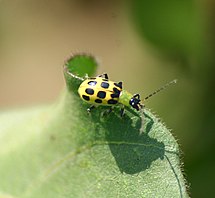
I am considering picking up some beneficial nematodes to help manage soil dwelling pests.  One reason for this is that I spotted two cucumber beetles at the end of last summer, bright beautiful little green ladybug-like beetles with 12 black spots.  While they are very pretty, these beetles are a real problem in the garden.  They eat just about any vegetable they can get to, then lay eggs in the soil, when larva hatch they too will feast on vegetables and they spread bacterial wilt and squash mosaic virus.

Spotted cucumber beetle


Cucumber beetles also have a striped species that looks similar but the spots are instead stripes that run from the head to the rear.  These guys are a real danger to a garden.  Unfortunately they are also a challenge to be rid of.  Parasitic wasps can be helpful, if you don't know how to get these, try planting flowers that will attract them to the garden.  Tiny nectar-filled flowers such as thyme, savory, dill, cilantro, parsley, yarrow, candytuft, verbena, sweet allysum and goldenrod.  If you spot caterpillars or other pest bugs with tiny white sacs attached to them leave them alone!  The sacs are the cocoons of parasitic wasps and the pests will die when they emerge, spawning a new generation of pest killers.  Another cucumber beetle predator is the soldier bug, "leather"-backed firefly-like bugs that can eat up to 100 bugs a day.  Soldier beetles are attracted to pollen and nectar filled flowers and particularly like hydrangea, goldenrod and milkweed.  Tachinid flies are also effective at managing beetle populations, and are another type of parasitoid.  Tachinids are not as preferential as other biological controls and will just as likely parasitize butterfly caterpillars.  Having a large garden variety will help to attract these pest managers.

Beneficial nematodes are microscopic roundworms that live in soil and prey on soil dwelling insects.  They are effective controls of fleas, ants, termites, roaches, flies, grubs; yet they are harmless to humans, pets, and our soil-dwelling friends the earthworms.  You can try to attract nematodes to the garden by adding plenty of compost and having rich organic soil, but this is a grab bag; you could just as easily attract pest nematodes.  It may be wiser to purchase a small package of beneficial nematodes to spread through your garden instead.

Since I live in a mobile home park that was built over an orchard in the 60s, I suspect this area was heavily treated with pesticides in the past and the likelihood of it supporting its own nematode population is fairly slim.  So I will most likely purchase them from a supplier and sow them in and around my garden and yard.  Ants are a major issue in our area, and I imagine if we had a natural nematode population that would not be the case. 

I also plan to sow a package of "Beneficial Bug Mix" flowers in the empty lot next door.  My garden lacks space to add a lot of these plants but I can at least use them to attract beneficials to the vicinity of the garden itself. 
If you plan to attract beneficials to your garden to help with pest management, you should keep a few things in mind:

-Don't spray! Insecticides will kill your beneficials, birds that eat pests, and the pests.  Let the birds and bugs do their jobs and handle the pests for you.

-Identify before you destroy.  It does you no good to attract ladybugs to your garden and then kill their nymphs because you thought they were pests.  Take time to identify bugs, if you can't then move them out of the garden and hope for the best.

-Provide what they need.  Food and shelter in the form of flowering plants, and water.  Your bugs need to drink too.

-Putting out a suet block or feeder of quality untreated bird seed will attract a variety of birds to your garden, many of which also eat pests.  You may find you have a lot of millet to pull up later in the year though.  You can also grow sunflowers and save the seed each year to offer the birds.

The garden is an environment all its own, keeping a balance between flowers and food, pests and beneficials will allow it to transform into its own natural environment that maintains its own balance rather than needing constant interventions. 


Monday, January 23, 2012

Perennial Herb Culture

Perennial herbs are generally the herbs with woody stalks that survive year after year.  In milder climates some soft herbs can survive for more than a year, such as chives.  Primarily the perennial herbs people think of are rosemary, lavender, thyme, oregano, sage, the mint family, and marjoram.  There are others but the culture of these plants is pretty similar between species.  Personally I don't recommend starting these plants from seed, the seeds are incredibly tiny, and a bit finicky to get started.  Plus they are available as starts everywhere and aren't terribly expensive.

Perennial herbs need a sunny spot that won't be a swamp during the wet season.  They manage pretty well in my area which is basically a temperate rain forest, but if they are in a depression and get too much water with too little drainage they can die.  I have never had a pest problem or disease problem with these plants.  In fact they have strongly scented oils that can act as repellents to some pests, and at the same time most produce a flush of flowers in spring or summer that attract many pollinators.  These herbs are a great addition to any garden, attracting bees and butterflies, smelling fabulous, keeping out pests.  They don't require any fertilization so long as they are in moderately fertile soil to begin with.  Adding nutrients early in the spring can improve the abundance of fresh growth in the springtime; but don't add more after June since they are finished with most of their growth at that point.

You can plant them in pots or in the ground around your garden, I wouldn't plant them in among your annuals though as planting new annuals each year could damage the roots of the perennials, and the perennials will spread quite a bit over time leaving your no room for the annuals after a few years.  If you put them in pots make sure to move them to a warmer spot during the winter.  I have never lost a perennial herb to frost when they're in the ground, but pots are not as insulating and I often have to replace potted herbs the next spring.
Pots of perennial herbs between vegetable beds.

Rosemary, thyme, sage, oregano and marjoram are all Mediterranean herbs; they are comfortable in hot, cool, dry or moist conditions; they will appreciate both thick clay soils and sandier soils.  In fact, I don't think I've met a soil they wouldn't grow in.  Mints on the other hand prefer a cooler spot with more moisture, sandy soil doesn't suit them well.  Different varieties of these herbs will grow in different ways also.  If you're looking for a ground cover an option to consider is a creeping or spreading version of rosemary or thyme, or a standard version of oregano.  All of these will stay low growing and spread over an area, they smell lovely and produce a sprinkling of tiny purple flowers in spring and summer.  Choosing variegated, or odd colored varieties can add some excitement as well, like lemon thyme with it's yellow and green splashed leaves, or purple sage.  For culinary use smell or taste the leaves of the plants before buying them to ensure they have the flavors you want as well as the look, woolly thyme for example is a spreading attractive ground cover but it is not as flavorful and therefore does not make a quality culinary herb.  No one will mock you for nibbling the plants at the nursery, I promise.
If you are looking for more upright growth in your herbs (for use as a back row with a fronting of bulbs or annuals, or something similar) chives grow a lively bunch of bright green onion-like tops, sage comes in a variety of colors and has a silvery fuzz to it's leaves, a standard (non-spreading) rosemary can reach 4 feet tall and act as a hedge, lavender stays fairly small and makes a great perennial border, and most varieties of mint spread by underground runner and stand up to 18 inches high.

All of these herbs can be cut fresh with a pair of scissors and added to foods, teas, or used as fragrance.  They can also be dried.  To dry herbs hold a bunch of stems in your hand no bigger than you can wrap your index finger and thumb around (if your bunch is too large the center may not get adequate air flow and can mold), tie the ends together with a string, hang in a cool, dry place where they will get ventilation.  Under the eaves of your porch, on a clothesline strung across your laundry room, wherever you can find the space.  I hang my bunches from my pot rack over the island, if my stove were underneath it I wouldn't hang them there because the heat and moisture coming off the stove could ruin the herbs.  Let them dry like that for a week or more, until the leaves are crisp and crumble under your fingers.  If in doubt about whether they are dry enough, just let them hang longer until there is no doubt.  Once they are totally dry you'll want to store them in airtight containers; either plastic bags stored in the freezer or in spice jars in the cabinet.  Either way you will save a lot of space by stemming the herbs and giving them a quick grind with a mortar and pestle or spice grinder. you can continue to hang your herbs in their bunches but they will lose flavor faster and can get a build up of dust on them if left for long.

My favorite way to deal with my dried herbs is to throw together some Italian seasoning, one of the spice mixes I use most often.  First I get my herbs all prepped for putting in jars or the freezer, then just mix together  roughly equal parts rosemary, thyme, oregano, basil, and marjoram.  Then store in a glass spice jar labeled Italian Seasoning.  If this blend isn't to your taste you can also add in savory, or red pepper flakes if you prefer it a little spicy, some people also add garlic, onion, or parsley.  I prefer to keep it a simple blend and add those extras only for certain dishes, or if I have no fresh onion or garlic.

20 year old rosemary at Dad's, rhododendron behind.
Some other great ways to use these plants include: lavender sachets, dried catnip for pets, herbal soaps and lotions, potpourri, rosemary barbecue skewers, sage smudging, teas, mint sprigs in drinks, and medicinal tinctures and teas.