While at the farmer's market this weekend I had a few questions for the Master Gardeners and Preservers there. Usually, I see their stall and completely draw a blank in regards to what I planned to ask them. (I also never remember to bring my knives to the market to have them sharpened. Boo.)
Since I was posting this week about preserving brassicas I wanted to ask if they had any ideas beyond my own. They didn't. Though they did tell me that the standards for all home canning and food preserving are determined... in Georgia. Specifically at the University of Georgia, so for those looking to learn the details of food preserving from a legitimate source that sets the national standard, check out the University of Georgia Extension Service Food Preservation Page.
I plan to spend some time there and bookmark it in my recipe folder so that I will have all the safety standards at hand when doing my home preserving.
*In case you don't about Extension Services: every state has an Extension Service, the job of the Service is to provide gardeners and agriculturists with information on pests, plants, diseases, and climate that is specific to their area. Some states offer a Master Gardener certification as well that allows people to attend classes and learn about agriculture in their area, sometimes this course is paid for straight out and other times it can be discounted by volunteering in the community, as part of the Extension Service, to answer questions of other gardeners. Check out your local Extension Service to find out more about what they can offer to help you as a budding gardener.
Showing posts with label drying. Show all posts
Showing posts with label drying. Show all posts
Monday, May 21, 2012
Thursday, February 9, 2012
Ask and Thou Shalt Receive
Please feel free to make any suggestions on topics to cover in the comments (which I believe I have finally gotten fixed). I do plan to cover as much as possible in culture, recipes, and general gardening, but if readers have suggestions of what they'd like to see I'd be happy to work on those first. Also, any questions regarding particular topics will be responded to as fast as possible, I would love to have reader input and am happy to help with any questions or concerns. Even if that means referring you to another website for guidance.

 Labels:
blog,
canning,
comment issues,
comments,
drying,
flower,
freezing,
fruit,
garden,
harvest,
landscape,
organic,
pest management,
questions,
raised bed,
square foot garden,
vegetable
Labels:
blog,
canning,
comment issues,
comments,
drying,
flower,
freezing,
fruit,
garden,
harvest,
landscape,
organic,
pest management,
questions,
raised bed,
square foot garden,
vegetable
Wednesday, February 8, 2012
Make a Note
Well, the beautiful weather has gone back to a moist gray chill. I suppose I will be back in the house for another week or two. That's okay though, since I wanted to bring up the topic of notes.
Taking notes on your garden seems like a waste of time, but in reality it is rather hard to remember the date and conditions of planting a specific seed for a year or more. As your garden gains more plant varieties and you start to push the limits of what you know, it's important to write these things down so that next year as you select tomato seeds you can refer back and remember that Brandywines were good producers, but Legend struggled in the bed it was in. You can make a list of what seed you have at the end of summer, so your new order in Spring doesn't accidentally double up. You can look back at some misconceptions you had and remind yourself not to do those things again.
I tend to get so excited about gardening by springtime that I put plants into the ground too early, or start them in the house too early and have sad spindly plants by the time the weather has warmed enough for them to go outside. I have to make a note to remind myself that curcubits don't actually like the weather in Oregon in May, they get too cold and wet and end up with mildew issues. If I use this information next year I'm more likely to hold off until June. I also keep notes on what seeds were planted inside, outside, and at different times; what day they were ready for harvest; what sprouted well and what didn't; and what the weather was like.
Taking notes is like slowly building up a Farmer's Almanac that is based on your specific location, crops, and experiences. You may plant rhubarb this year, have it die, then 6 or 7 years down the road think, "Oh, I should plant some rhubarb, I like rhubarb!" but not remember the circumstances that led to its death the last time and end up having the same thing happen again.
Note taking doesn't have to be really intensive, if you're a journaler by nature keep a little leather bound journal next to your garden gloves, or keep a cheap spiral bound notebook if you prefer. If you're a blogger, type it all out in a blog. I am lucky to have an iPhone that I keep on me nearly always, I use the Notes app to type in notes on what day it is, what the weather has been like, what seeds/plants are growing and how they fare, and this year I will add to that what sort of harvest I see from each. I almost prefer to do a voice-to-text note taking; I am not a skilled typist and even less so on the iPhone keyboard, it's tedious to take notes that way but it's always at hand and is durable. Plus I back my notes up with Dropbox so if my phone is lost or damaged I will have a backup copy safe and sound.
Note Dos and Don'ts:
-Do date your entries!
-Don't write a book, this is just some notes not a novel.
-Do list plant varieties as well as types, and anything special about them. Indigo Rose (determinate, blue, slicer, hybrid) tomato produced 3lbs. by July 8th. Oregon Spring (determinate, slicer, hybrid) produced 5lbs by July 8th, first tomato of the year ready on June 12th!
-Don't keep notebook in your bookshelf in the office or library. Keep it close to hand to ensure you will keep it up to date.
-Do keep up with note taking throughout the year. How much harvest and how long your preserved harvest lasts will be helpful in deciding how much to plant next time. Jan. 31st 2012, still have 14 jars strawberry jam, and 20 jars freezer jam; ran out of frozen strawberries. 40 jams is too many, freeze more whole berries next time.
-Don't forget to keep track of trials on new things! April 2nd, 2012 laid pennies around two cabbages to test for slug repellent, check back in two weeks. April 16th, 2012 cabbages surrounded in pennies show less slug damage than others, will continue with penny use.
Taking notes on your garden seems like a waste of time, but in reality it is rather hard to remember the date and conditions of planting a specific seed for a year or more. As your garden gains more plant varieties and you start to push the limits of what you know, it's important to write these things down so that next year as you select tomato seeds you can refer back and remember that Brandywines were good producers, but Legend struggled in the bed it was in. You can make a list of what seed you have at the end of summer, so your new order in Spring doesn't accidentally double up. You can look back at some misconceptions you had and remind yourself not to do those things again.
I tend to get so excited about gardening by springtime that I put plants into the ground too early, or start them in the house too early and have sad spindly plants by the time the weather has warmed enough for them to go outside. I have to make a note to remind myself that curcubits don't actually like the weather in Oregon in May, they get too cold and wet and end up with mildew issues. If I use this information next year I'm more likely to hold off until June. I also keep notes on what seeds were planted inside, outside, and at different times; what day they were ready for harvest; what sprouted well and what didn't; and what the weather was like.
Taking notes is like slowly building up a Farmer's Almanac that is based on your specific location, crops, and experiences. You may plant rhubarb this year, have it die, then 6 or 7 years down the road think, "Oh, I should plant some rhubarb, I like rhubarb!" but not remember the circumstances that led to its death the last time and end up having the same thing happen again.
Note taking doesn't have to be really intensive, if you're a journaler by nature keep a little leather bound journal next to your garden gloves, or keep a cheap spiral bound notebook if you prefer. If you're a blogger, type it all out in a blog. I am lucky to have an iPhone that I keep on me nearly always, I use the Notes app to type in notes on what day it is, what the weather has been like, what seeds/plants are growing and how they fare, and this year I will add to that what sort of harvest I see from each. I almost prefer to do a voice-to-text note taking; I am not a skilled typist and even less so on the iPhone keyboard, it's tedious to take notes that way but it's always at hand and is durable. Plus I back my notes up with Dropbox so if my phone is lost or damaged I will have a backup copy safe and sound.
 |
| Sample of notes in the Notes app. |
Note Dos and Don'ts:
-Do date your entries!
-Don't write a book, this is just some notes not a novel.
-Do list plant varieties as well as types, and anything special about them. Indigo Rose (determinate, blue, slicer, hybrid) tomato produced 3lbs. by July 8th. Oregon Spring (determinate, slicer, hybrid) produced 5lbs by July 8th, first tomato of the year ready on June 12th!
-Don't keep notebook in your bookshelf in the office or library. Keep it close to hand to ensure you will keep it up to date.
-Do keep up with note taking throughout the year. How much harvest and how long your preserved harvest lasts will be helpful in deciding how much to plant next time. Jan. 31st 2012, still have 14 jars strawberry jam, and 20 jars freezer jam; ran out of frozen strawberries. 40 jams is too many, freeze more whole berries next time.
-Don't forget to keep track of trials on new things! April 2nd, 2012 laid pennies around two cabbages to test for slug repellent, check back in two weeks. April 16th, 2012 cabbages surrounded in pennies show less slug damage than others, will continue with penny use.
Labels:
blog,
canning,
drying,
flower,
freezing,
fruit,
garden,
garden notes,
garden plan,
harvest,
herb,
hybrid,
landscape,
note taking,
organic,
pest management,
plants,
seed,
tomato,
vegetable
Tuesday, January 24, 2012
Pea Culture
Hopefully I can get a few posts about the culture of different veggies up before spring comes along, to help out gardeners trying new things; on that note, this post is all about peas.
Peas originated in the Mediterranean and Middle East regions, they are eaten fresh or cooked. They can be frozen, canned (pressure can method), or dried. Peas are harvestable between 50 and 75 days depending on variety. There are three primary types of pea; the snow pea, snap pea, and shelling pea. Shelling peas are removed from the pod and only the pea seeds are eaten as the pods are tough and tasteless. Snow peas are the variety most often seen in stir fries, whole pods with smaller undeveloped seeds inside. Snap peas are eaten in the pod as well, but are even sweeter than snow peas and have a crisp, thick pod that is nearly stringless. Depending on which way you prefer to eat your peas you could plant one, two or all three types of pea in your garden.
Peas are one of the first things planted in the spring, they can germinate in soils that are only 40 degrees F. So long as the risk of hard frost has passed they can go directly into the garden. Peas should be sown in the ground, rather than started indoors. They are long and slim vining plants and don't always cope well with transplanting, they are also such fast growers, and have such large seeds that it's just much simpler to put them in the garden. If they fail to germinate in a week or so, plant another round and keep waiting. Pea seeds should be planted fairly deep, about an inch underground. They take up little room and require little nutrition, they can be planted as close as 1-2 inches apart. Or in SFG style, 8 plants to a square. Pea seeds will only be viable for about 2 years, so despite their inexpensive price don't be tempted to stock up too much. Peas are very easy to save seed from, simply leave the end-of-season crop on the vine until they brown and become dry, then harvest, dry further inside, then shell and store seeds in paper bags. (Avoid plastic bags as they can trap any remaining moisture and rot your seeds). Peas also self-pollinate, they don't require pollinators, and generally each flower will pollinate itself. This means that to accidentally cross two pea plants you pretty much have to rub them together. Pea seed will fairly reliably produce seed that grows the same plants as the previous generation.
A cool season crop, peas prefer temperatures below 70 degrees. Peas that mature in temperatures over 85 degrees can develop tough pods. Also, peas stop putting on flowers once temperatures get over about 85 degrees. Harvest continually to ensure continued production of fruits. You can increase your harvest by using a pea innoculant, but innoculant in no way guarantees a great harvest.
The greatest risk to peas is the enation virus, and you should watch for enation resistant varieties when selecting peas for your garden. Peas actually build nitrogen stores in the soil they are planted in, so are a great winter crop or rotation crop to keep in the organic garden. Move them around each year, or start an early spring crop in the space of later heavy feeders. By the time the peas are finishing their growth the heavy feeding summer plants should be ready to put outside.
As vining crops peas will need a trellis of some type, which also helps to keep the fruits up off the ground and in easy picking reach. Peas are an inexpensive, simple to germinate, delicious crop to grow and are perfect for gardens that have small children around. Kids can pick them easily, eat them straight from the vine, watch how they grow and twine around each other and the trellis. In general peas are a great crop for anyone.
I prefer to grow the snow or snap peas, shelling peas are so easy and inexpensive at the store it just doesn't make sense to use up garden space on them, snow and snap peas are expensive though. Plus, I don't look forward to all that shelling. Snow peas are delicious eaten fresh, they can also be blanched and frozen for eating throughout the year. Snap peas are also delicious fresh; sweet, crunchy, and very low in calories; snap peas do not store nearly as well though and can become mushy if frozen or canned. I suggest growing primarily shelling or snow peas, with a small bunch of snap peas just to eat fresh. Last year I planted 6 squares of peas, each square holding 8 plants and I was overwhelmed with the quantity of produce I harvested from them. It may not seem like it at first, but over time, as round after round of peas is ready to pick you will find that each plant is actually very productive. How many peas (in the pod) will you eat each day? However many you think that is, that's probably about how many plants you need. I will happily eat my way through 20-40 pea pods in a day, and my husband and kids rarely eat them. So I need 20-40 plants to produce that amount, if I plan to freeze them I will have to plant more. This year I am putting in more than last year because I only ended up with 2 quarts of frozen peas and would like to have more than that for next winter.

Next time: Pea Recipes, My Own and links to others.
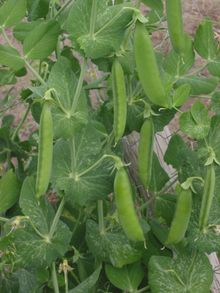 | |
| Pea plant in full fruit. |
Peas originated in the Mediterranean and Middle East regions, they are eaten fresh or cooked. They can be frozen, canned (pressure can method), or dried. Peas are harvestable between 50 and 75 days depending on variety. There are three primary types of pea; the snow pea, snap pea, and shelling pea. Shelling peas are removed from the pod and only the pea seeds are eaten as the pods are tough and tasteless. Snow peas are the variety most often seen in stir fries, whole pods with smaller undeveloped seeds inside. Snap peas are eaten in the pod as well, but are even sweeter than snow peas and have a crisp, thick pod that is nearly stringless. Depending on which way you prefer to eat your peas you could plant one, two or all three types of pea in your garden.
Peas are one of the first things planted in the spring, they can germinate in soils that are only 40 degrees F. So long as the risk of hard frost has passed they can go directly into the garden. Peas should be sown in the ground, rather than started indoors. They are long and slim vining plants and don't always cope well with transplanting, they are also such fast growers, and have such large seeds that it's just much simpler to put them in the garden. If they fail to germinate in a week or so, plant another round and keep waiting. Pea seeds should be planted fairly deep, about an inch underground. They take up little room and require little nutrition, they can be planted as close as 1-2 inches apart. Or in SFG style, 8 plants to a square. Pea seeds will only be viable for about 2 years, so despite their inexpensive price don't be tempted to stock up too much. Peas are very easy to save seed from, simply leave the end-of-season crop on the vine until they brown and become dry, then harvest, dry further inside, then shell and store seeds in paper bags. (Avoid plastic bags as they can trap any remaining moisture and rot your seeds). Peas also self-pollinate, they don't require pollinators, and generally each flower will pollinate itself. This means that to accidentally cross two pea plants you pretty much have to rub them together. Pea seed will fairly reliably produce seed that grows the same plants as the previous generation.
A cool season crop, peas prefer temperatures below 70 degrees. Peas that mature in temperatures over 85 degrees can develop tough pods. Also, peas stop putting on flowers once temperatures get over about 85 degrees. Harvest continually to ensure continued production of fruits. You can increase your harvest by using a pea innoculant, but innoculant in no way guarantees a great harvest.
The greatest risk to peas is the enation virus, and you should watch for enation resistant varieties when selecting peas for your garden. Peas actually build nitrogen stores in the soil they are planted in, so are a great winter crop or rotation crop to keep in the organic garden. Move them around each year, or start an early spring crop in the space of later heavy feeders. By the time the peas are finishing their growth the heavy feeding summer plants should be ready to put outside.
As vining crops peas will need a trellis of some type, which also helps to keep the fruits up off the ground and in easy picking reach. Peas are an inexpensive, simple to germinate, delicious crop to grow and are perfect for gardens that have small children around. Kids can pick them easily, eat them straight from the vine, watch how they grow and twine around each other and the trellis. In general peas are a great crop for anyone.
 |
| Snow peas, purple beans, and zucchini: one day's harvest. |

Next time: Pea Recipes, My Own and links to others.
Labels:
cross-pollinate,
drying,
easy plants,
flower,
freezing,
fruit,
garden,
harvest,
money-saving,
open pollinated,
organic,
peas,
plants,
recipe,
seed,
small space,
trellis,
vegetable
Monday, January 23, 2012
Perennial Herb Culture
Perennial herbs are generally the herbs with woody stalks that survive year after year. In milder climates some soft herbs can survive for more than a year, such as chives. Primarily the perennial herbs people think of are rosemary, lavender, thyme, oregano, sage, the mint family, and marjoram. There are others but the culture of these plants is pretty similar between species. Personally I don't recommend starting these plants from seed, the seeds are incredibly tiny, and a bit finicky to get started. Plus they are available as starts everywhere and aren't terribly expensive.
Perennial herbs need a sunny spot that won't be a swamp during the wet season. They manage pretty well in my area which is basically a temperate rain forest, but if they are in a depression and get too much water with too little drainage they can die. I have never had a pest problem or disease problem with these plants. In fact they have strongly scented oils that can act as repellents to some pests, and at the same time most produce a flush of flowers in spring or summer that attract many pollinators. These herbs are a great addition to any garden, attracting bees and butterflies, smelling fabulous, keeping out pests. They don't require any fertilization so long as they are in moderately fertile soil to begin with. Adding nutrients early in the spring can improve the abundance of fresh growth in the springtime; but don't add more after June since they are finished with most of their growth at that point.
You can plant them in pots or in the ground around your garden, I wouldn't plant them in among your annuals though as planting new annuals each year could damage the roots of the perennials, and the perennials will spread quite a bit over time leaving your no room for the annuals after a few years. If you put them in pots make sure to move them to a warmer spot during the winter. I have never lost a perennial herb to frost when they're in the ground, but pots are not as insulating and I often have to replace potted herbs the next spring.
Rosemary, thyme, sage, oregano and marjoram are all Mediterranean herbs; they are comfortable in hot, cool, dry or moist conditions; they will appreciate both thick clay soils and sandier soils. In fact, I don't think I've met a soil they wouldn't grow in. Mints on the other hand prefer a cooler spot with more moisture, sandy soil doesn't suit them well. Different varieties of these herbs will grow in different ways also. If you're looking for a ground cover an option to consider is a creeping or spreading version of rosemary or thyme, or a standard version of oregano. All of these will stay low growing and spread over an area, they smell lovely and produce a sprinkling of tiny purple flowers in spring and summer. Choosing variegated, or odd colored varieties can add some excitement as well, like lemon thyme with it's yellow and green splashed leaves, or purple sage. For culinary use smell or taste the leaves of the plants before buying them to ensure they have the flavors you want as well as the look, woolly thyme for example is a spreading attractive ground cover but it is not as flavorful and therefore does not make a quality culinary herb. No one will mock you for nibbling the plants at the nursery, I promise.
If you are looking for more upright growth in your herbs (for use as a back row with a fronting of bulbs or annuals, or something similar) chives grow a lively bunch of bright green onion-like tops, sage comes in a variety of colors and has a silvery fuzz to it's leaves, a standard (non-spreading) rosemary can reach 4 feet tall and act as a hedge, lavender stays fairly small and makes a great perennial border, and most varieties of mint spread by underground runner and stand up to 18 inches high.
All of these herbs can be cut fresh with a pair of scissors and added to foods, teas, or used as fragrance. They can also be dried. To dry herbs hold a bunch of stems in your hand no bigger than you can wrap your index finger and thumb around (if your bunch is too large the center may not get adequate air flow and can mold), tie the ends together with a string, hang in a cool, dry place where they will get ventilation. Under the eaves of your porch, on a clothesline strung across your laundry room, wherever you can find the space. I hang my bunches from my pot rack over the island, if my stove were underneath it I wouldn't hang them there because the heat and moisture coming off the stove could ruin the herbs. Let them dry like that for a week or more, until the leaves are crisp and crumble under your fingers. If in doubt about whether they are dry enough, just let them hang longer until there is no doubt. Once they are totally dry you'll want to store them in airtight containers; either plastic bags stored in the freezer or in spice jars in the cabinet. Either way you will save a lot of space by stemming the herbs and giving them a quick grind with a mortar and pestle or spice grinder. you can continue to hang your herbs in their bunches but they will lose flavor faster and can get a build up of dust on them if left for long.
My favorite way to deal with my dried herbs is to throw together some Italian seasoning, one of the spice mixes I use most often. First I get my herbs all prepped for putting in jars or the freezer, then just mix together roughly equal parts rosemary, thyme, oregano, basil, and marjoram. Then store in a glass spice jar labeled Italian Seasoning. If this blend isn't to your taste you can also add in savory, or red pepper flakes if you prefer it a little spicy, some people also add garlic, onion, or parsley. I prefer to keep it a simple blend and add those extras only for certain dishes, or if I have no fresh onion or garlic.
Some other great ways to use these plants include: lavender sachets, dried catnip for pets, herbal soaps and lotions, potpourri, rosemary barbecue skewers, sage smudging, teas, mint sprigs in drinks, and medicinal tinctures and teas.
Perennial herbs need a sunny spot that won't be a swamp during the wet season. They manage pretty well in my area which is basically a temperate rain forest, but if they are in a depression and get too much water with too little drainage they can die. I have never had a pest problem or disease problem with these plants. In fact they have strongly scented oils that can act as repellents to some pests, and at the same time most produce a flush of flowers in spring or summer that attract many pollinators. These herbs are a great addition to any garden, attracting bees and butterflies, smelling fabulous, keeping out pests. They don't require any fertilization so long as they are in moderately fertile soil to begin with. Adding nutrients early in the spring can improve the abundance of fresh growth in the springtime; but don't add more after June since they are finished with most of their growth at that point.
You can plant them in pots or in the ground around your garden, I wouldn't plant them in among your annuals though as planting new annuals each year could damage the roots of the perennials, and the perennials will spread quite a bit over time leaving your no room for the annuals after a few years. If you put them in pots make sure to move them to a warmer spot during the winter. I have never lost a perennial herb to frost when they're in the ground, but pots are not as insulating and I often have to replace potted herbs the next spring.
 |
| Pots of perennial herbs between vegetable beds. |
Rosemary, thyme, sage, oregano and marjoram are all Mediterranean herbs; they are comfortable in hot, cool, dry or moist conditions; they will appreciate both thick clay soils and sandier soils. In fact, I don't think I've met a soil they wouldn't grow in. Mints on the other hand prefer a cooler spot with more moisture, sandy soil doesn't suit them well. Different varieties of these herbs will grow in different ways also. If you're looking for a ground cover an option to consider is a creeping or spreading version of rosemary or thyme, or a standard version of oregano. All of these will stay low growing and spread over an area, they smell lovely and produce a sprinkling of tiny purple flowers in spring and summer. Choosing variegated, or odd colored varieties can add some excitement as well, like lemon thyme with it's yellow and green splashed leaves, or purple sage. For culinary use smell or taste the leaves of the plants before buying them to ensure they have the flavors you want as well as the look, woolly thyme for example is a spreading attractive ground cover but it is not as flavorful and therefore does not make a quality culinary herb. No one will mock you for nibbling the plants at the nursery, I promise.
If you are looking for more upright growth in your herbs (for use as a back row with a fronting of bulbs or annuals, or something similar) chives grow a lively bunch of bright green onion-like tops, sage comes in a variety of colors and has a silvery fuzz to it's leaves, a standard (non-spreading) rosemary can reach 4 feet tall and act as a hedge, lavender stays fairly small and makes a great perennial border, and most varieties of mint spread by underground runner and stand up to 18 inches high.
All of these herbs can be cut fresh with a pair of scissors and added to foods, teas, or used as fragrance. They can also be dried. To dry herbs hold a bunch of stems in your hand no bigger than you can wrap your index finger and thumb around (if your bunch is too large the center may not get adequate air flow and can mold), tie the ends together with a string, hang in a cool, dry place where they will get ventilation. Under the eaves of your porch, on a clothesline strung across your laundry room, wherever you can find the space. I hang my bunches from my pot rack over the island, if my stove were underneath it I wouldn't hang them there because the heat and moisture coming off the stove could ruin the herbs. Let them dry like that for a week or more, until the leaves are crisp and crumble under your fingers. If in doubt about whether they are dry enough, just let them hang longer until there is no doubt. Once they are totally dry you'll want to store them in airtight containers; either plastic bags stored in the freezer or in spice jars in the cabinet. Either way you will save a lot of space by stemming the herbs and giving them a quick grind with a mortar and pestle or spice grinder. you can continue to hang your herbs in their bunches but they will lose flavor faster and can get a build up of dust on them if left for long.
My favorite way to deal with my dried herbs is to throw together some Italian seasoning, one of the spice mixes I use most often. First I get my herbs all prepped for putting in jars or the freezer, then just mix together roughly equal parts rosemary, thyme, oregano, basil, and marjoram. Then store in a glass spice jar labeled Italian Seasoning. If this blend isn't to your taste you can also add in savory, or red pepper flakes if you prefer it a little spicy, some people also add garlic, onion, or parsley. I prefer to keep it a simple blend and add those extras only for certain dishes, or if I have no fresh onion or garlic.
 |
| 20 year old rosemary at Dad's, rhododendron behind. |
Subscribe to:
Posts (Atom)