Showing posts with label broccoli. Show all posts

Monday, June 25, 2012

Harvest Monday: June 25th

Harvest Monday is sponsored by Daphne's Dandelions and is an opportunity to share your harvests and what you do with those harvests with others.  Please stop by to see what other gardeners are doing this week.

This week I went strawberry picking at a local farm.  After picking and hulling 9 1/2 pounds of berries, I made 18 jars of freezer jam.  I don't think that 18 plus the 5 remaining from last year is going to last us a full year though.  The farm will have raspberries ready this week, so I will be out picking them and hopefully make up another 10 or so jams, so we'll have enough to last until next summer.

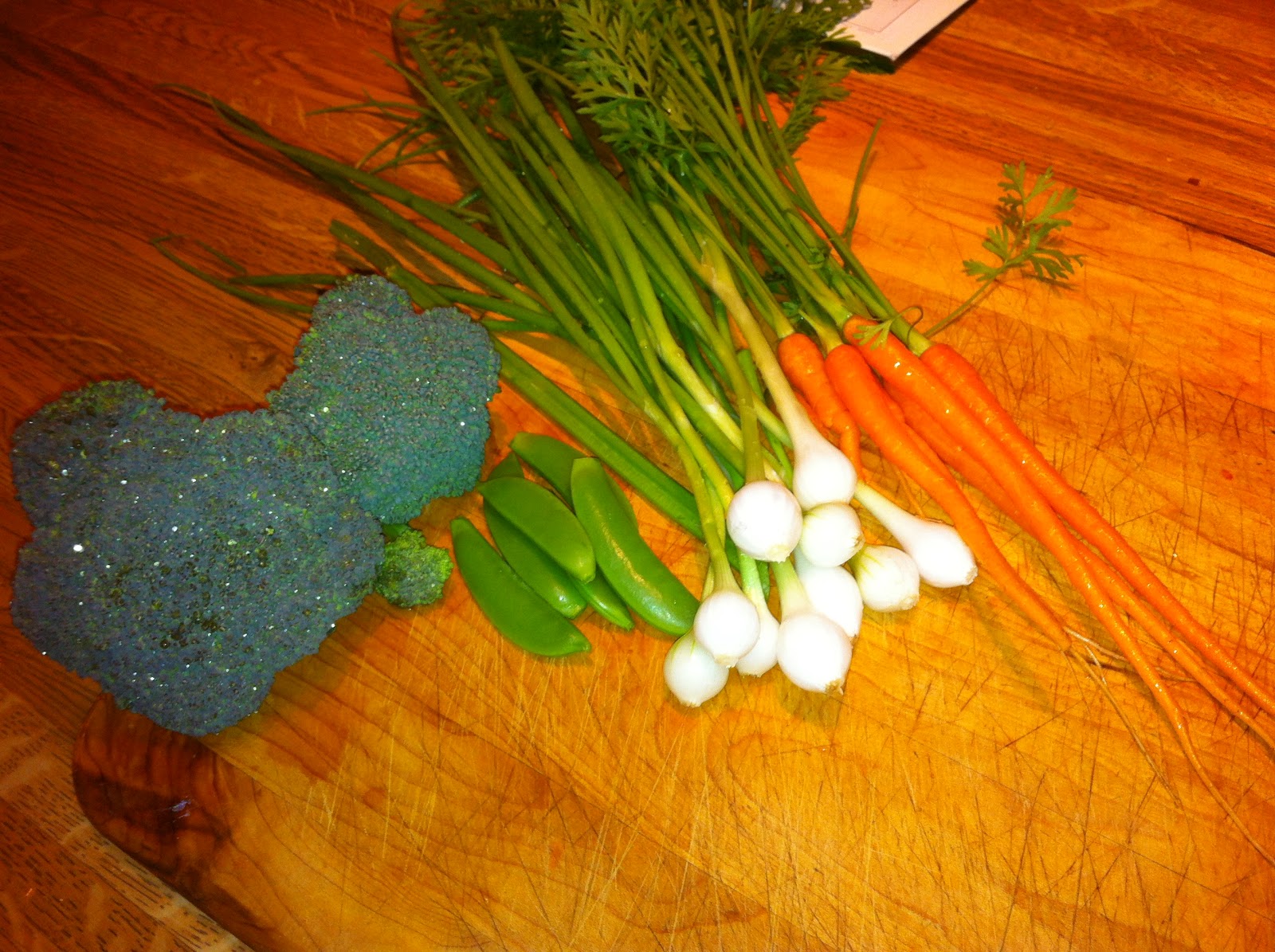
One of the week's harvests: broccoli, pearl onions, sugar snap peas, and carrots.
 Besides the farm picking, I brought in another 3 lbs. of strawberries off my own plants (yay! more strawberry shortcake! I am going to get SO fat.)  As well as several more harvests.  Mostly the harvests were of pearl onions, a few carrots, and some sugar snap peas.  I did get a couple good sized broccoli and one small cabbage, because I was impatient and couldn't wait any longer to pick one.  The peas, onions, carrots, and broccoli went into a stir fry.  My mom got a bunch of everything except the broccoli too.

Yum! Stir fry.
 The cabbage and remaining onions and carrots will be made into coleslaw for my husband; and any peas that come in will either be eaten as snacks or frozen for another time.

My daughter stretching out to enjoy the evening on the patio.
It's amazing how much arm-twisting goes into getting a 13 year old computer geek outside during the summer, so I was amazed and pleased to see my girly outside after our jam-making, enjoying a little relaxation in the night air.  This picture also makes it obvious that the patio could use some tidying up, so I think that will be my chore for the day.

Tuesday, June 19, 2012

Garden Update: June 19th

Let's take a walk around the garden.

Coming in through the front gate we pass the strawberries, currently they are cranking out about a pound of berries daily. 
Tomatoes starting to perk up.
As we enter the gate to the left we see the remaining un-planted starts in their pots.  A scoop of compost in each pot, followed by a dose of fish fertilizer, and a dose of compost tea the next day has really improved the health of the tomatoes.  They have perked up, greened up, and kicked out a few healthy new leaves.  There is still some purpling but they are definitely improving, and hopefully with another boost of tea in a few days that too will fade.  I'm really surprised they are recovering so well, I was afraid I would lose them all within a week or two.

The remaining starts; tomatoes and a few peppers.
Turning to the left we see the first raised bed.  With the removal of the celery, broccoli, garlic, and remaining lettuce the bed is looking pretty thin.  Several tomatoes have been planted to replace the harvested plants, and all of the cucumbers as well.  The sugar snap peas in back are cranking out pea pods like crazy, though none have yet begun to bulge with seed development.  The first of these peas should be ready in a day, possibly two.

First tomato to develop.  Oregon Spring.
I finally have my first tomato beginning!  It's a bit late to be at this stage, but the Spring has been rather cool and wet, and I am happy to have anything right now.  Oregon Spring has proven itself to be a great producer in the past (for such a small plant), and judging by the 18 flowers on it right now I'm guessing it will be again.  IF the weather ever warms up.  The other tomatoes that have gone in the ground are green and healthy and obviously recovering well from their bout with malnutrition.


First nasturtium blossoms.
Further along the first bed we see a burst of color as the first nasturtium blooms pop out amid the blue-green leaves of the cabbages.  The Parel cabbages have firm but small heads and are nearly ready for harvest, Derby Day however still has a long way to go.

Graffiti cauliflower
 Surprise, surprise! Deep within the recesses of the cauliflower leaves are tiny but beautiful little heads of cauliflower.  Graffiti is ahead of Amazing by a few days, and the color is just incredible.  The one good thing about the cooler weather is that I may actually get summer cauliflower undamaged by heat.


Herb and bench area
 Moving past the first bed we see the bench area, the herbs here have exploded.  The lavender and sage doubled in size, the spearmint is spreading (and recovered well from whatever was eating it).  The catnip looks very sad, but that's to be expected since the cats flop down and roll on it, and then chomp the leaves off like it's an all-you-can-eat salad bar.  I'm surprised it's survived at all.

Bed #2
Just past the bench is the second raised bed.  The peas are not as tall here, but everything else has grown above and beyond.  In fact, I was forced to break off several of the largest broccoli leaves because they were shading out so many other plants.  A few little lettuces are tucked away here for later eating, and some beautiful dill is hiding in amid the brassicas.  Otherwise it is very similar to the first bed.  On the far end are the few peppers I planted after pulling the chard and kale.  I transplanted one chard plant and one kale plant into the pumpkin bed in hopes of a few more harvests.

Whiskey barrel and pots
To our left, at the end of the patio, sits the first whiskey barrel.  The barrel currently contains Alex's carrots, most of which are just sizing up before being harvested.  The eggplant, slicing cucumbers, and jalapenos were planted a few days ago.  There are also a couple bolted cilantro tucked into the barrel, and I plan to let them go to flower to help attract beneficials.  Behind the barrel are three large pots containing artichokes and my rhubarb.  They are all growing well, but there will be no harvests off of them this year.

Whiskey barrel 2 and pots
 Further to the left is the second whiskey barrel.  This barrel holds a few little lettuce plants that will be harvested soon, and the same eggplants, jalapenos and lemon cucumber combination as the first barrel.  The three large pots hold my potato plants.  Feeling down into the dirt beneath the potatoes you will find several long thin rootlets that will hopefully plump up into potatoes soon.  The small pot contains a spare kale that had nowhere else to go, it's struggling and I probably will never see a harvest from it.

Stepping into the yard between the barrels we face the shed and the rosemary and thyme planted in front of it.  Both are growing incredibly well and the tiny thyme flowers are always buzzing with insect life.  I didn't picture the third barrel here, but it sits along the fenceline billowing with flowers.  The delphinium has faded and gone to seed, so things look a bit shabby, but the bee balm is just about ready to bloom and the glads and lillies are popping up between the other flowers.

Pumpkin bed.
At the very back of the garden sits the pumpkin bed.  Beans fill most of this bed, both pole beans along the back, and bush beans throughout.  A massive zucchini has filled the corner near the fountain and will take over most of that side of the bed by summer's end.  To the left side of the bed, planted along the shed trellis are the pumpkin plants.  They are healthy and growing but haven't yet had enough heat to begin their stretch up the trellis onto the shed roof.  There are a few tiny basil planted at the front edge of the bed, but the slugs have happily nibbled them down to almost nothing and I will be surprised if they survive to provide me fresh basil this year.

Turning left and walking through the back gate we come into the previous blackberry patch.  It still looks pretty shabby back here.  Annual and perennial weeds are popping up throughout the yard, the lava rock path only extends a few feet before giving up, and the blackberries are popping out new leaves all over.  I go back there and trim them down to stubs every week or two, but haven't gotten up the time and energy to finish all the cleanup yet.  There is a small strip of cleared ground though that contains four small plots of winter squashes.  I have given up any thoughts of growing corn back there though, it is too late and the area still isn't ready for it.  The squashes are doing well for the most part, a few died (likely eaten by slugs) but the rest are starting to stretch their leaves out and expand into the area.  I can't wait to see them take over that space and make it a flowing carpet of squash leaves and flowers.  And eventually, fruit!

And that concludes our tour.  Please stop by the concession stand on your way out.


Monday, June 18, 2012

Harvest Monday: June 18th

My best harvest so far! Mostly because I decided it was high time to start pulling things so I could plant more tomatoes.  I even remembered to take photos this time.

Saturday alone I managed to harvest over 7 lbs. of veggies.

3 lbs. strawberries

A pile of celery

Some pearl onions that were starting to look like golf balls sitting on the dirt.

Garlic braid, I have no idea what variety this is but it doesn't seem to get very big, the tops had all fallen over.

The last of the Swiss chard and first planting of lettuce, and the first of Alex's carrots.
My garlic were ready according to everything I know (which isn't much), but the bulbs were very small and even the largest only appeared to have about 4 cloves to it.  Oh well, maybe next year I'll plant some other variety, these were given to me last year by a friend and i figured I'd give them a shot.

Alex is super excited about the carrots finally coming up, the Sugarsnax are fabulous and the first to arrive.  I think Little Finger and Atomic Red could wait a bit longer to harvest.

Harvest Monday is hosted by Daphne's Dandelions and is a place to share your harvests and what you do with those harvests with the garden blogger community.

Next week, more strawberries, peas, onions and carrots (I'm hoping!).

Tuesday, June 12, 2012

Garden Update

 This week I pulled a lot of kale and a few broccoli and celery and finally got a chance to plant some more tomatoes.  I also put in a couple cucumbers, peppers, and eggplants.

Back to front: peppers, cukes, eggplants.
 All of this transplanting gave me a chance to see how the starts were doing in their pots.  Quite a few that were planted 2 to a pot were rootbound, so I divided them into the newly empty pots. 


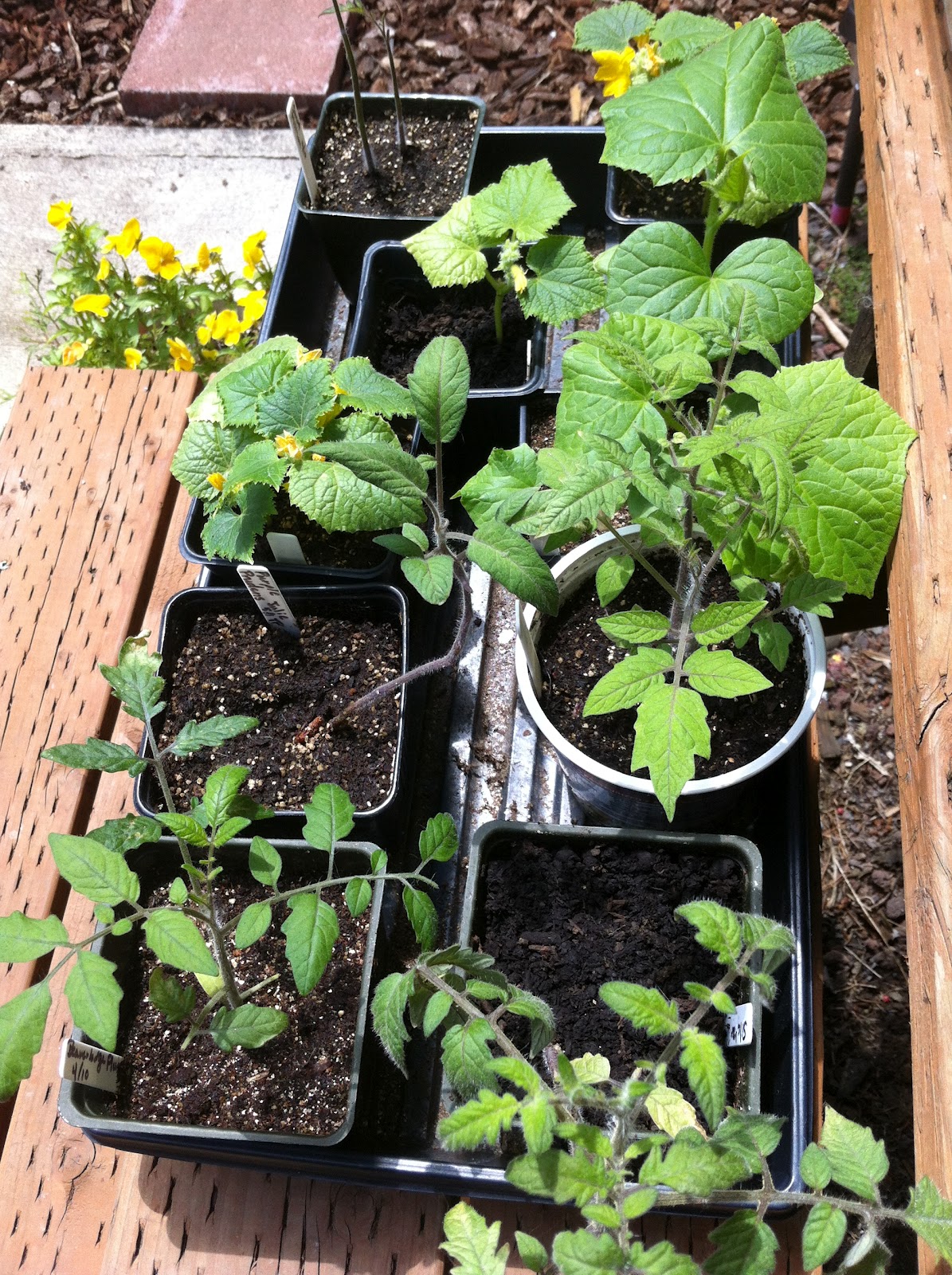
Cucumbers and the largest tomato plants.
 Not long after posting about the health of my little plants, the tomatoes started having their leaves blacken and crisp up and then fall off.  I'm guessing it's some type of fungus; the grow room maintains a temperature between 68 and 82 degrees, but when it's hot and humid outside it becomes very humid in there.  So all of the plants got moved outside, for sunshine and cool nighttime temperatures.  I'm brewing some compost tea to spritz them with as well, and if that fails to improve things I'll try garlic water spritz too.  I'm hoping one thing or the other will help them to survive this.

Yellowing cucumber leaves.
 Strangely, all of my pickling cucumbers are still in good health but the Lemon and Marketmore 97 are having yellowing leaves and gray spots.  This always seems to happen to my cucumbers.  All the cucumber disease pictures online look pretty much the same though, so it's hard to tell what might be causing it.  I may take one of the plants to the Farmer's Market next weekend and ask the Extension Agents there if they can identify it.
Sweet Million afflicted by fungal disease.
 The Sweet Million was the hardest hit by the fungus, it has been transplanted into the garden now and I'm hoping it will perk up nicely.  At this rate I am beginning to doubt I'll even have tomatoes this year.

Cabbage head developing
 Meanwhile, in the garden proper, the cabbages are growing strong and have small but firm heads coming in.  The cauliflower are absolutely huge, but still show no signs of heading.

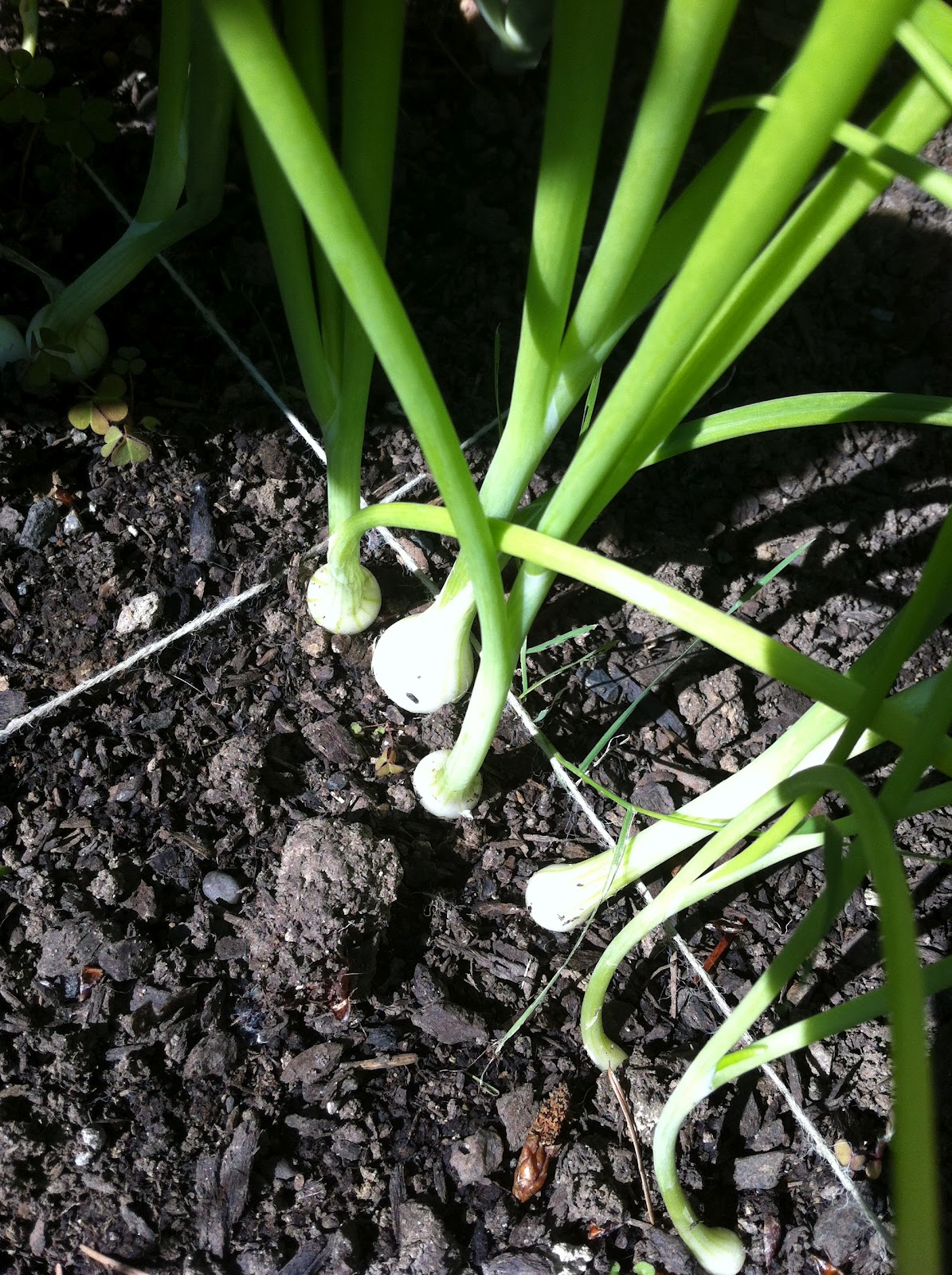
Pearl onions
 While the pearl onions are growing well and beginning to show their glossy white bulbs, the spanish white onions are not bulbing at all. 

Pea flowers!
 Finally the peas are flowering, they seem late to me, though it's probably just my imagination.

Zucchini
 My one and only zucchini is ridiculously healthy and putting out it's first male flower.  There are several female flowers on it as well but they are not quite ready to bloom.

Garden from the East side.  The thing above the fence is the butterfly bush.
All in all everything is doing well.  I'm concerned about the tomatoes, but I have faith that once they are planted they will recover well.  I am anxious to get them into the ground and be done with all this waiting.

Wednesday, May 30, 2012

End Of May: Garden Update

I haven't posted in over a week, partly because I've had visitors coming and going, and partly because the garden hasn't done much in that week.  I harvested several more heads of lettuce, and some kale and chard that I sauteed up and threw in the freezer for another time.  There are still no ripe strawberries or peas and the anticipation of them is killing me.  I did pull enough lettuce to get my two earliest tomato plants into the garden finally, both are Oregon Spring and one is already flowering.  Sadly it also suffered a bit of sunburn during the hot days a few weeks ago.

Flowers on Oregon Spring tomato.
The garden as a whole is getting rather crowded.  Not so crowded that the plants are suffering, so I think my spacing is okay, but the carrots and onions are starting to get shoved aside by the cabbage leaves.  The good thing about spacing things so closely is that there's very little bare dirt, which reduces weeds, and the shade of the plants helps keep moisture in without needing mulch.  The bad thing is that sometimes your cabbage gets a little overzealous and completely smothers your carrots.

The garden is getting crowded.
 The broccoli are finally getting some heads on, I wish I had enough room to let them keep growing after the main heads are harvested, but I will likely get one large head each and then rip them out to make room for the tomatoes and peppers and cucumbers.

Broccoli head.  It had better get bigger than this!
 Despite the damage done by slugs, we are still swimming in lettuce.  Sadly, because there are no tomatoes and carrots and other such things, and I refuse to go buy them when we'll have some of our own soon... I have been struggling with making salads.  Plus, the lettuce are so pretty!  Especially the ruffly Red Sails next to Salad Bowl and the tall straight green of Valmaine.  All of these varieties ended up being delicious too.  I was very happy with my mixed lettuce seed, except that it was mixed so I couldn't control the proportion of each variety to each other.  I ended up with 2 Red Sails, 4 Salad Bowl/Slo-Bolt (I can't tell the difference!), 6 Valmaine, and like 20 Buttercrunch! 

Lettuces are too pretty to pull... just can't bring myself to do it yet.
 My little boy, Alex, has an amazing green thumb.  He was the one who planted the sunflowers last year that grew over 14 feet tall.  This year he planted some carrots in one of the whiskey barrels.  They are doing much better than mine, though I did have to thin them a bit.  Every day he goes out to check on his carrots and says "They are doin' good!"  He's so excited for them to get big enough to eat after all this waiting.

Alex's carrots.
 My brother informed me that it was way beyond time for me to fill up my potato buckets, so I scooped in more soil to a few inches below the tops of the plants.  I'm still kind of winging it on the potatoes, I just plan to keep them alive this year... I'll work on improving my harvest next time. 

Potato pots, potted kale and more lettuces in the whiskey barrel.
 The pumpkin bed is uncovered, and the beans are putting on their second set of leaves.  Soon enough the entire corner where the pumpkin bed is will be a wall of green, with piles of fresh green and purple beans coming in.
The pumpkin bed; pumpkins, zucchini, pole beans in back, and bush beans.
Finally, my stockpile of canned goods from last year has been reduced to 2 jars of applesauce, 1 bread and butter pickles, 1 pickle relish, 5 jars of strawberry jam, and 1 freezer jam.  Time for the last minute push to get things finished off before the restocking begins.  Guess we'll be eating a lot of PB&J in the next few weeks.  I made a total of 41 jars and frozen 1/2 pints of strawberry jam last year; I'm thinking that worked out to just about right.  Though this year I'll be doing more freezer jams and less canned, they are so much easier.

Soon enough the sun will be back full force and plant growth will take off again!  Can barely contain my excitement!

Monday, May 21, 2012

For Food Preservation, Go To Georgia?

While at the farmer's market this weekend I had a few questions for the Master Gardeners and Preservers there.  Usually, I see their stall and completely draw a blank in regards to what I planned to ask them.  (I also never remember to bring my knives to the market to have them sharpened. Boo.)

Since I was posting this week about preserving brassicas I wanted to ask if they had any ideas beyond my own.  They didn't.  Though they did tell me that the standards for all home canning and food preserving are determined... in Georgia.  Specifically at the University of Georgia, so for those looking to learn the details of food preserving from a legitimate source that sets the national standard, check out the University of Georgia Extension Service Food Preservation Page.

I plan to spend some time there and bookmark it in my recipe folder so that I will have all the safety standards at hand when doing my home preserving.

*In case you don't about Extension Services: every state has an Extension Service, the job of the Service is to provide gardeners and agriculturists with information on pests, plants, diseases, and climate that is specific to their area.  Some states offer a Master Gardener certification as well that allows people to attend classes and learn about agriculture in their area, sometimes this course is paid for straight out and other times it can be discounted by volunteering in the community, as part of the Extension Service, to answer questions of other gardeners.  Check out your local Extension Service to find out more about what they can offer to help you as a budding gardener.

Friday, May 18, 2012

Cooking With Coles

Some of my favorite ways to eat broccoli, and cauliflower are fresh from the garden in salads or as a vegetable tray, or steamed lightly as a side dish.  Obviously those are the easiest ways to make them, but sometimes you have to get creative to get a whole harvest eaten before it's too late; or you need to preserve them for later in the year.

My all-around favorite way to use up brassicas is Colcannon.  Colcannon is traditionally made from mashed potatoes and kale (or cabbage), with scallions, butter, salt and pepper added. It can contain other ingredients such as milk, cream, leeks, onions and chives.  It is an Irish food, and is traditionally served on Halloween.
  • 1 pound cabbage, broccoli, kale, cauliflower
  • 1 pound potatoes
  • 2 leeks
  • 1 cup milk
  • salt and pepper to taste
  • 1 pinch ground mace
  • 1/2 cup butter
  1. In a large saucepan, boil brassicas until tender; remove and chop or blend well. Set aside and keep warm. Boil potatoes until tender. Remove from heat and drain.
  2. Chop leeks, green parts as well as white, and simmer them in just enough milk to cover, until they are soft.
  3. Season and mash potatoes well. Stir in cooked leeks and milk. Blend in the vegetables and heat until the whole is a pale green fluff. Make a well in the center and pour in the melted butter. Mix well.
Colcannon pretty much amounts to mashed potatoes and veg.  It is very tasty and can use up pretty much any cole crops you have in excess, it also freezes well for use during the winter when you may feel like something warm and hearty but not feel like spending the time to cook it.

Since I usually eat my broccoli fresh or steamed with little additional flair I don't have a broccoli-only recipe to share, but the recipe below looks good and i plan to try it out when the broccoli are ready.

Awesome Broccoli-Cheese Casserole

For a change in tempo, this is a spicy recipe from India for cauliflower.  The recipe I found online has several vegetables in it, but the proportions can easily be adjusted, for cauliflower bhaji just replace the potatoes with more cauliflower.

Indian Vegetable Bhaji

No one in my family likes coleslaw, except my husband.  He is a slaw fiend and after much browsing last year I found the perfect recipe for him.  There are several comments about this recipe being too sweet, so if you try it you may want to put in about half the sugar initially, then add a bit and taste until it is the sweetness you prefer.  Coleslaw is a great way to use up cabbage, especially since cabbage doesn't freeze well.

Sweet Restaurant Slaw

For fresh use these recipes are some different ways to use your harvests.  The colcannon, bhaji, and casserole should even freeze well.  Now what do you do when you have so much harvest you can't eat it all before it goes bad? Or if you want to save some for later in the year?

 Cabbage is not very freezable as far as I know, it can be preserved as sauerkraut though.  I've never tried this, but my sister has and apparently sauerkraut is a hit or miss.  It is made by fermenting and canning the shredded cabbage.  If you have a lot of cabbage and no way to eat it before it spoils give sauerkraut a shot, but be warned it may just spoil rather than coming out right.  Cabbage can be frozen in recipes, like colcannon.

Broccoli and cauliflower should be picked early in the day, washed thoroughly in cold water, chopped into small pieces (florets), then blanched for 1-2 minutes in boiling water.  The broccoli will turn a bright green.  Immediately move the florets to ice water for a couple minutes to stop the cooking process.  Drain the florets and place in freezer bags; if you want to do gallon freezer bags, freeze the florets in a single layer on cookie sheets first then bag them.  This keeps them from becoming one big mass of frozen vegetable, and makes removing a serving size easier.  Label with the name of the vegetable, variety (if you are doing more than one variety), and the date. 

One other way to preserve cabbage, broccoli and cauliflower is as pickled vegetables.  Picalilli is a well-known type of pickled mixed vegetables.  There are dozens of different recipes available for pickled vegetables, personally I'm not a fan.  Though I do like Refrigerator Pickled Vegetables, but they don't help much when it comes to preservation.

A good book to check out for recipes and directions for preserving any harvest is Putting Food By, which even includes directions on root cellaring and drying brassicas.

And lastly, since I didn't discuss it on the culture post we will cover seed saving from brassicas.  After flowering, leave flower stalks on the plant until they make seed pods that are nearly dry, before they dry completely cut the stalks off and place in a large paper bag, seed pods down.  Leave the bag in a warm, dry area for a few weeks, you'll know they are ready when a gentle touch will cause seeds to drop from them.  Strip the seeds and pods off the stem into the paper bag.  Remove the stem and shuffle the rest around in the bag, this should loosen up any seeds still attached to their pods.  Get a clean dry bucket and set it outside on a day with a nice breeze.  Slowly pour the seeds and chaff into the bucket from about a foot above it.  As they pour the chaff will be blown away by the wind and the seeds will drop into the bucket.  If you still see chaff, dump the bucket back into the bag and repeat pouring.  Pretty quickly you will see only seeds.  Store seeds in a paper envelope or bag in a cool dry place, labeled with the species, variety, and year.  Brassica seeds will keep for up to 3 years.

If you have a brassica recipe or preservation technique you'd like to share, please leave a comment below.


Cole-Ture

Brassicas, sometimes called cole crops or cruciferous vegetables, are a genus of plants in the Mustard family.  It is remarkable for containing more important agricultural and horticultural crops than any other genus.  Most Brassica species are annual or biennial.  The genus is native to Western Europe, the Mediterranean, and temperate Asia.

Some of the agricultural species of brassica today include: rutabaga, turnip, kohlrabi, cabbage, kale, broccoli, cauliflower, Brussels sprouts, mustard, cress, bok choy, and rapeseed (or, in the U.S., canola).

The brassicas provide high levels of nutrients, including Vitamin C, soluble fiber, and several anticancer agents.  To maximize the nutritional value of these plants avoid boiling them, and instead steam them for 3-4 minutes.

The ten most commonly eaten cruciferous vegetables are in a single species B. Oleracea, and only differ by cultivar.  Check out the Taxonomy Chart at Wikipedia to see just how closely related these plants are.

What follows is a brief description of the culture of the cole crops I am most familiar with:
Bolting broccoli

Broccoli was first introduced to the United States by Italian immigrants but did not become widely known until the 1920s.

Broccoli: broccoli is an annual, it will sprout from seed, grow, flower, and seed all within one year.  Like most of the popular cole crops, broccoli can be over-wintered in a sunny spot with a mild climate.  Light frost will not harm it, and in fact, too warm temperatures in Spring and Summer may cause it to bolt, going from dense green (or purple) heads to yellow flowers nearly overnight.  Once broccoli heads begin to flower they become very bitter.  Plants grow in an upright manner, unlike their cousins the cabbages.  Seeds can be started as early as December indoors, then planted outside once soil temperatures reach 50 degrees.  The earlier broccoli is transplanted, the better, as it will be more likely to produce large heads before the weather warms too much.  Broccoli can be planted as a Spring crop or direct seeded in summer for a Fall crop.  It prefers cool, moist soil; it is not susceptible to molds for the most part.  The primary scourges of broccoli, and most other cole crops  are slugs and cabbage moth caterpillars.  Removing plants after harvest can reduce the damage of caterpillars, as can row covers early in the season (preventing moths from laying eggs), and keeping plants indoors until they have at least two sets of true leaves will help with slugs.  Slugs
will eat holes in the leaves but if plants are large enough this is only cosmetic and won't affect the harvest.
Imported Cabbageworm, A.K.A. Cabbage moth larva.
 The best thing about broccoli is that it takes very little care, it is not disease prone, not particular about its soil (though it does best in Nitrogen high soil) and can be grown nearly all year in many climates.  The downside is that it tends to be hit or miss at harvest time, if you wait too long for the head to reach it's full size you may end up harvesting some very bitter broccoli that is ready to flower.  Also, once the main head is harvested many broccolis will put out side shoots; I have found though that unless I have an entire bed of broccoli these side shoots do not make a large enough harvest to be worth the wait and all the space they take up in the garden.

Cauliflower head.
The first reliable reference to cauliflower is found in the writings of Arab Muslim scientists between the 12th and 13th centuries.


Cauliflower:  cauliflower is similar to broccoli in many ways, it is annual, prefers cool weather, is mostly disease-free, and shares the same pests.  Cauliflower is usually planted early in Spring, or in the late summer for Fall harvest, along with its cousins broccoli and cabbage.  Cauliflower tends to be more picky about heat and drying out though, I have heard many a gardener bemoan the cracking and loss of their cauliflower heads after dry spells.  Planting early, even watering, or planting as a Fall crop are some ways to prevent this.  To keep your cauliflower pearly white, you should blanch it by wrapping the leaves over the head as it begins to develop.  Cauliflower most often is found as a tight packed white ball, but is also found in green, orange, and even purple.  Check out the different tastes of these variations at a local farmer's market and ask what the varieties are called so you can plan to plant your favorite in Fall, or next Spring.


Cato the Elder praised the cabbage for its medicinal properties, declaring that "It is the cabbage that surpasses all other vegetables."

Cabbage:  much like the previous two plants cabbage is grown in early Spring or late Summer.  It prefers cool weather, has no real disease problems, and few pests.  Cabbage however, is much less finicky when it comes time to harvest.  Primarily this is because cabbage is a biennial, it won't flower or go to seed until its second year of growth.  Because of this a head of cabbage can often be left for several weeks before it has to be harvested; it also means it is far less likely to split, and only extreme temperature or moisture changes will cause the head to split.  Cabbage requires no blanching either.  It is most commonly found as a solid green ball, but is also available in red or purple varieties, Chinese cabbage which is much looser leaved, and in all different sizes as well, from fist-sized to pumpkin-sized.  Cabbage heads are ready to be harvested when they are solid and hard to the touch.

In addition to this, cabbages are one of the prettiest plants to grow in my opinion.  I love the way their flat leaves open up into a massive rosette around the globe-like head.  The blue-tinged leaves sometimes take on a purple tinge as well, all in all they are very pretty.

In square foot gardening, broccoli, cauliflower, and cabbage each take one square foot to grow.  If you are selecting large varieties though it doesn't hurt to have nearby squares only half filled with smaller plants, such as 2 lettuce, or 4 peas.  Cabbage leaves especially are very wide and can cover up other plants next to them if they are too close.  One way to manage this is to grow cabbages in between slightly taller growing plants, the cabbage leaves can shade the roots of the taller varieties and in return they shade the cabbage a bit.

Saving seed from these crops can be a bit tricky, since the cultivated brassicas are so closely related they can easily cross-pollinate.  A 3-4 year rotation of seed saving can help with this: Year 1, save broccoli seed, not allowing other annual brassicas to flower; Year 2, save cabbage seed from biennial cabbage planted the previous year, not allowing other brassicas to flower; Year 3, save seed from cauliflower, don't allow others to flower; Year 4, repeat with another biennial, or annual brassica.  Since brassica seeds stay viable for 3 years this is a good rotation to follow, any more years would leave you with very old seed that may not germinate from your first year.  If you have more than four brassica cultivars you will either have to resort to trading for or buying seed, or put plenty of space between your cultivars.  There are other ways to manage this, including bagging, spacing farther apart, etc. but this is probably the simplest.  No extra steps but harvesting everything you don't want seed from before it blooms.

A final note on these crops: although we normally eat only the heads of these three plants, the outer leaves and stems are edible as well.  If you find yourself a bit short on cabbage for a recipe you can add cauliflower leaves, outer cabbage leaves, and broccoli leaves and stems (so long as they haven't become woody and tough) to fill in.

I think that's all I have for these crops, I will post some of my favorite recipes for them soon as well.  If you have any other tips or tricks about cole culture to share please leave a comment!