Showing posts with label shade. Show all posts

Thursday, March 8, 2012

Some Days the Writing Doesn't Come So Easy

I'd like to say I've been busy in the garden and that has slowed my postings.  Sadly, that's not the case.  Instead I've had to deal with chores, kids, planning dinner, washing laundry, and the weather.  This week has gone from rain and hail (Monday), to snow (Tuesday), to bright sunny days w/ freezing temperatures (Wednesday and Thursday).  It is supposed to warm up on Friday, it is also supposed to start raining on Friday.  I just can't seem to win against the weather, either the soil is frozen or so waterlogged it can't be dug in.

Despite the fact that I desperately need to turn my beds over and amend the soil I will have to wait out the weather for that.  This means I can't plant my peas, garlic (yes, I know, I should have planted it in November) or onions yet.  In fact, while other gardeners are planting things left and right, I am stuck waiting for soil to warm and dry out a bit, and the shade to move.  The only thing I can plant right now is my potatoes since they are going in pots; of course the potting soil I have for them is frozen solid, which means they too have to wait.

The cherry tree and camellia don't seem to be the least bit phased about the weather, in fact they are both starting to show signs of new leaf buds.  I must've done something right!

Hope things improve outside soon, if my starts get too big I won't have room for them under the grow lights.

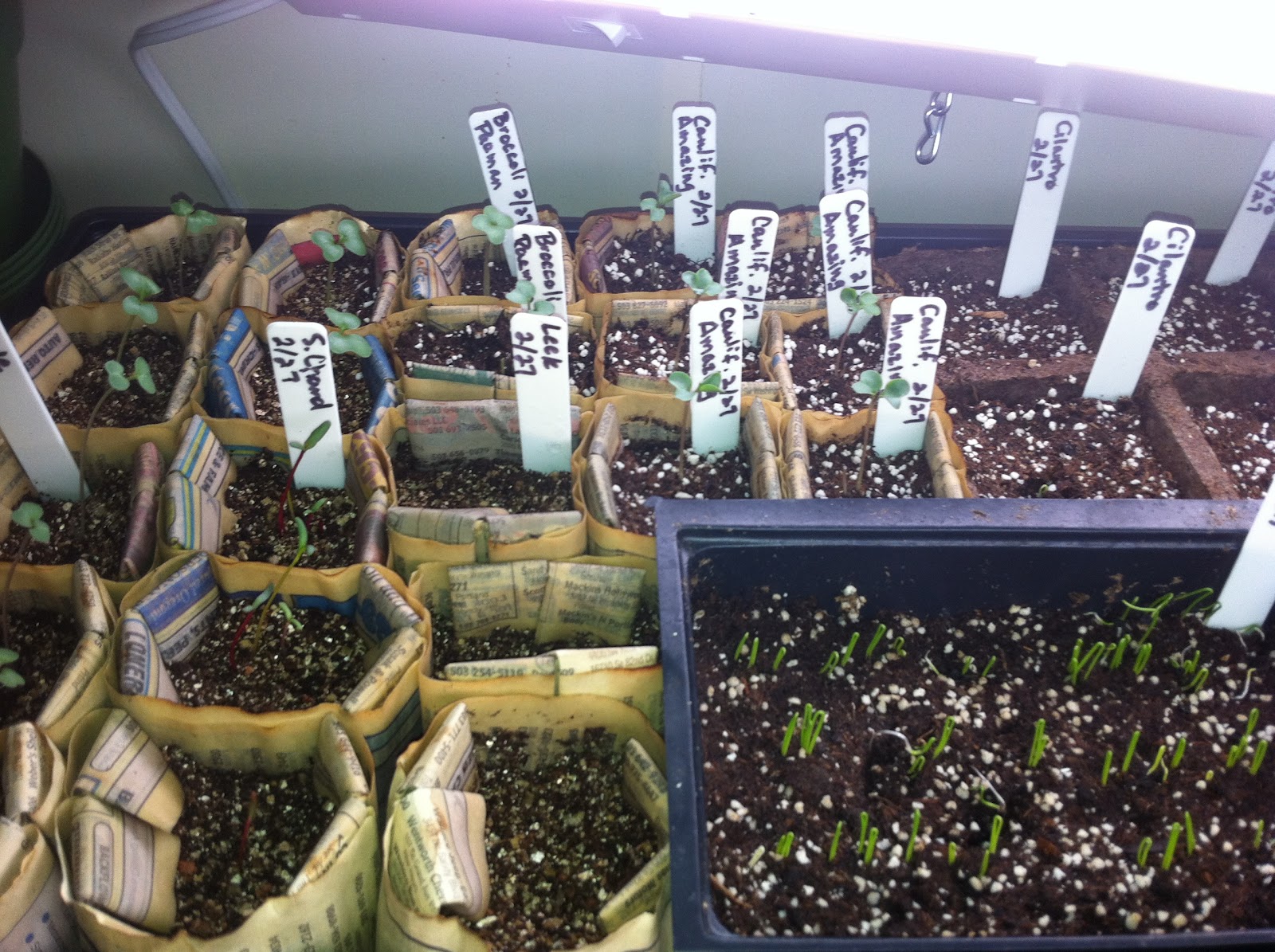
Today's seedling update:  Things are doing well; I planted too many lettuces in each pot, after some thinning I have decided I'm just going to have to move a bunch into other pots.  The final sprouts to pop up were the leeks, which are just beginning to show. 

Tray 2-planted 2/27 most of these have sprouted, though some aren't above the soil yet.

Tray 1- 2/25 everything is sprouted, lettuce are putting on first true leaves.

Who knew artichoke made such pretty little sprouts?  Hoping these won't get too big before I can move them outside and separate them.
 I ended up adding the 4' light fixture to the upper shelf because the littler ones just weren't cutting it.  it hangs over the washer a few inches, but really, who cares about clean clothes when there are plants to grow? I just have to remember to lift it out of the way to wash clothes; we don't really have to go without laundry.

So that's the news for now, I am chomping at the bit to get the garden in action.  I'll just have to rein it in a little longer.

Sunday, March 4, 2012

Cherry Tree Achieved, And Other News


With two whole rain-free days over 50 degrees, I have made the most of the nice weather.  Yesterday my daughter and I finished up weeding the beds, cleaned out the strawberry bed, laid down another bag of bark mulch, and trimmed the candytuft and dead daylily leaves from last summer.

Cleaned up strawberry bed, only the strong were left behind. Still looks pretty messy.

One of the reasons I didn't join in the garden frenzy of getting things planted this weekend, like so many other gardeners, was that my beds are still completely shaded by the fence.

A few more weeks and the front edge of the beds will finally see some sun.

More importantly, my dwarf Bing cherry tree finally got put in the ground.  My husband was kind enough to do all the hard work of raking off the top layer of lava rock and digging the hole.  Then we poured in a small pile of compost, spread the roots around the pile, and held the tree in place while filling the hole in around it.  My fingers are crossed and I'm hoping it will do well. 
View of the cherry from the road.  Not much of a view yet.
Cherry tree, between the new sprouts of the daylilies.

The next thing on my list of garden to-do items is planting the camellia.  If I don't collapse in agony after that, it's back to work on the blackberries.  I might just be able to get ahead of them before they really start growing. 

Tools are all ready for the camellia.
Camellia all ready to be planted. Only one not ready is me!
Hope everyone's out there enjoying some sunshine!

Monday, February 6, 2012

Eggs Florentine and Other Spinach Culture

Let's talk green.  Spinach, that is.  Spinach is an early spring crop,  it prefers cooler weather and will bolt when it gets too hot, you can also plant it in the Fall but if you aren't careful about timing it may still bolt.  The earliest record of the spinach plant is from China AD 647.  Since then it has been used throughout China, India, the Middle East, and was introduced to the Italians in the 9th century.  Native of Florence, Italy, Catherine de Medici was a huge fan of spinach and insisted it be served with every meal; this is why "Florentine" is the label attributed to foods with spinach added.  (BTW, all my spinach trivia is via Wikipedia's "spinach" entry)

Spinach plant, this is a much healthier plant than mine were.


Like many leafy greens spinach is said to have high antioxidant levels, it is a great source of Vitamins A, C, E, K, and the B complex vitamins.  It is also high in many minerals, and is considered to be a rich source of iron. Storage of spinach for more than a few days can destroy its nutritional value though, which is one reason to grow it yourself; fresh from the ground it is packed with vitamins and minerals.  Spinach is also one of the 12 most pesticide-laden produce products, so even if you don't grow your own organically you should always be sure to buy it organic.

Spinach comes in three primary types: Savoy, with dark green crinkly or curly leaves; Flat or Smooth, with broad smooth leaves that are easier to clean; and Semi-savoy, with less crinkled leaves this variety is a bit easier to clean than a standard savoy. 

New Zealand Spinach is actually not even closely related to spinach, it was given the name because of it's resemblance to spinach.  New Zealand Spinach leaves are eaten and have a similar taste and texture to spinach.  Unlike normal spinach it is comfortable growing in hotter climates, and is nearly untouched by slugs and snails.  If, like me, you find you lose more spinach to the slugs or bolting than you get on your plate, then New Zealand Spinach might be worth a try in your garden.

Start your spinach seeds in the ground several weeks before the last frost date, 3 to 5 weeks is acceptable.  In my garden it's pointless to start spinach this early since my garden beds don't see sunlight until April, I start spinach at the end of March.  It takes about 7 weeks to reach full size, but can be harvested a few leaves at a time after the first 4 weeks or so, when the leaves are large enough to be worth the trouble to harvest.  According to SFG standards spinach can be planted as close as 9 plants per square foot. 

At my house, early Spring is slug season so I rarely see much spinach at all.  In fact, I likely won't even be planting it this year since I lose so much to the slugs and most of the rest to bolting.  For those who want to plant it be sure to protect it from slugs, and if needed shade it from the heat to prevent bolting.  Some tips for doing this can be found in my posts "Slugs and Snails and Puppy Dog Tails" and "Bolting Is Bogus".


Since spinach is so very happy to bolt like crazy, make sure to plant open pollinated varieties and let them go to seed when they bolt.  You can essentially have free spinach seed for life!  Last year my spinach bolted the first week of June, set flowers that attracted pollinators to the garden, went to seed, and dropped the seed by early August.  Then that dropped seed sprouted just as the weather began to cool, and a second crop popped up for fall.  Not a bad system when you think about it.

As a final note, while spinach can be a bit touchy, and is appealing to certain slimy pests; it also grows quickly, is packed with nutrition, and is very versatile in cooking.  Give it a shot, and enjoy.

"I'm strong to the finish, cuz I eats my spinach!"--Popeye the Sailor Man

Sunday, February 5, 2012

Thinking on Trees

The few days of beautiful February weather got me kicked off to a good start on my yard work, which means I haven't had as much time to sit around the house and blog.

Yesterday I got the pleasure of raking the yard and laying down bark mulch, as it turns out 4 cubic feet of bark doesn't come anywhere near what I will actually need to finish the yard around our patio.  I was surprised at just how little it did cover, today I will go back to the store and get another 6 bags (since that's likely all my car can carry at once) and see how much farther it gets me.

In the meantime I am on a mission to discover what would be the best plant to put in the front of my house, where it is bare and gets no shade at all in the summer from about 2 pm to sunset.  If I can come up with something attractive with flowers or fruits that will shade the house it could make a big difference in our cooling bill during the summer heat, and provide food or bouquets or at the least a nice centerpiece to the house.  I have considered a lilac, but am thinking that it may be too slim to make much difference in shade.  I've also considered trellising grapes, wisteria, or clematis, but again I am not sure they would get large enough to provide much shade.  An evergreen could make a statement, and won't make a big mess like deciduous or fruit trees, but it also won't make a floral show in spring or fruits later in the year.  The other option that came to mind was a cherry tree, or other fruit tree that wouldn't require cross-pollination.  I'd have flowers, fruits, a mess to clean up, and a shade tree large and branching enough to make a difference.
This time of year the house is shaded, but by summer there will be nothing to keep it cool.

The annuals are not nearly so difficult to decide on since they change each year, but a tree is a big deal.  It will be there for years, and probably won't produce much for several years after planting, I need to be absolutely certain before selecting a tree to put into the yard.

When you are considering a semi-permanent to permanent change to your landscape here are some things to keep in mind:

-How big will it get?
-How much maintenance will it require?
-Will it drop fruits or leaves that need cleanup each year and do you want to take on the extra work?
-Will the planting location make a difference in other things? Will it shade the house, or garden?  Could the roots grow too large and damage sidewalks, driveways, or water pipes?
-What are you trying to gain from the planting? Shade, flowers, food, etc.
-If it is a fruit tree, will you need more than one for pollination?
-Will you move before you can reap the benefits of the plant? If you expect to move in 3-5 years it doesn't make much sense to plant a tree that won't offer much shade for 10 years.
-If you select for appearance, be sure to take the time to find out if your tree or shrub is native, and if it has many known pests or diseases.  If you select something for its health to begin with, you will have fewer worries later on.

The Arbor Day Foundation can be a great resource for learning about trees, and even offers 10 free trees selected for your area as a membership incentive (they also offer member discounts for the purchase of trees). This can be a great way to get some trees started in a larger landscape, or you can ask friends or neighbors if they'd be interested in sharing your 10 trees.  The small donation/membership cost is worth it if you are planning to add trees to your yard, but aren't necessarily seeking specific types.  When I joined a few years ago it was primarily just to make a donation to what I felt was a worthy group, I ended up sending my free trees to my nephew who has several acres and raises fowl as well as a garden, he made good use of the trees which I didn't really have the space for at the time.

I am definitely leaning toward a cherry tree, however there is some debate over what type; my daughter likes sweet cherries, while I prefer to preserve pie cherries. There are combination trees available, but I have never seen one that did as well as separate sweet and sour trees.  Next stop, check with the local nursery on good selections for our area, and do a little research on planting a new fruit tree.

Monday, January 23, 2012

Got Shade?

So far shade gardening has not been my forte.  Many homes are situated in a manner that at lest some part of the yard is shady and visible to everyone passing by.  You can either fill these areas with gravel or mulch or let them turn into weeds, or use them as a place to keep your compost and empty pots; or you can try to make them a part of your gardening experience by creating a shade garden.  Vegetables? Fruits? Herbs? Forget it. It's just not going to happen so don't go getting any ideas about try to grow these things in the shade.  Some more useful options are moss, hosta, or rhodies.  Rhododendrons are native to my area and it's obvious why.  The dark moist richness of the forest floor is all a rhody really needs.  They grow quite well in the gaps between the tall firs and strain outward to catch a passing ray or two of sunlight.  While rhodies will tolerate full shade, they prefer to glimpse some sunlight at least a few hours of the day.  Moss likes moist shady areas, and there are many varieties in different colors and textures that can fill a small area and at least make it look green.

The best way to plan for a shade garden is to visualize what plants grow in the forested areas near you.  Here in western Oregon we have fir stands, and growing below the treetops are rhododendrons, ferns, Oregon grape, mushrooms, huckleberries, bleeding hearts and Dutchman's britches (common names for the different colored flowers of the Dicentra genus), and columbine.   In shady cultivated gardens you can spot acanthus, begonia, hellebore, impatiens, fuschia, and hosta.  Some blend of the wild-growing and cultivated, the foliage and the flowering can offer the best contrasts for a shade garden.

If you have the room put in a rhododendron, surround it with a few types of fern, and fill in the small spaces around these with lower growing hosta, then tuck flowers like begonia, impatiens, bleeding hearts and columbine in around each.  The bonus of a shade garden is that you don't have to water nearly as much, in some cases not at all.  Many shade plants are also perennial, like hosta and fern, columbine and bleeding heart.  One year spent putting together your shade garden and an annual trimming of dead branches and leaves and pruning of shrubs can be all it takes to have a beautiful space where previously there was a muddy pit, or a tangle of weeds.

When choosing plants look carefully at the tags or the descriptions in catalogs, watch for a little half-black sun symbol, or completely black sun.  These mean partial or full shade.

Catalog entry for shade or partial shade plant.

If you are truly at a loss on how best to plant in a shady space, you can always resort to a rock garden, or a water feature (which will benefit from the lack of sun and grow less algae).